
LangSmith and Adaline both help teams understand LLM behavior and improve outputs over time. They share core features, but their lifecycle focus differs.
LangSmith is built by the LangChain team and is designed around developer-first observability and experimentation. It offers tracing, a prompt playground, datasets, and evaluation flows that let you test changes before and after deployment.
Adaline is the prompt-to-production platform. It treats prompts as deployable artifacts with environments, evaluation, and rollbacks, and connects those releases to evaluations and production monitoring in a single loop.
The core difference is that LangSmith provides strong building blocks for tracing and experimentation. Adaline couples those blocks to release governance, so teams can ship prompt changes safely and measure impact with less handoff.
LangSmith
LangSmith is a platform for debugging, tracing, and evaluating LLM applications, with tight integration into LangChain-based systems. It emphasizes visibility into chains and agents, repeatable experiments over datasets, and evaluation patterns that can run offline or on production traffic.
LangSmith Features
- Tracing and debugging: Inspect step-by-step runs to find where outputs degrade.
- Dataset management: Create datasets from curated cases or past traces and reuse them for repeatable tests.
- Prompt playground: Try prompt variants and model configs in the UI.
- Experiments: Run evaluations over datasets and compare runs in analysis views.
- Evaluators: Human review, code rules, LLM-as-judge, and pairwise comparisons.
- Best for: Developer teams building with LangChain that want strong tracing plus experimentation tooling.
Key Consideration
LangSmith’s strengths show up when your main problem is developer visibility and iteration velocity. Many teams, however, also need operational discipline around prompt releases: clear ownership, environment separation, promotion workflows, and instant rollback when production shifts.
LangSmith can support these practices, but the surrounding release process often lives in your application code, your configuration system, or your internal deployment playbooks. If your reliability bottleneck is not “we can’t debug,” but “we ship prompt changes without gates,” you will want a workflow that makes releases first-class objects.
Adaline
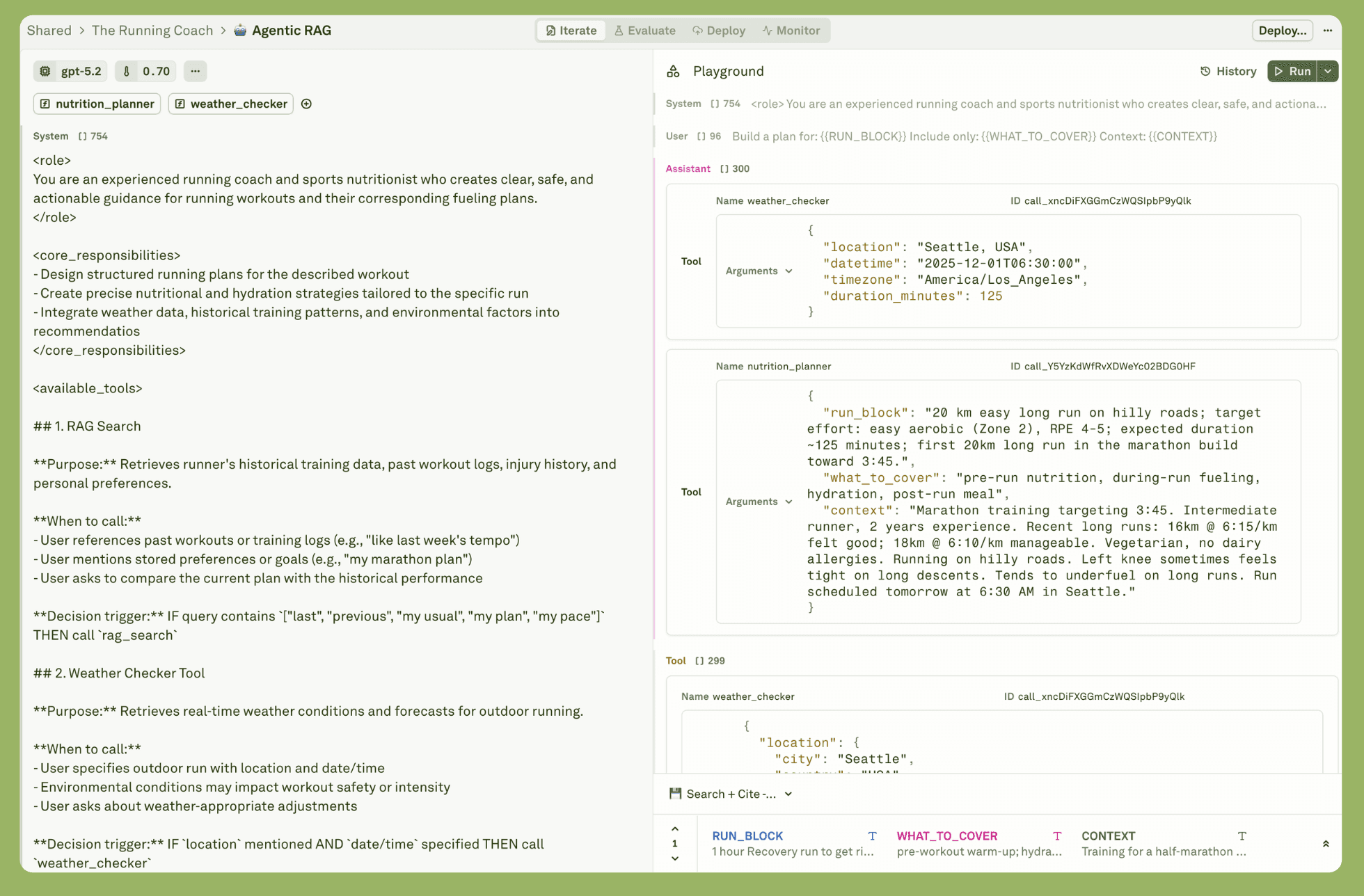
Adaline's Editor and Playground that allows you to engineer prompts and test them using various LLMs.
Adaline is a single collaborative platform where product and engineering teams iterate, evaluate, deploy, and monitor prompts for LLM applications and agentic workflows. It is designed as a system of record for prompt changes, with controlled environments and measurable quality signals attached to each release.
Adaline Features
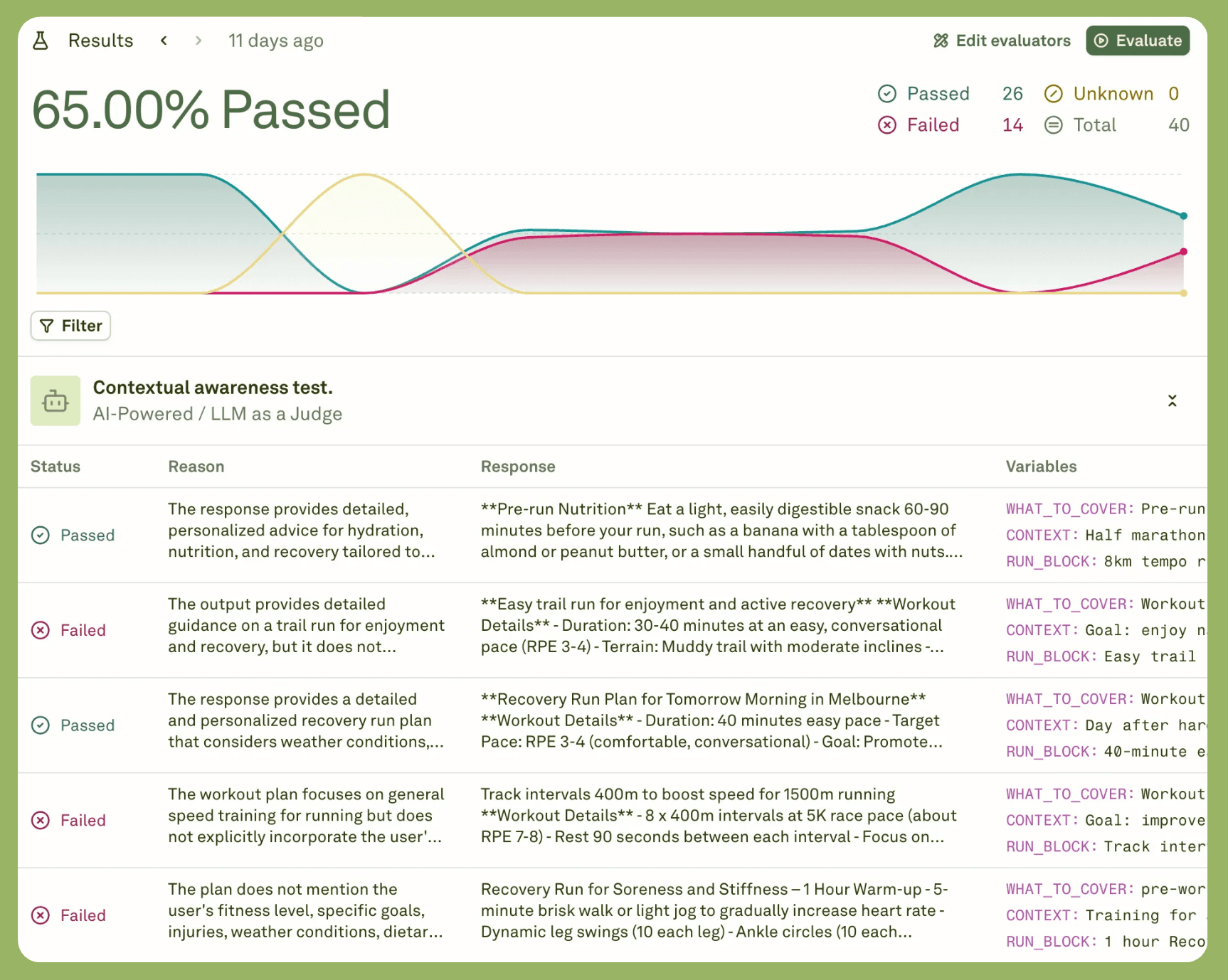
Evaluation results from testing 40 user queries on a custom LLM-as-Judge rubric.
- Collaborative iteration: A shared editor and playground to compare outputs across models and variants.
- Dataset-driven evaluation: Run eval suites at scale using built-in evaluators and custom JavaScript logic.
- Release governance: Promote prompts across Dev, Staging, and Production with tracked history and instant rollback.
- Production observability: Inspect traces and spans, search by prompt version, and monitor time-series metrics for latency, cost, tokens, and evaluation scores.
- Continuous evaluations: Re-run evals on live traffic samples so regressions are detected early.
Adaline’s advantage is not only that it measures behavior, but also that it can learn from it. It connects measurements to the exact prompt version that shipped, enabling faster post-release decisions.
This matters for production releases.
Best For
Teams shipping customer-facing AI where prompt changes must be safe, auditable, and measurable. If you want prompts shipped like releases with evaluation gates, choose Adaline.
Core Feature Comparison
Workflow Comparison
LangSmith workflow for a production regression:
- Find the failing run in traces and inspect the chain steps
- Create or update a dataset from the failing examples.
- Run an evaluation experiment and review results in the UI.
- Update the prompt or configuration and re-run the experiment.
- Ship the change through your application’s deployment process.
- Monitor production and repeat as needed.
Adaline workflow for a production regression:
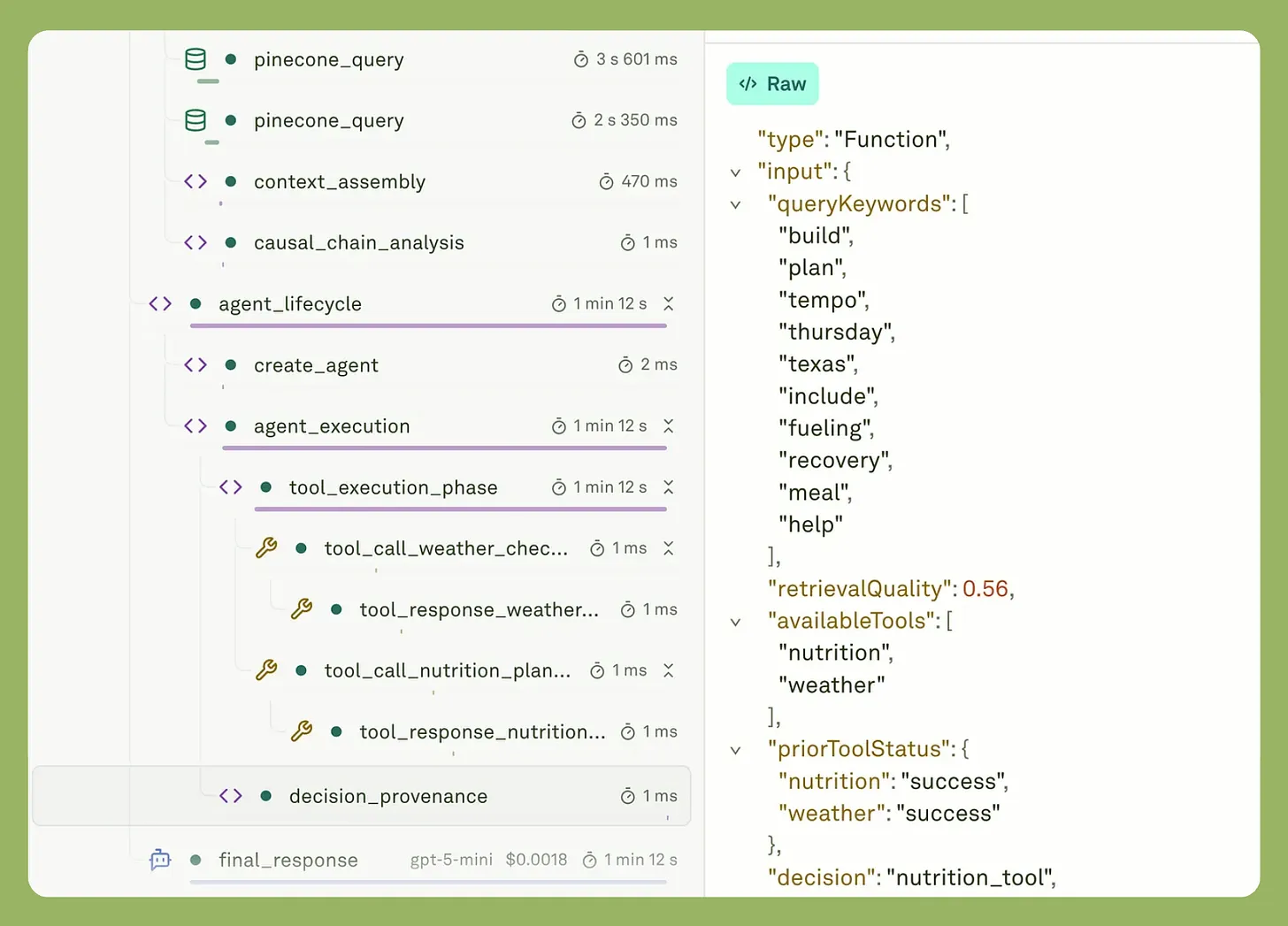
Screenshot of observability results in the Adaline dashboard.
- Find the failing trace and identify the prompt release that produced it.
- Add failing cases to a dataset and define evaluators that encode your quality bar.
- Run an evaluation across versions and review quality and cost side-by-side.
- Promote the winning version from Staging to Production with a tracked release.
- Keep continuous evaluations running on live samples to detect drift.
- Roll back instantly if metrics cross a threshold.
The practical difference: LangSmith excels at the experiment layer. Adaline closes the loop by integrating promotion, rollback, and monitoring into a single lifecycle.
Conclusion
Choose Adaline when:
- You need environments, promotion, and rollback to be first-class prompt workflows.
- You want evaluation as a gate before shipping and as a signal after shipping.
- You need production monitoring tied directly to the prompt versions that changed outcomes.
- PMs and engineers must collaborate on prompts with shared artifacts and history.
- You want one system of record for prompt ops, not a set of disconnected tools.
Choose LangSmith when:
- You are deeply invested in LangChain and want developer-first tracing and experiments.
- You need a mature dataset-and-eval workflow for rapid iteration.
- Your release governance already exists in your deployment stack.
- You mainly want debugging and evaluation infrastructure, not prompt release management.
For production AI, visibility is necessary but not sufficient. The teams that move fastest are the ones that can ship changes safely, measure impact consistently, and revert quickly when reality disagrees.
Frequently Asked Questions (FAQs)
Is LangSmith only for LangChain?
LangSmith is closely associated with LangChain, and many teams use it in that ecosystem. It can still fit broader stacks, but the smoothest experience is typically for LangChain chains and agents.
Which platform is better for prompt versioning, environments, and rollback?
Adaline is designed around release governance, with Dev/Staging/Prod promotion and instant rollback built into the prompt lifecycle. LangSmith can support prompt iteration and evaluation, but environment promotion is often handled elsewhere.
Can I run evaluations before and after shipping?
Yes in both. LangSmith supports evaluation workflows across the lifecycle, including offline and online patterns. Adaline treats evaluations as a routine gate and pairs them with release artifacts, so the decision history is easier to audit.
What should I choose if I need one platform for PromptOps?
Choose Adaline if you want iteration, evaluation, deployment, and monitoring in one governed loop. Choose LangSmith if you primarily need tracing and experimentation, and you already have strong release controls outside the tool.