
LLM observability is not just “logging prompts.” When a production incident happens, you need to reconstruct the entire path: the inputs, retrieved context, tool calls, intermediate steps, model outputs, and the cost/latency profile of the run.
The second requirement is harder. Root-cause debugging only matters if you can ship a controlled fix. That means turning failures into datasets, evaluating changes against explicit criteria, and releasing prompt updates with the same discipline you apply to code.
Langtrace is an open-source, OpenTelemetry-based observability tool for LLM applications with tracing, evaluations, and metrics across common LLM stacks.
Adaline also provides traces, evaluations, and production analytics, but differentiates by treating prompts as deployable artifacts with version control, environments, promotion, and rollback—so debugging connects directly to what is live.
How We Compared Adaline And Langtrace
- Tracing depth: Multi-step runs, spans, and searchability for root-cause analysis.
- Evaluation workflow: Datasets, LLM-as-a-judge, custom logic, and reporting.
- Release discipline: Prompt versioning, environments, promotion, rollback.
- Production monitoring: Time-series visibility into quality and spend signals.
- Operating model: How well the tool supports an end-to-end “debug → fix → ship” loop.
1. Adaline
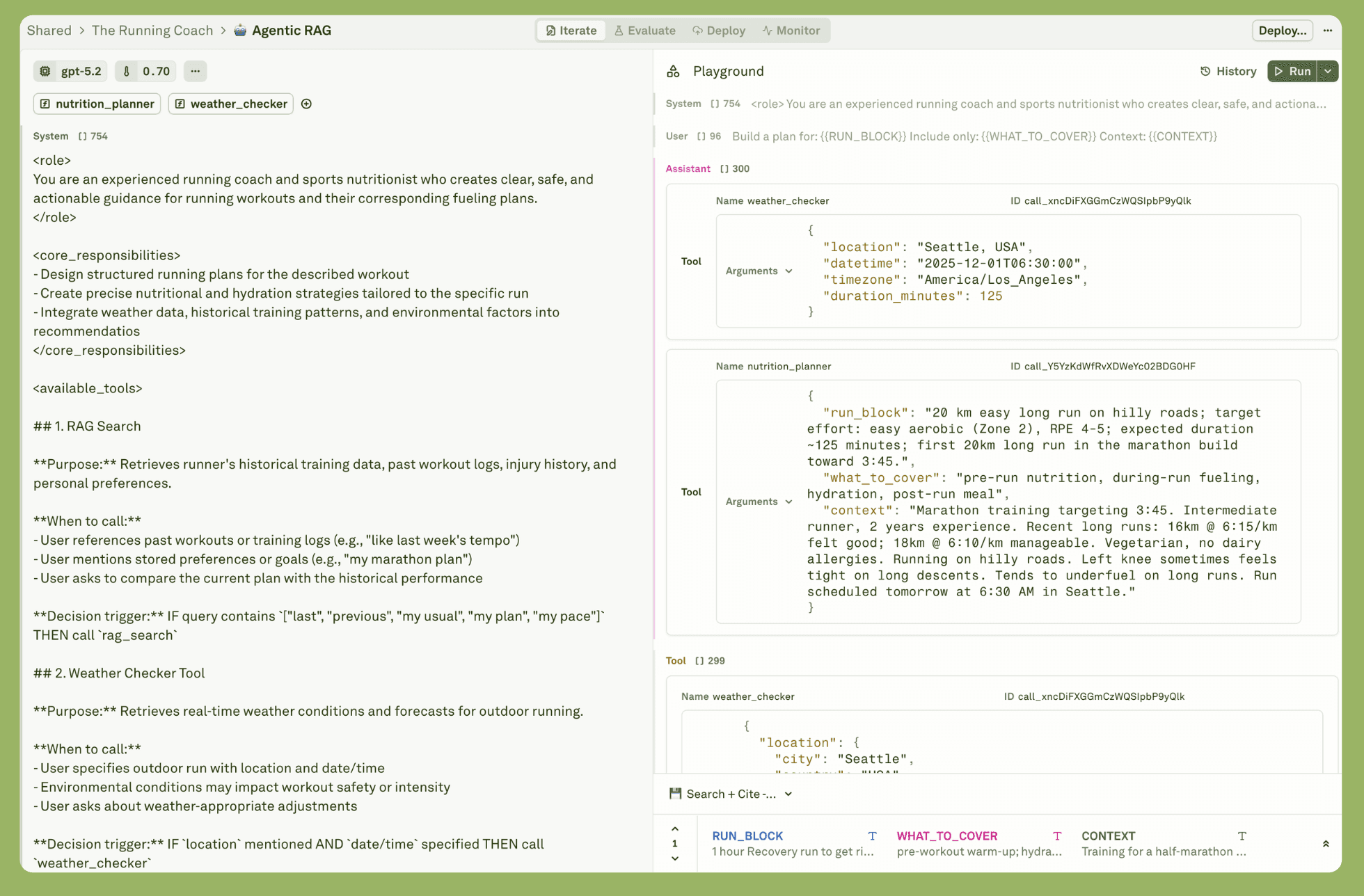
Adaline's Editor and Playground allow you to engineer prompts and test them with various LLMs.
Adaline is a collaborative platform where product and engineering teams iterate, evaluate, deploy, and monitor LLM prompts, with a single system of record for prompt work.
What Adaline Is Used For
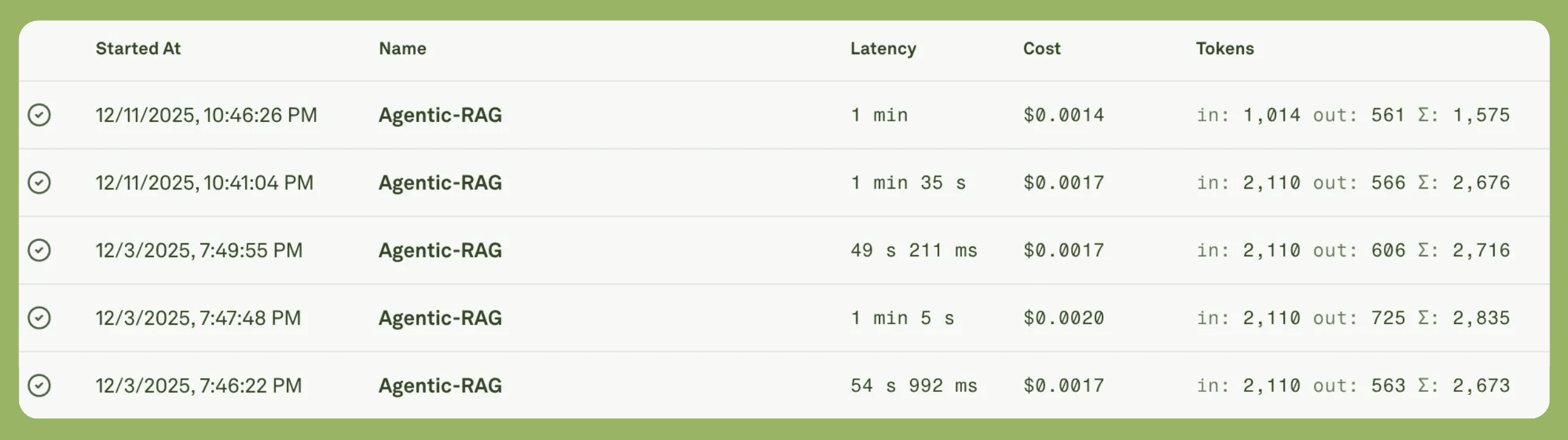
Adaline tracks latency, cost, and token consumption and token generated by the LLM.
- Dataset-driven evaluation using linked datasets (CSV/JSON) so tests reflect real user inputs.
- Multiple evaluator types, including LLM-as-a-judge, text match/similarity, regex/keyword checks, and JavaScript/Python custom logic.
- Tracking latency, token usage, and cost alongside evaluation results to avoid “quality improved but spend exploded” releases.
- Prompt release governance: Version history, Dev/Staging/Production environments, cross-environment promotion, and instant rollback.
- Production monitoring: Traces/spans, searchable debugging by prompt/inputs/errors/latency, continuous evaluations on live traffic samples, and time-series analytics for latency/cost/tokens/eval scores.
Key Point
Adaline is designed for the full operational loop. When you find a production issue, you can reproduce it on a dataset, validate the fix with evaluators, promote through environments, and roll back instantly if a regression appears.
Best For
Teams that want observability and root-cause debugging tightly coupled to PromptOps: controlled prompt releases, clear ownership, and fast rollback.
2. Langtrace
Langtrace positions itself as an open-source observability platform for LLM applications that collects and analyzes traces to help teams improve LLM apps. Its open-source project describes Langtrace as OpenTelemetry-based end-to-end observability for LLM apps, providing real-time tracing, evaluations, and metrics, with SDK integration in TypeScript and Python.
Langtrace also emphasizes deployment flexibility: Langtrace Cloud, self-hosting, and sending traces to any OpenTelemetry-compatible backend.
What Langtrace Is Used For
- OpenTelemetry-based tracing for LLM apps and agent workflows.
- Evaluations and dataset curation as part of the platform’s observability workflow.
- Integrating across LLM frameworks and vector databases through SDKs and ecosystem integrations.
- Using an existing observability stack (Datadog/New Relic/Grafana, etc.) by exporting via OpenTelemetry conventions.
- Operating with open-source foundations plus optional managed plans, with usage-based span limits (useful for early-stage testing).
Key Point
Langtrace is compelling when your priority is standards-based tracing and flexibility. If your org already has an OpenTelemetry pipeline, Langtrace can fit naturally into how you instrument, export, and analyze traces.
Best For
Engineering teams that want OpenTelemetry-native LLM observability with open-source control, plus optional cloud hosting.
Where Adaline Tends To Be The Better “Langtrace Alternative”
Both products help you observe and diagnose LLM behavior. The decision typically comes down to what happens after you find the issue.
If your team’s bottleneck is instrumentation and trace collection, Langtrace’s OpenTelemetry orientation is a strong fit. It is designed around tracing and exporting signals in a standards-based way.
If your bottleneck is shipping fixes safely, Adaline tends to win because it makes prompt changes operationally explicit:
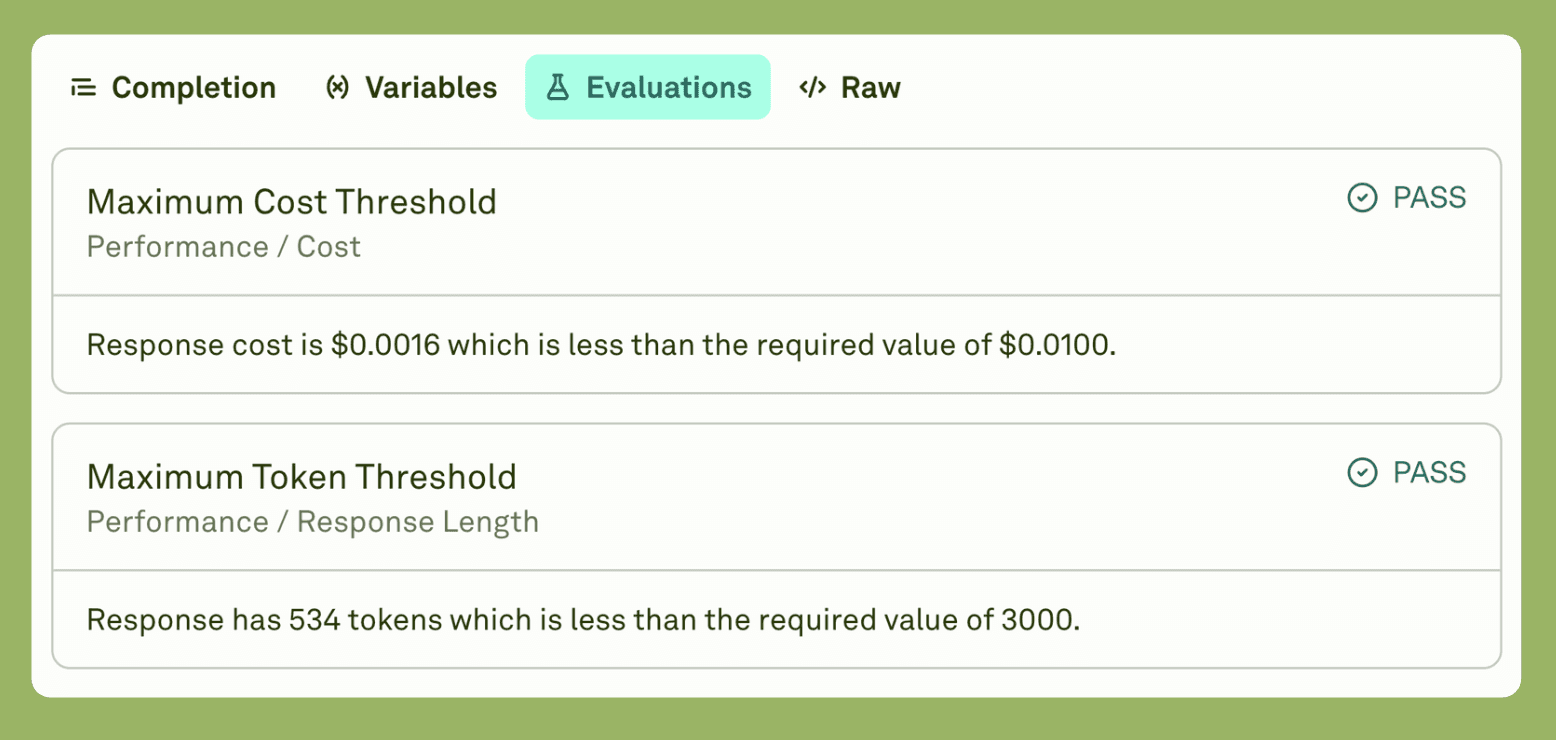
Run continuous evaluations on live queries sent by the users.
- Every prompt has a tracked history and can be treated like deployable code.
- You can promote from Staging to Production and roll back instantly.
- You can run continuous evaluations on live traffic samples to catch regressions early.
This is what turns root-cause debugging from “we found it” into “we fixed it, and we can prove it.”
Capability Snapshot
A Root-Cause Debugging Workflow That Prevents Repeat Incidents
A reliable “debug → fix → ship” loop typically looks like this:
- 1Trace the failure with full context: prompt inputs, retrieved documents (if RAG), tool calls, and intermediate steps.
- 2Promote the failure into a dataset so it becomes a regression test, not a one-off incident report.
- 3Define evaluators that match your acceptance criteria (LLM-as-a-judge, schema checks, domain-specific logic).
- 4Compare candidate fixes across quality plus operational metrics (latency/tokens/cost).
- 5Release with governance: stage the change, promote only when gates pass, and roll back fast if production signals deteriorate.
Langtrace supports the early parts of the loop through OpenTelemetry-native tracing and a platform posture that includes evaluations and dataset work.
Adaline supports the full loop, with release controls and continuous evaluations on live samples, so regressions are detected quickly after shipping.
Conclusion
Langtrace is a strong option when you want OpenTelemetry-first LLM observability and flexibility across cloud, self-hosted, and export-to-your-backend setups.
Adaline is the better Langtrace alternative when your goal is operational reliability: evaluation tied to prompt releases, explicit environments, promotion, instant rollback, and continuous evaluations that keep production stable as prompts evolve.
Frequently Asked Questions (FAQs)
Is Langtrace Open Source?
Yes. Langtrace describes itself as fully open source and OpenTelemetry-based, with an open-source repository and SDKs for TypeScript and Python.
Can Langtrace Send Traces To My Existing Observability Backend?
Yes. Langtrace documentation describes the OpenTelemetry integration that supports sending traces to OpenTelemetry-compatible backends (e.g., Datadog, New Relic, Grafana).
Does Adaline Support Multi-Step Agents For Root-Cause Debugging?
Yes. Adaline supports traces as a timeline across multi-step agent workflows, and evaluations can be configured at the final answer or intermediate steps.
What Is The Biggest Difference Between Adaline And Langtrace?
Langtrace is primarily centered on observability and standards-based tracing. Adaline adds PromptOps: version control, Dev/Staging/Production environments, promotions, and rollbacks, so evaluation results map directly to what is live.
When Should I Choose Adaline Over Langtrace?
Choose Adaline when prompt releases are frequent or high-stakes, and you need controlled deployments, quality gates, cost visibility, and fast rollback as defaults—not as a separate process.