
If you are searching for a “Promptfoo alternative,” you are usually not asking whether Promptfoo works. It does. You are asking whether a test runner is enough for your shipping process.
Promptfoo is a strong open-source toolkit for prompt evaluations and red teaming. It shines in CI pipelines where you want reproducible tests and measurable comparisons.
Adaline is a better fit when your core requirement is prompt release discipline: a system of record for prompts, governed promotion across environments, explicit approvals, and evaluation gates that prevent regressions from reaching production.
This guide helps you decide when to stay with Promptfoo, when to complement it, and when to switch to Adaline.
Quick Summary
Best Promptfoo Alternative For Teams Shipping Prompts Like Releases: Adaline
- Best for teams that need a governed workflow: iterate, evaluate, deploy, and monitor.
- Strong fit when you need approvals, environments, rollback, and eval gates.
When Promptfoo Is Still The Best Choice: Promptfoo
- Best for teams that want an open-source prompt testing and red teaming toolkit that runs well in CI.
- Strong fit when you already have release governance elsewhere.
Common Pairing Pattern
Many teams keep Promptfoo for developer-local testing, and CI runs and use Adaline as the system of record for releases, promotion, and production monitoring.
Adaline Vs Promptfoo
How We Evaluated This Comparison
We compared Adaline and Promptfoo across what breaks in production, not what looks good in a demo.
We assessed both tools across six practical needs:
- 1
CI-grade evaluations
Can you run repeatable tests on every change and get deterministic, reviewable outputs? - 2
Red teaming workflow
Can you generate adversarial cases, measure failures, and turn them into regression tests? - 3
Prompt release governance
Do you have a controlled process for promotion and rollback across Dev/Staging/Prod? - 4
Evaluation gates
Can tests block release promotion when quality drops below thresholds? - 5
Ownership and auditability
Can you answer who changed what, why, and what was approved? - 6
Production improvement loop
Can you connect incidents to prompt versions and convert them into new tests?
What Promptfoo Is Strong At
Promptfoo is typically adopted because it is simple, scriptable, and CI-friendly.
- CI evaluations: Run prompt eval suites on every PR and compare outputs across models, prompts, and parameters.
- Red teaming: Probe prompts for jailbreaks, unsafe behavior, prompt injection, and edge-case failures.
- Developer ergonomics: Tests live alongside code and can be run locally.
- Flexibility: Teams can define custom checks and scoring logic.
If your core goal is “test prompts like code,” Promptfoo is one of the most practical ways to start.
Where Teams Outgrow Promptfoo
Teams outgrow Promptfoo when the problem stops being “we cannot run evals” and becomes “we cannot ship safely.” The symptoms look like this:
- Multiple prompt versions exist, but there is no single source of truth for what is in production.
- Evaluations run, but they do not gate promotions. The team still ships because deadlines win.
- Rollback exists only as a Git revert, which is too slow during an incident.
- Ownership is unclear because prompt changes are scattered across repos and PRs.
- Production failures do not reliably turn into new regression tests.
This is the key distinction.
Promptfoo helps you test. Adaline helps you test, release, and monitor.
Where Adaline Wins
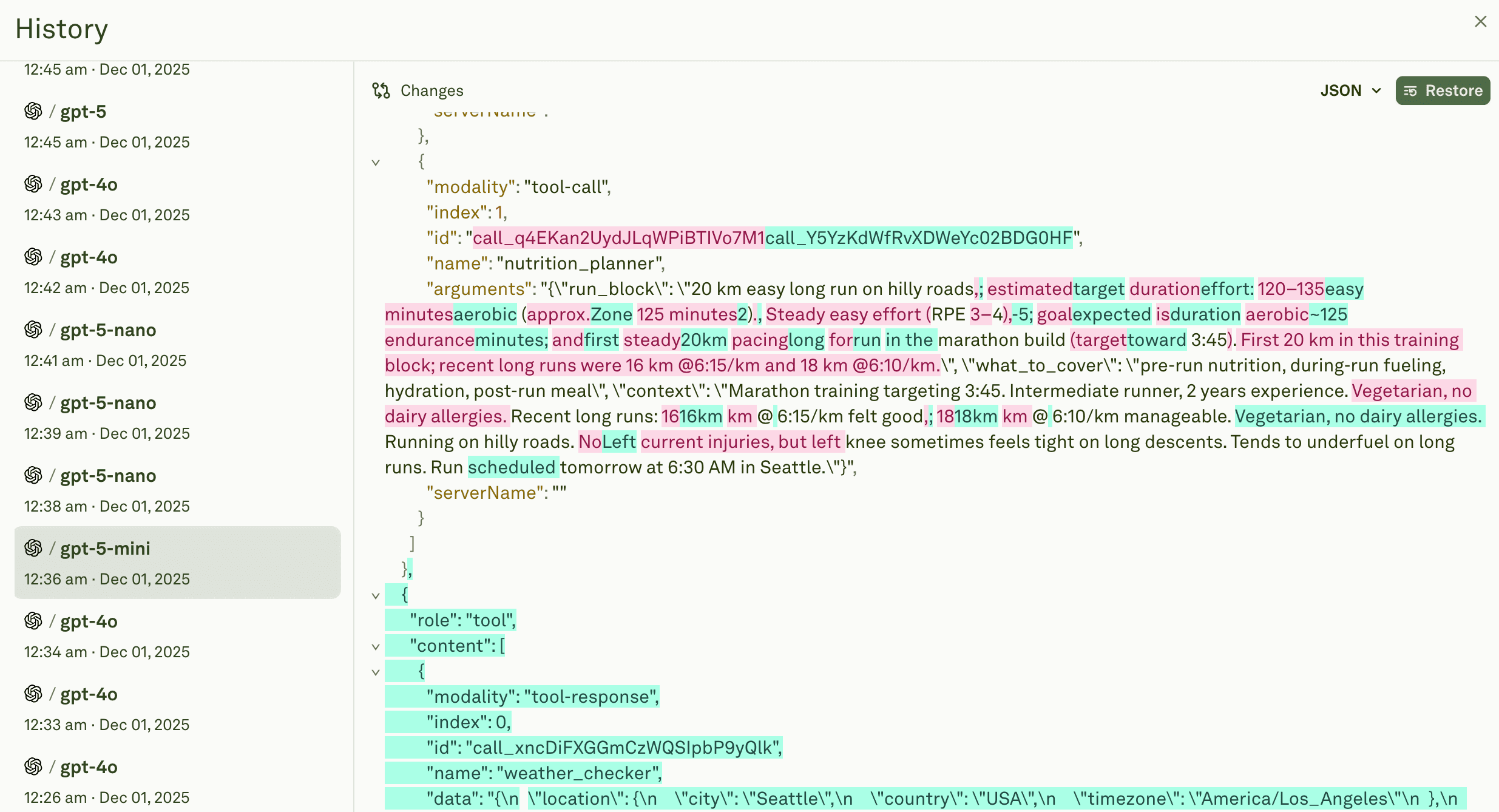
Adaline offers prompt versioning and diff. Users can also restore or rollback previous prompts to production or a certain environment.
Why teams choose Adaline over Promptfoo
- 1
Release discipline is built in
Adaline is designed around controlled prompt releases. You can promote versions across environments and roll back quickly when something breaks. - 2
Eval gates function as policy
Adaline is strongest when evaluation results are binding. Failed thresholds can block promotion. - 3
Ownership and auditability are explicit
Approvals and release history reduce “who shipped this?” confusion. - 4
Production closes the loop
Adaline is built to connect versions to production signals and live samples so quality improves over time.
When is Promptfoo the better choice?
Promptfoo is often the better choice when:
- You want an open-source CI eval runner and you already have governance elsewhere.
- Your team is early and needs a low-friction testing harness.
- You want maximum flexibility in how tests are defined in-repo.
Decision Framework
Choose Adaline if these statements are true:
- We need Dev/Staging/Prod separation and controlled promotion.
- We want evaluation thresholds to block promotions.
- We need fast rollback as an operational action.
- We need a single system of record for what is in production.
Choose Promptfoo if these statements are true:
- We need a CI eval runner and red teaming harness.
- We manage release governance via code review and deployment tooling.
- We do not need environment promotion and rollback as platform features.
Original Asset: Red Teaming To Release Gates Checklist
Use this to decide whether your red teaming work is actually improving releases.
If you answer “no” to three or more, you likely need a release system, not only a test runner.
- Do red team findings reliably become regression tests?
- Do regression tests run on every prompt change?
- Do test results block promotion when quality drops?
- Can you roll back a prompt change quickly during an incident?
- Can you identify exactly which prompt version is in production right now?
- Can you link a production failure to a specific prompt version and test suite?
Reference Pipeline: From Promptfoo-Style Tests To Release Gates
This is a practical model that many teams follow as they mature.
Stage 1: Local and CI testing.
- Store Promptfoo configs and tests in-repo.
- Run suites on pull requests.
- Track failures and iterate.
Stage 2: Introduce a release gate.
- Define pass/fail thresholds.
- Require a passing suite before promotion.
- Stop treating evals as advisory.
Stage 3: Formalize environments.
- Separate Dev, Staging, and Production.
- Promote only from Staging to Production.
- Assign explicit owners who can approve promotions.
Stage 4: Connect production to tests.
- Sample real traffic.
- Capture incidents.
- Convert incidents into new regression tests.
Promptfoo can support stages 1 and parts of stage 2. Adaline is built to operationalize stages 1 through 4 as a governed workflow.
Migration Guide: Promptfoo To Adaline (Practical And Safe)
This outline keeps your evaluation coverage intact while you adopt release discipline.
Step 1: Inventory your current eval suites
- List your Promptfoo suites and what they cover.
- Identify which suites are release-critical.
Step 2: Define a minimal production regression set.
- Start with 20–50 high-signal test cases.
- Include known failure modes and edge cases.
Step 3: Define thresholds.
- Decide what “good enough to ship” means.
- Make thresholds explicit and reviewable.
Step 4: Establish environments.
- Define Dev, Staging, and Production.
- Decide who can promote and who can approve.
Step 5: Import prompts as versioned assets
- Make Adaline the system of storing, managing, and recording for prompt versions.
- Tag candidates for Staging.
Step 6: Cut over with staged promotion
- Promote to Staging first.
- Monitor.
- Promote to Production with rollback prepared.
Step 7: Operationalize the incident loop
- Capture production failures.
- Convert them into new tests.
- Make the suite stricter over time.
FAQs
What is Promptfoo used for?
Promptfoo is commonly used as an open-source prompt-evaluation and red-team toolkit. Teams run eval suites in CI, compare outputs across prompt variants and models, and use adversarial testing to probe failures.
Can Promptfoo replace a prompt management platform?
Promptfoo can run tests, but it is not designed as a prompt release system. Most teams still need a system of record for prompt versions, governed promotion, and rollback.
What does “Promptfoo alternative” usually mean?
It usually means the team wants more than a test runner. The most common need is release discipline: environments, approvals, rollback, and evaluation gates that decide what ships.
Should we use both Promptfoo and Adaline?
Often yes. But using Adaline to manage the entire promptOps lifecycle, including iteration, evaluation, releases, promotion, and production feedback loops, makes a lot of sense.
How do we turn red team findings into real reliability improvements?
Make findings actionable by converting them into regression tests, running them on every prompt change, and gating promotions when failures occur.
How do we avoid regressions while switching?
Run a parallel phase. Keep Promptfoo suites in CI while you adopt Adaline for versioned releases, environments, thresholds, and staged promotion.
Final Take
Promptfoo is an excellent CI eval and red teaming toolkit, especially when you want an open-source, repo-native workflow.
If your reliability bottleneck is not “we cannot test,” but “we cannot ship prompt changes safely,” Adaline is the better Promptfoo alternative in 2026 because it provides release discipline: versioned prompts as assets, approvals, environments, rollback, and evaluation gates that determine what reaches production.