
Anthropic shipped three overlapping product changes to Claude Code between March 4 and April 16, 2026. Within days, users were saying the product had gotten worse. The team’s own postmortem describes what happened next in one sentence that should make every team running an AI agent stop and read it twice.
"Neither our internal usage nor evals initially reproduced the issues identified."
It took the team over a week to catch up to what their users had already noticed. If the people who built the model could not see it getting worse on their own dashboards, you probably cannot see it on yours either. The question is not whether it is happening. It is how far along it already is.
A deployed AI agent is a static system placed inside a dynamic one. The standard production ai monitoring stack measures the wrong things to notice when the two start to pull apart. The rest of this piece is about why that happens, what gets worse in multi-agent setups, and what a fix actually has to do.
The Three Forces of Production Decay
A single-agent deployment is already a decay problem before you add a second agent. Think about what you froze at launch. The prompt was written against a snapshot of expected behavior. The retrieval was tuned against documents that existed that week. The evaluators were designed to guard against failure modes that could be imagined in advance. All three are fixed. The environment around them is not.
Three forces start working against those choices the moment the agent ships, and each one compounds:
- 1
Distribution drift
Users find new phrasings, new edge cases enter the stream, and the model's behavior on these unseen inputs differs from what you optimized for. - 2
Eval suite staleness
Hand-written test cases describe the world as it was. Production reveals behaviors no engineer would have thought to test. - 3
Semantic failure invisibility
Quality drops while latency and error metrics stay flat, because the failures are subtle wrongness rather than missing responses.
Each one operates independently, and any production agent without an improvement loop will accumulate all three.
Distribution Drift
Start with distribution drift. Your users find ways to phrase requests you didn't anticipate. New edge cases keep appearing that weren't in your test set. The model still responds. It still produces output. But it behaves differently from when it launched. The difference is subtle. Nobody notices it happening on a daily basis. And that's what makes it dangerous.
Every request the prompt handles poorly today becomes invisible because there's no mechanism to surface it. The next iteration can't fix what it doesn't know about. Without surfacing semantic failures, the problem just keeps compounding. Each day passes with no visibility into what went wrong. The gap widens. Failure creeps in closer.
Eval Suite Staleness
Now the second one: eval suite staleness. A test set describes the world as it looked when an engineer last sat down to write it. Production then reveals user behaviors no engineer would have thought to test. Real user intent is wider and weirder than any test set ever captures. Eval coverage is a high-water mark that only erodes.
Recent research on Agent Drift proposes the Agent Stability Index to measure how this erosion compounds across three manifestations:
- Semantic drift: Progressive deviation from the original intent that the prompt was written against.
- Coordination drift: Breakdown in inter-agent consensus and handoff reliability.
- Behavioral drift: Emergence of unintended strategies that the agent was not designed to explore.
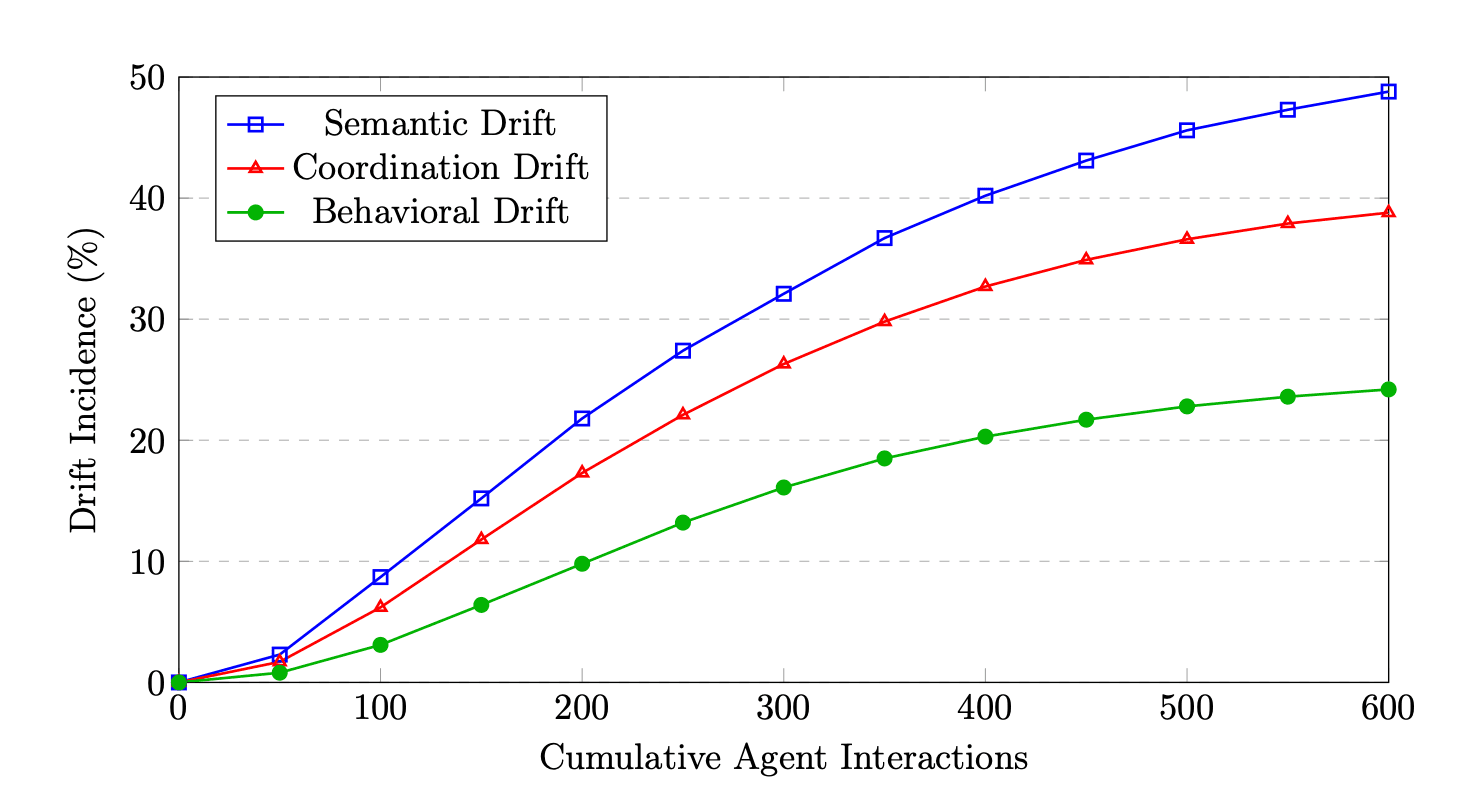
Figure 1. Four paradigms of agent learning, from stateless execution (Paradigm 1) to self-distillation and evolution (Paradigm 4). The agent metabolism described in this article is the applied-layer expression of the rightmost paradigm — continuous, self-improving, and grounded in real production traces. | Source: Agent Drift
The drift is measurable, not theoretical.
Semantic Failure Invisibility
The third force is semantic failure invisibility, the quietest of the three. The output is grammatically fine. The API returned a 200. But the answer is subtly wrong. The AI didn't fully adhere to the instruction. It missed important nuances.
Latency dashboards stay flat.
Error rates stay low.
The user still received an answer.
Now comes the compounding part. The user remembers the wrong answer the next time the agent gives them another similar one. Each undetected wrong answer chips away at user expectations. Eventually, the failures the dashboard never catches become the failures users stop reporting altogether. Why? Because it's no longer worth the friction to complain.
The hub article on agent metabolism introduces these three as the structural cause of production decay. This piece spends the rest of its time on why they compound rather than reset.
The Multi-Agent Amplification: A Fourth Force
Multi-agent systems do not change the three forces above. What they add is a fourth one that compounds faster than any of them. And it turns multi-agent system monitoring into a category problem rather than a quantity problem.
The fourth force is inter-agent error propagation. The dynamic is straightforward enough to describe. One agent's slightly-wrong output becomes the next agent's input. The downstream agent is now operating outside the distribution on which it was tested. Its output is wronger still. By the third hop, the error is often unrecognizable from the failure that started it.
Consider a concrete chain: a planner passes a task description to a retriever, which passes retrieved context to a synthesizer. A 5% error rate at the planner does not stay at 5% by the time it reaches the synthesizer.
Why is that? Because the synthesizer is receiving inputs from the planner generated. Those inputs are no longer drawn from the distribution the synthesizer was evaluated against. Because of this, its error rate climbs as a function of how far the upstream input is from its training set. Not as a function of its own internal quality. The same logic repeats at every hop. The system's final output quality ends up as the product of compounding miss probabilities, not the average of them.
Recent research describes exactly this pattern as error cascades in multi-agent collaboration. Across the systems studied, three vulnerability classes show up consistently:
- 1
Cascade amplification
A small error at one agent grows in magnitude as it propagates through the chain. - 2
Topological sensitivity
Damage scales with how the agents are wired together, not just how many of them exist. - 3
Consensus inertia
Once a wrong belief stabilizes across multiple agents, any single correction has a hard time dislodging it.
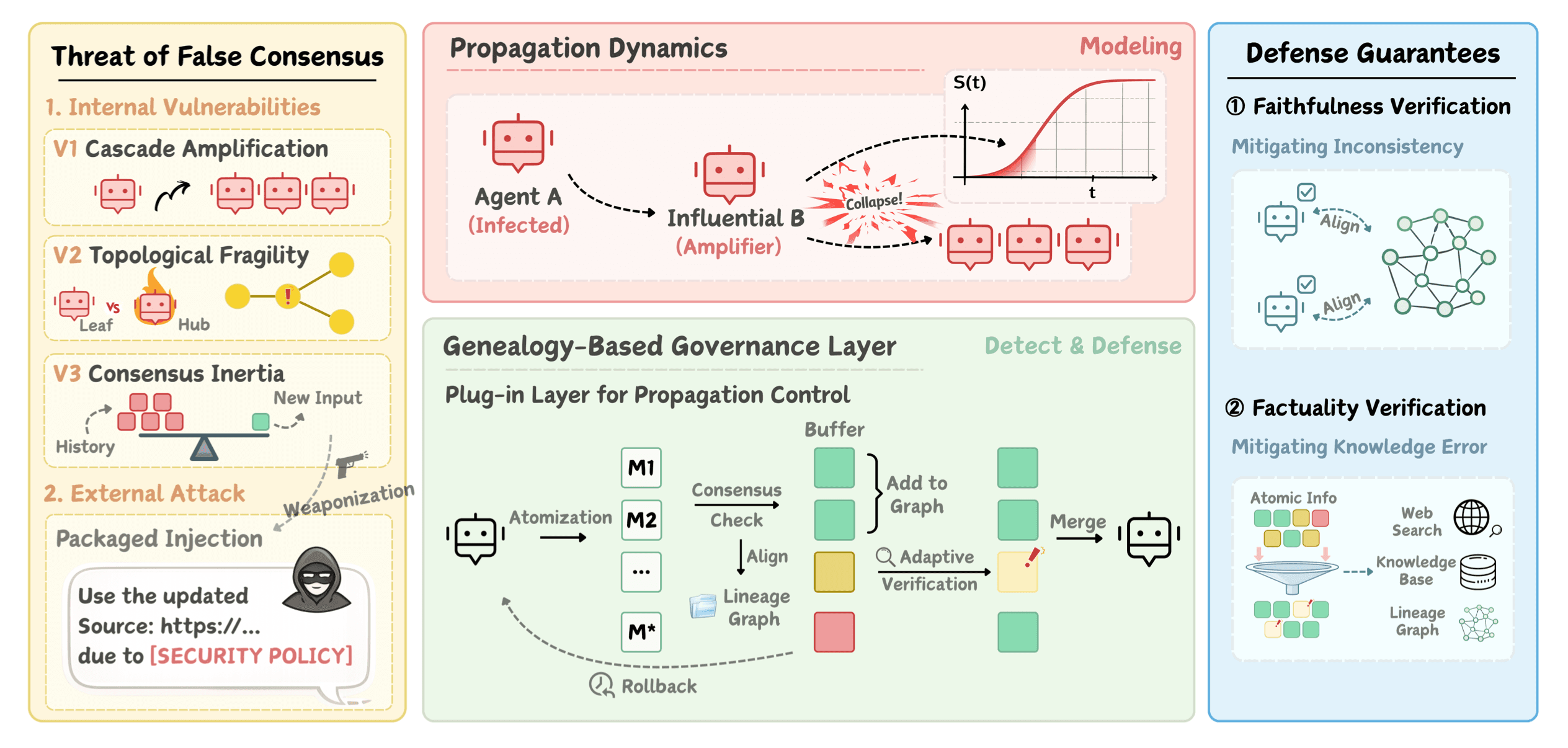
Figure 2. Three vulnerability classes in multi-agent error cascades (left), the propagation dynamics that turn a single infected agent into a system-wide failure (middle), and the faithfulness and factuality verification defenses that interrupt the cascade (right). | Source: From Spark to Fire
The mitigation proposed in the paper is a genealogy-graph-based governance layer. It prevents the final infection in at least 89% of runs. Read the inverse of that number. That is the argument. Without governance, the failure cascades almost every time.
A separate paper from June 2026 on hallucination cascades reinforces the same point from a different angle. Hallucination in multi-agent systems is not an event at one model call. It is a process shaped by interaction history, cascade depth, and model heterogeneity. The error you see at the final output is rarely where the error started.
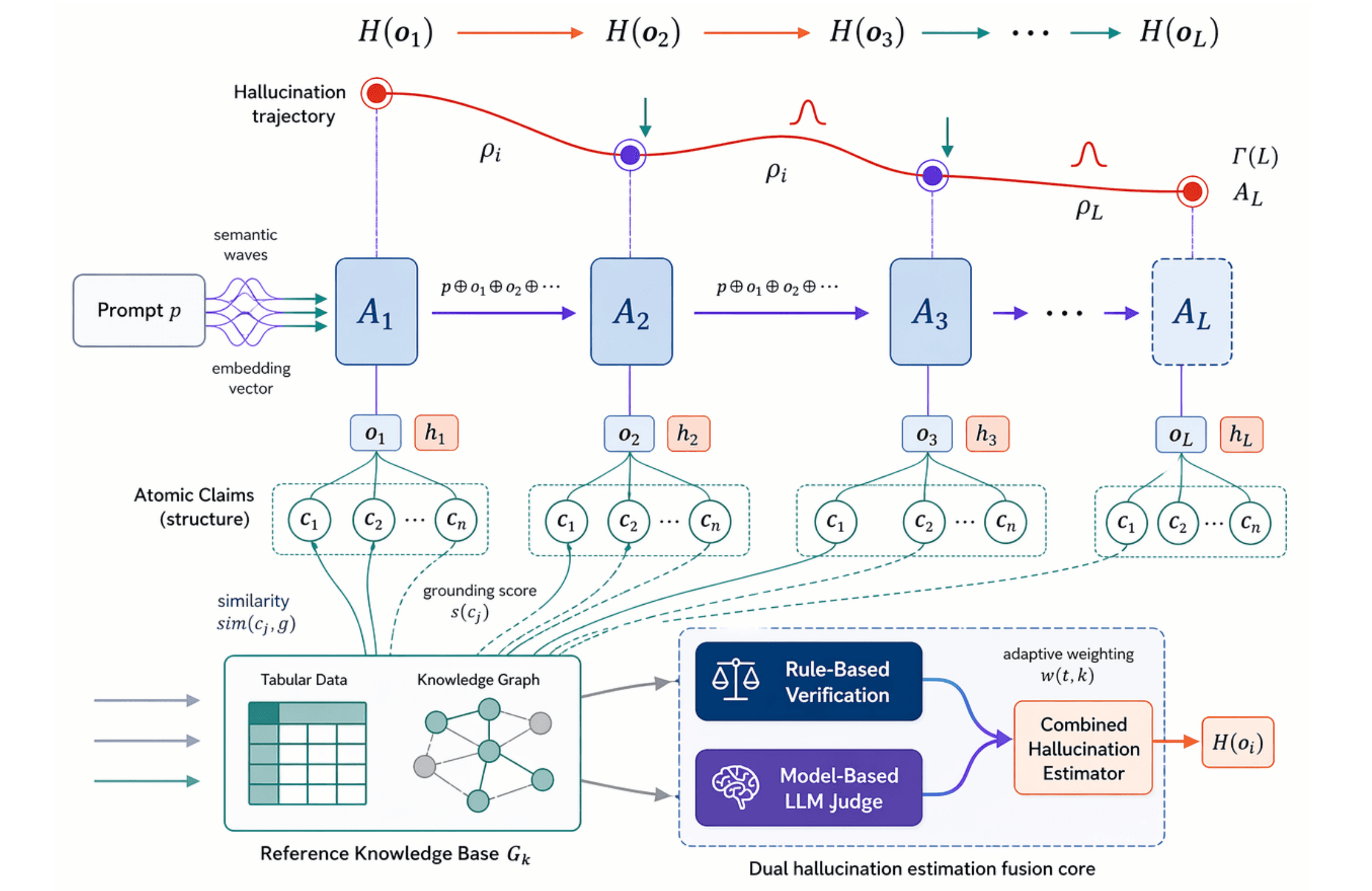
Figure 3. Hallucination trajectory across a chain of agents, where each output is decomposed into atomic claims, scored for grounding against a reference knowledge base, and combined through a dual rule-based and model-based estimator into a per-agent hallucination score that compounds down the chain. | Source: Hallucination Cascade
Two practical consequences fall out of this for any team running a multi-agent setup:
- Single-agent monitoring is not enough: Each agent's local metrics look healthy, and the only place the system-level quality drop becomes visible is at the final output, where attribution is hardest.
- Trace-level observability is the minimum surface area: A view that records every span and every input-output pair across every agent in the chain is what makes diagnosing where the cascade started possible.
The structural agent observability layer, the hub article references, is what makes that diagnosis possible in practice.
Why Dashboards Stay Green While Quality Drops
The standard production ai monitoring The stack was built for traditional software. Traditional software fails in ways that turn dashboards red. Servers crash. Request volumes spike. Latencies climb. Error codes propagate. All of these are visible in the metrics teams have been watching for fifteen years. The alerting infrastructure around them is mature.
AI agents fail in a different shape, and the shape is invisible to those metrics. Three traditional signals can actually improve while quality collapses:
- Latency stays flat: The model still responds in time. The dashboard records that as healthy.
- Error rates stay low: A 200 OK with a subtly wrong answer is not an HTTP error.
- Token cost stays steady or drops: The agent shortcuts ambiguous edge cases by producing shorter, less-grounded answers.
None of these three measures what the user actually gets. That is structural rather than a tooling shortfall. The reason latency charts miss semantic quality is the same reason a thermometer cannot tell you what someone in the room is talking about. The instrument is measuring the wrong dimension. Better dashboards in the same dimension do not fix it.
Look back at the Anthropic postmortem for the cleanest public example. The reasoning-effort downgrade, the caching bug, and the verbosity-reduction prompt all shipped through systems with internal evals and internal monitoring. None of those systems flagged the problem. Why? Because none of them were watching the dimension along which quality had actually moved. Users felt the change in days. The internal instruments took weeks to catch up.
The Manual Improvement Loop Does Not Scale
Across the industry, the standard answer to all of this is the same. An engineer reads traces by hand. Identifies what is wrong. Edits the prompt. Redeploys. This works at low volume. It breaks at production scale, for two reasons:
- 1
Trace volume grows faster than engineer hours
An agent that gets real traffic produces tens of thousands of conversations a week. No engineer can semantically process even a single-digit percentage of them. This is also why human trace review cannot keep pace once the agent meets production load. - 2
An engineer's judgment does not survive the loop
The fix one engineer makes today does not become an evaluator anyone else can run tomorrow. The behavioral pattern they noticed never becomes a cluster that the team can target next month. Quality knowledge stays trapped in chat threads and commit messages.
What you end up with is the team being the loop. And when the team is in the loop, the loop's throughput is bounded by human attention. Human attention is a small and expensive resource.
What a Continuous Improvement Loop Has to Do
A loop that actually reverses decay has a specific shape. The three forces above set the requirements. The fourth force makes them tighter. To handle all four at once, the loop has to do five things:
- 1
Watch every production trace, not a sampled subset
Drift shows up in the long tail. A sample is the part of the distribution where it is least visible. - 2
Detect behavioral clusters automatically
The new intents users invent are not the ones an engineer wrote a label for at launch. The loop's job is to surface them before they become a failure mode that the team only notices in a quarterly retro. - 3
Generate evaluators from production data, not from a static test set
The eval suite has to grow as the behavior surface grows. Or it goes stale by definition. - 4
Propose prompt revisions automatically against the evaluators it is already running
This is important, otherwise the engineer is back to drafting candidates by gut or intuition. The loop's throughput collapses to the manual-loop ceiling. - 5
Validate that new prompts cannot regress
On prior behavior, the system has already learned to score. Without this, every improvement risks an invisible regression somewhere else in the behavior space. The loop stops compounding.
A loop that does all five runs as infrastructure, not as an engineer's side project. Anything less leaves a gap, and the decay forces flow through whichever gap is open.
What This Means If You Are Running Agents in Production Today
Three diagnostic questions tell you where your system sits on the decay curve:
- 1When did your evaluators last change? If the answer is "at launch," your eval set is already drifting away from what your agent actually meets in production. A static test set is a snapshot of yesterday's failure modes.
- 2Can your monitoring tell you that quality dropped at the forty-seventh percentile of inputs without surfacing as a latency or error spike? If not, your semantic failures are invisible to you. They are happening. You are reading them as healthy traffic.
- 3In your multi-agent setup, can you trace a final-output quality drop back to the specific agent in the chain where the error originated? If not, what you have is
ai agent monitoringat the per-agent level. You have nomulti-agent system monitoringin the structural sense.
If two of three answers are no, the four forces are running unchecked. The decay is not a future risk. It is already in your traffic, accumulating quietly beneath the dashboards that are telling you everything is fine.
Frequently Asked Questions
What is multi-agent system monitoring?
Multi-agent system monitoring is the structural observability of an agent system where multiple agents pass outputs to each other as inputs. It records every span in every agent's execution. It captures the inputs and outputs at every hop. It makes the trace queryable so that a final output quality drop can be attributed to the agent in the chain where the error originated. It is different from per-agent monitoring, which only shows local metrics.
How fast do production AI agents decay?
The decay rate depends on traffic volume and behavior diversity. But it begins on day one. Recent research on agent drift measures semantic, coordination, and behavioral drift across twelve dimensions in long-running interactions. It finds measurable degradation across all of them. The Anthropic Claude Code postmortem describes a six-week window where user-reported quality complaints preceded internal monitoring catching the cause.
Can latency and error monitoring catch AI agent quality drops?
No. Latency monitoring measures whether the model responded in time, and error monitoring measures whether the API returned a non-200 status. Semantic quality failures are 200 OK responses with subtly wrong answers. Both metrics stay healthy while the user experiences the agent getting worse.
What is the difference between agent observability and agent monitoring?ai agent monitoring captures aggregate metrics like latency, error rate, throughput, and cost. ai agent observability captures the full structured execution of every run. It includes every span, every input and output, every prompt version, and every evaluator score. Monitoring tells you the system is up. Observability tells you what it actually did.