
Any living system adapts to the environments in which it operates. And those that stop adapting either die, weaken, or decay. A deployed AI agent is, by default, the opposite of a living system. It ships as a fixed configuration of prompts, retrieval rules, and evaluators, and then it meets a production environment that never stops moving.
Agent metabolism turns a static deployment into an adaptive system. It is a continuous improvement loop that takes every live conversation an agent has, learns from it, and turns that learning into measurable upgrades to the agent’s behavior over time.
We use the word metabolism on purpose.
A metabolism is not a one-off process or a quarterly refresh. It is the constant background activity that keeps a system alive in a world that keeps shifting around it. The same logic applies to production AI agents. Without an agent metabolism, every prompt you wrote before launch starts to drift, every evaluation suite starts to miss new failure modes, and every assumption you encoded into the system starts to age out of usefulness. Recent research on self-evolving agents has reached the same conclusion from the model side: agents that do not learn from their own experience cannot keep up with the environments in which they are deployed.
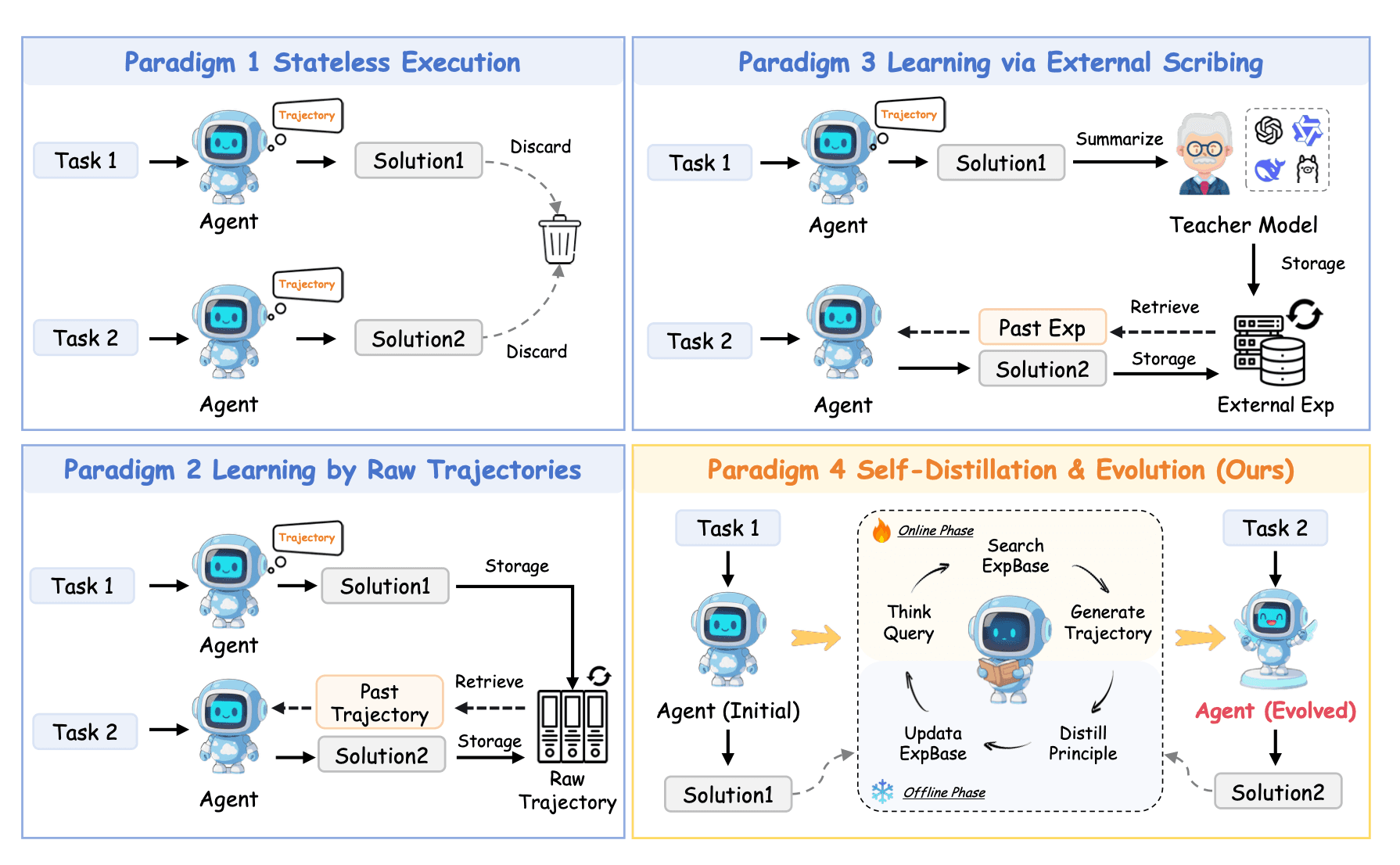
Figure 1. Four paradigms of agent learning, from stateless execution (Paradigm 1) to self-distillation and evolution (Paradigm 4). The agent metabolism described in this article is the applied-layer expression of the rightmost paradigm — continuous, self-improving, and grounded in real production traces. | Source: EvolveR
This piece explains what the loop is, why it matters, and how each stage compounds quality with every cycle. We will use real numbers from the "Running Coach" agent on the Adaline platform, because the strongest argument for self-improvement infrastructure is the data it produces.
Why AI Agents Decay Without a Metabolism
A deployed AI agent is a static system placed inside a dynamic one. The prompts were written against a snapshot of expected user behavior, the retrieval was tuned against the documents available at launch, and the evaluators were authored against the failure modes that someone could imagine in advance. All three of these are fixed at the moment of deployment. The environment around them is not, and that is the structural cause of production AI agent quality erosion.
Three forces drive the decay:
- 1
The prompt-production distribution drift
Inputs in production drift away from the inputs you designed against. - 2
Eval suite staleness
Static test cases stop describing the world your agent actually meets. - 3
Semantic failures invisible to monitoring
Quality drops while latency and error metrics stay flat.
Each one operates independently, and any production agent without a metabolism will accumulate all three.
The Prompt-Production Distribution Drift
The set of inputs your agent receives in production drifts away from the set of inputs you used to design and test it. Users find new ways to phrase requests, edge cases appear in your data, and the model's behavior on these unseen inputs is not the behavior you optimized for.
The prompt that scored well on your launch evals is not the prompt that scores well on next month's traffic, and there is no automatic mechanism that notices the difference. This is why agents fail after deployment, and the distance widens the longer it goes unaddressed.
Eval Suite Staleness
Hand-written test cases describe the world as it looked when an engineer last sat down to write them. Production reveals behaviors that no engineer would have thought to test, because the actual distribution of user intent is wider and weirder than the test set.
The longer the eval suite stays static, the less it tells you about real quality, and this is why static eval suites slowly stop working.
Semantic Failures Invisible to Monitoring
Latency stays flat, error rates stay low, and the agent still gets worse, because the failures are semantic. The output is grammatically fine, the API returned a 200, and the user still got an answer that was subtly wrong.
These are the failures that latency charts miss, and the reason latency charts miss semantic quality is structural, not a tooling shortfall that better dashboards will fix. This is also how agents decay without a continuous loop, one quiet semantic failure at a time.
A static system inside a dynamic environment decays by design. The question is not whether to build an improvement loop. The question is what shape it should take.
The Agent Metabolism: A Continuous Improvement Loop
The agent metabolism is the named architecture that replaces the static-system-in-dynamic-environment problem with a self-sustaining loop. It is the set of components that take production traffic as input, identify what the agent is doing well and where it is failing, generate candidate improvements automatically, validate them against a quality floor, and deploy the survivors back into production. The loop runs continuously, and each pass through it sharpens the next.
Here is the shape of the loop:
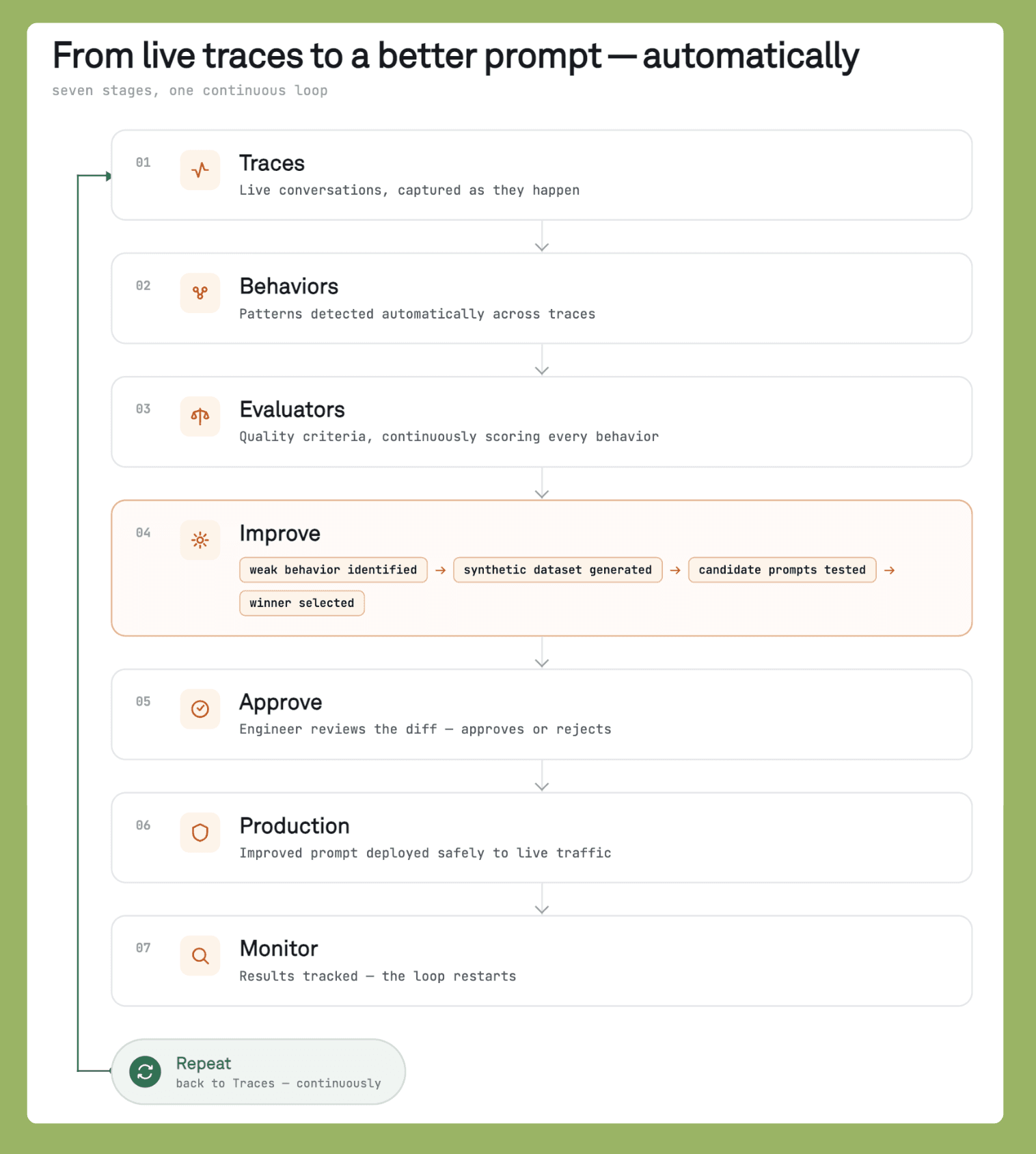
Figure 2. The self-improvement loop.
The order is not cosmetic.
Each stage depends on the output of the one before it.
- Traces feed the behavioral clustering that finds patterns.
- The behaviors give the evaluators something specific to score against.
- The evaluator scores tell the improvement engine which behaviors to target.
- The improvement engine generates the candidates that the engineer reviews and approves.
- The approval gate guarantees that the deployed prompt cannot regress on any prior behavior the system has already learned to score.
- The monitor then watches the new prompt in production, the next batch of traces flows in, and the cycle starts again.
This is closer to a biological metabolism than to a release process. It is always running.
How Each Stage of the Loop Feeds the Next
The four stages do more than execute in sequence. Each one produces an output that makes the next stage measurably better, and the improvement is what creates the llm improvement cycle that compounds.
Traces: The Raw Material of Understanding
A trace is not a log. A log records what happened. A trace captures the full structured execution of what happened.
Every trace includes:
- Every span and every model call in the run.
- Every input and every output, including intermediate steps.
- The eval score against the quality criteria you have defined.
- Latency, cost, token counts, prompt version, and status.
All of it is queryable by field, not by string match.
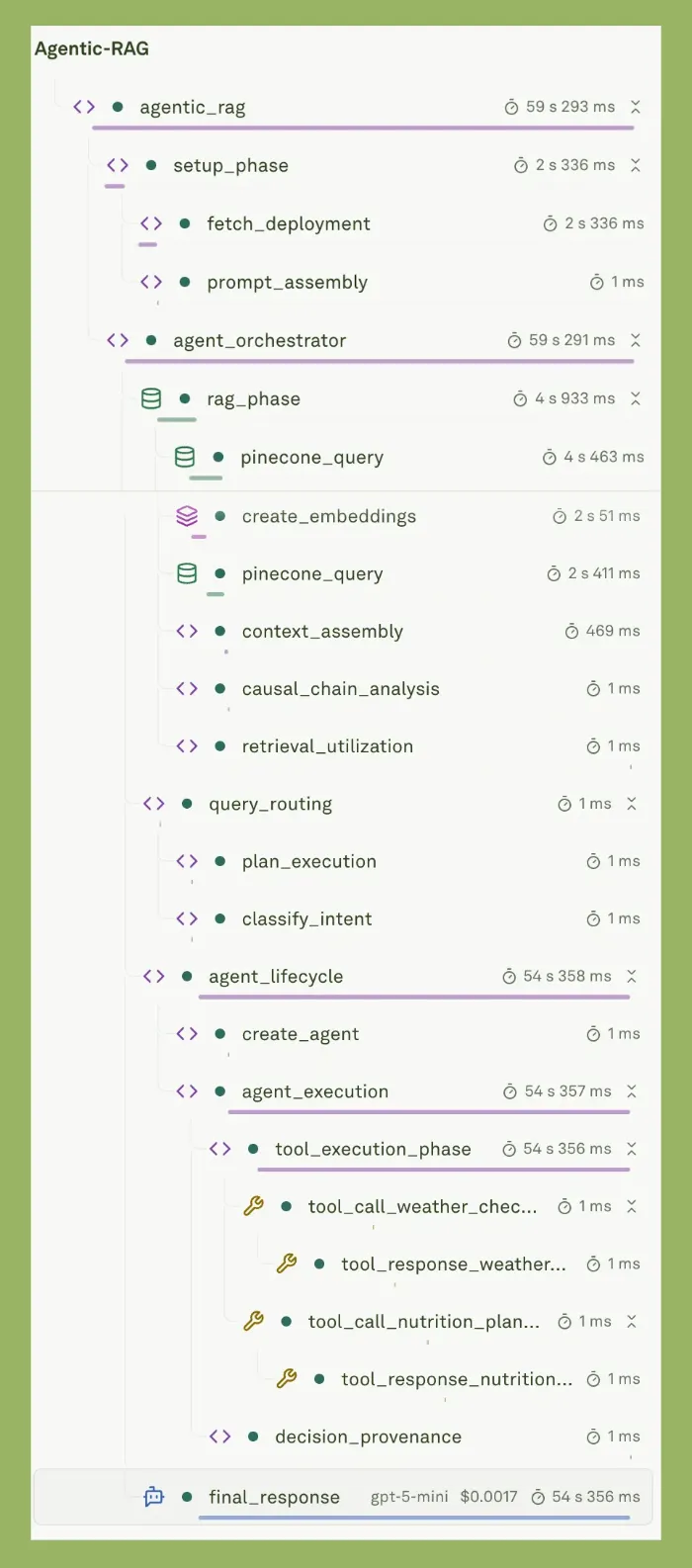
Figure 3. A single trace from an Agentic-RAG agent on Adaline. Nested spans cover setup, RAG retrieval, query routing, agent lifecycle, and tool calls, each timestamped and costed at the span level. The agent metabolism reads across thousands of traces like this one to extract the behavioral patterns that the next stage works with.
For instance, "The Running Coach" agent on Adaline has produced 5,050 traces in the last 30 days. You can filter the corpus on any dimension that matters. Common slices include:
- 1Every trace that ran over a cost threshold.
- 2Every trace that crossed a certain latency.
- 3Every trace that used a specific prompt.
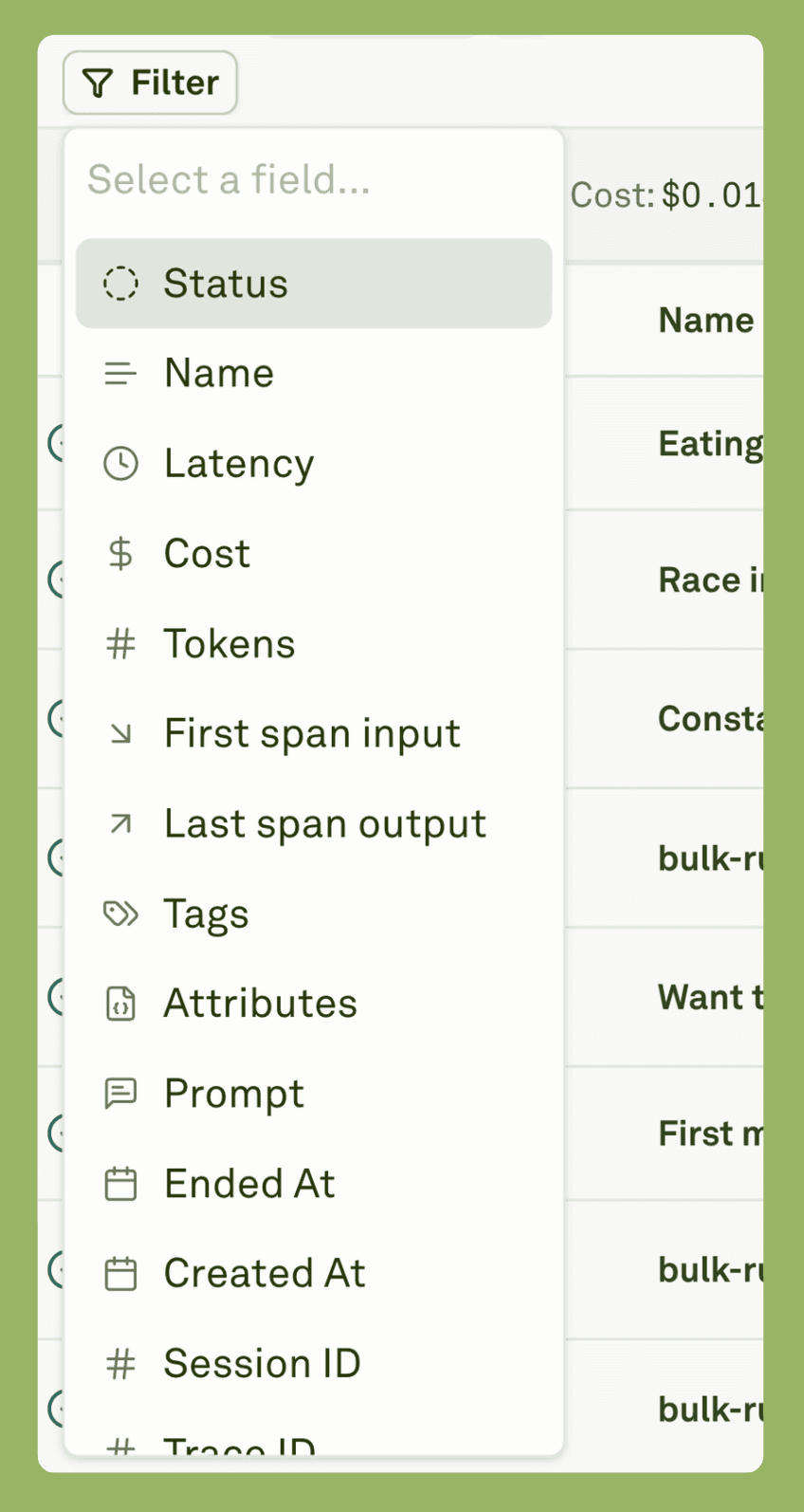
Figure 4. The filter fields available on the Traces view in Adaline. Every trace can be sliced by status, latency, cost, tokens, span inputs and outputs, prompt version, tags, attributes, and timestamps. This is what "queryable by field" looks like in practice, and it is what the slices above are filtering against.
This is structural agent observability. It tells you what happened, precisely, for every interaction.
What it does not tell you is what those traces mean as a group. That work — finding patterns nobody named in advance — happens in the next stage.
The compounding mechanism here is simple. The richer the trace corpus grows, the more material every downstream stage has to work with. A trace logged today makes the system smarter tomorrow.
Behaviors: Turning Volume Into Signal
Volume is not the same as signal, and most production teams confuse the two. A team that monitors 19,372 conversations a month does not have insight into 19,372 things. It has insight into the behavioral patterns that the system can extract from them.
A behavior is an auto-discovered cluster of how real users actually use the agent in production. It is not a category that an engineer wrote in advance. It is a usage pattern that the system found on its own by reading the traces and grouping the ones that share an underlying intent. Each behavior corresponds to one distinct way the agent gets used, and each one carries a label and a description so the team can name it and talk about it.
The pipeline runs in four steps:
- 1Pull every conversation trace from production.
- 2Extract the user's intent for each span inside the trace.
- 3Cluster the spans that share semantically similar intent.
- 4Label each cluster with a name and a description, organized into a hierarchy of intent groups.
The Running Coach platform has identified 133 distinct behavior patterns from its 19,372 conversations. Each one is a recognizable usage pattern, named with the kind of concrete, human-readable label that an engineering team would write on a whiteboard. Nobody wrote those labels by hand. The clustering process produced them by reading the corpus.
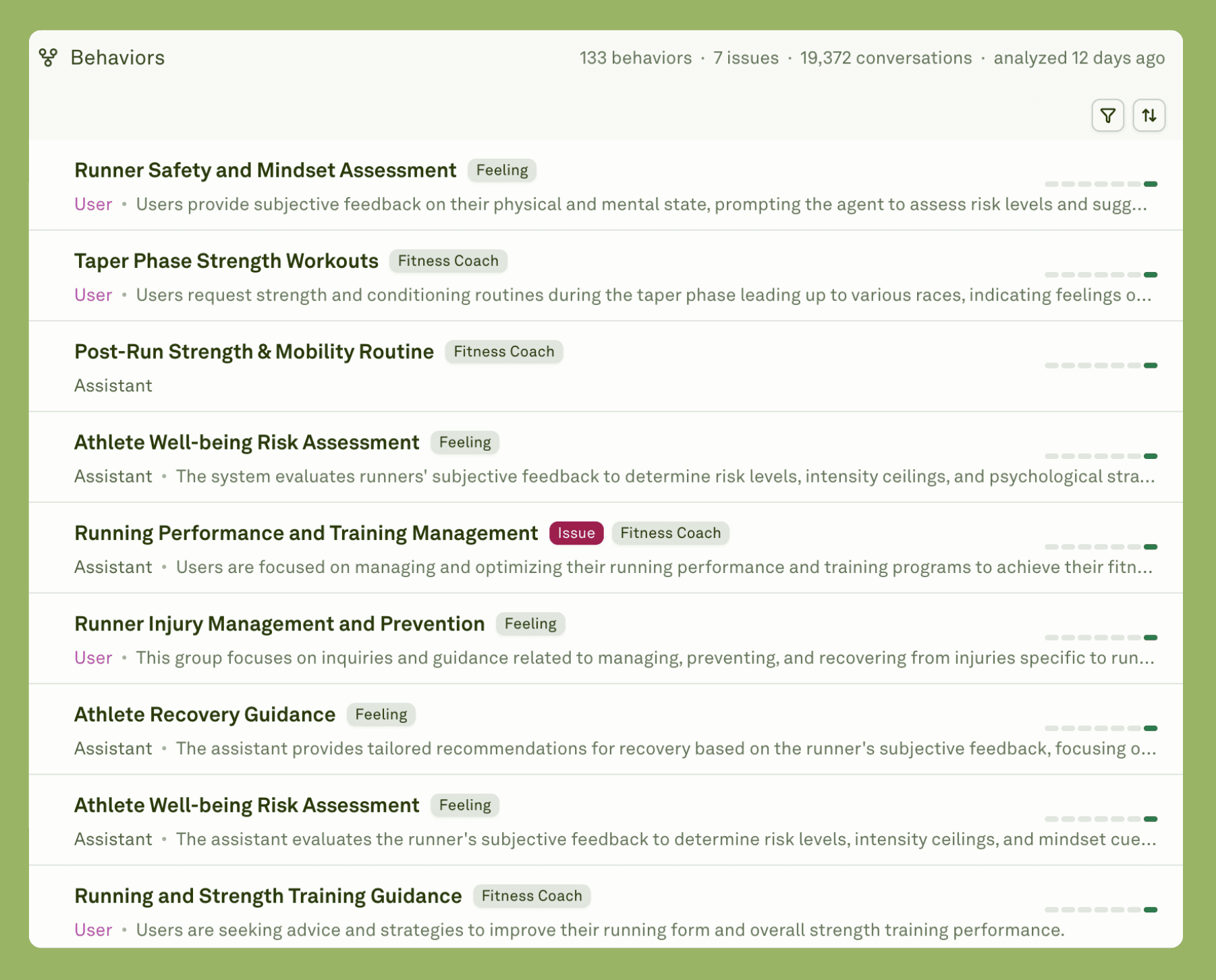
Figure 5. The Behaviors index view in Adaline: 133 auto-discovered usage patterns for the Running Coach agent, 7 of them flagged as Issues, all derived from 19,372 conversations. Each cluster carries a system-generated label, a one-line description of the underlying user intent, and a tag for the prompt it routes through. No engineer wrote any of these names or descriptions.
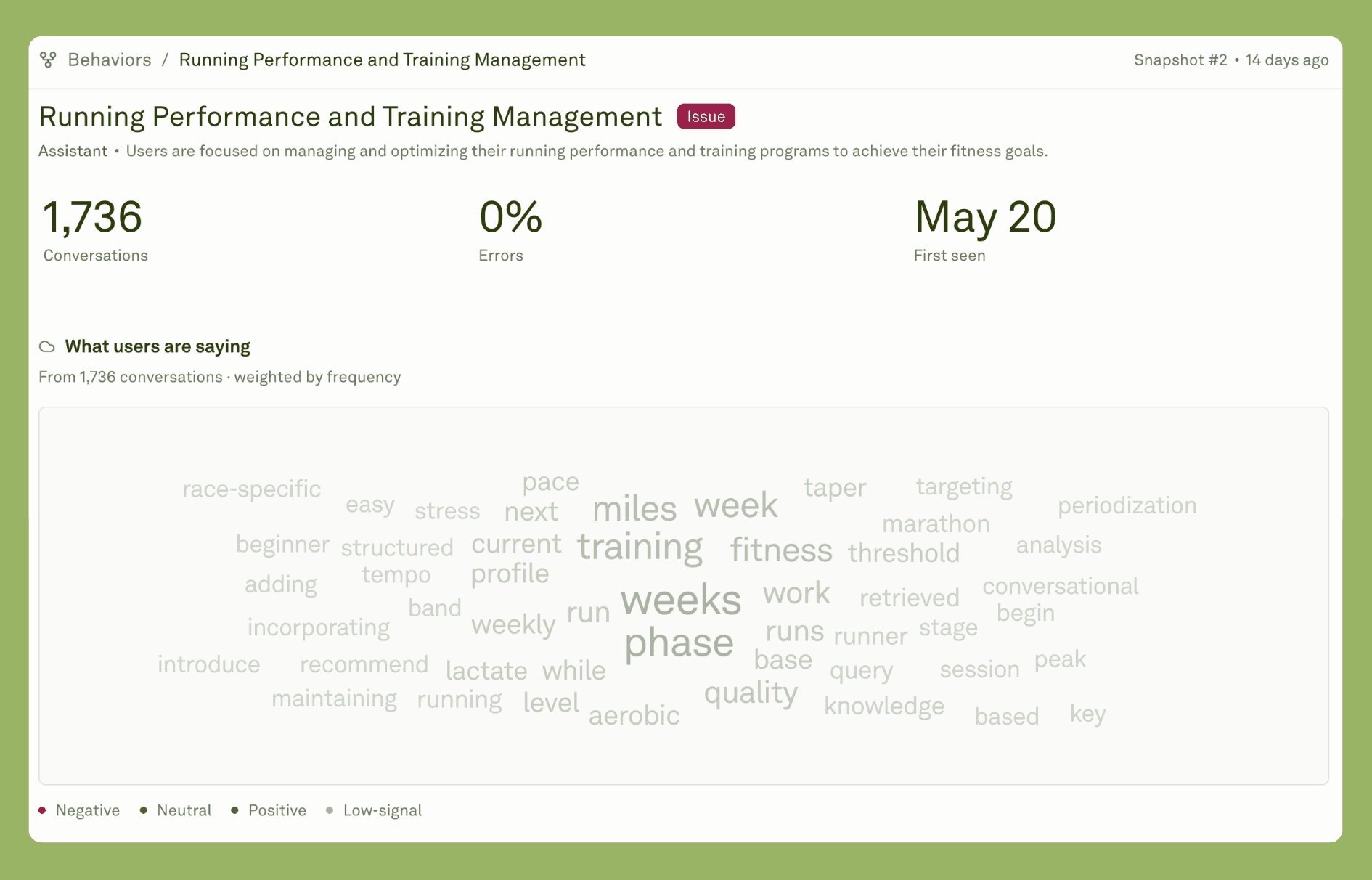
Figure 6. A single behavior cluster in detail on Adaline. The system has named the cluster "Running Performance and Training Management," written a one-line description of the underlying user intent, grouped 1,736 conversations under it, flagged the cluster as an Issue, and surfaced the words those users actually use. None of this was authored by an engineer.
Two examples of what this looks like in practice:
- 1
Semantically distinct, behaviorally identical
A user asking "should I run today?" and a user asking "is this knee pain a problem?" can belong to the same behavior cluster if the agent's response logic is doing the same thing for both. - 2
Failure rates surfaced without a search query
The system notices when 14% of a specific behavior is failing, without anyone knowing in advance to look for it.
This is the layer where issues, drift, and unknown intents become visible. The prompt may have shipped against three or four intents that an engineer imagined. Production reveals dozens, and the ones the prompt is not handling well are the ones the loop must target first. This is also how semantic failure patterns in high-volume traffic become visible at all.
The compounding mechanism is resolution:
- 1More traces produce finer clusters.
- 2Finer clusters produce more precise targeting of the next improvement.
- 3More precise targeting is what makes the loop efficient.
This is also how hybrid trace intelligence works at scale.
Evaluators: Quality Criteria That Sharpen Over Time
An evaluator is a piece of code that scores an agent's output against a quality criterion. It runs on every output the agent produces and emits a numerical score that the platform records alongside the trace. Together, the evaluators form a continuous LLM evaluation loop that runs in parallel with production traffic.
The Running Coach agent has 14 evaluators running across its 4 production prompts. They split into two categories:
- AI-powered judges that score subjective qualities such as helpfulness, tone, and answer fit.
- Performance-based checks that score objective properties such as latency, format, and constraint adherence.
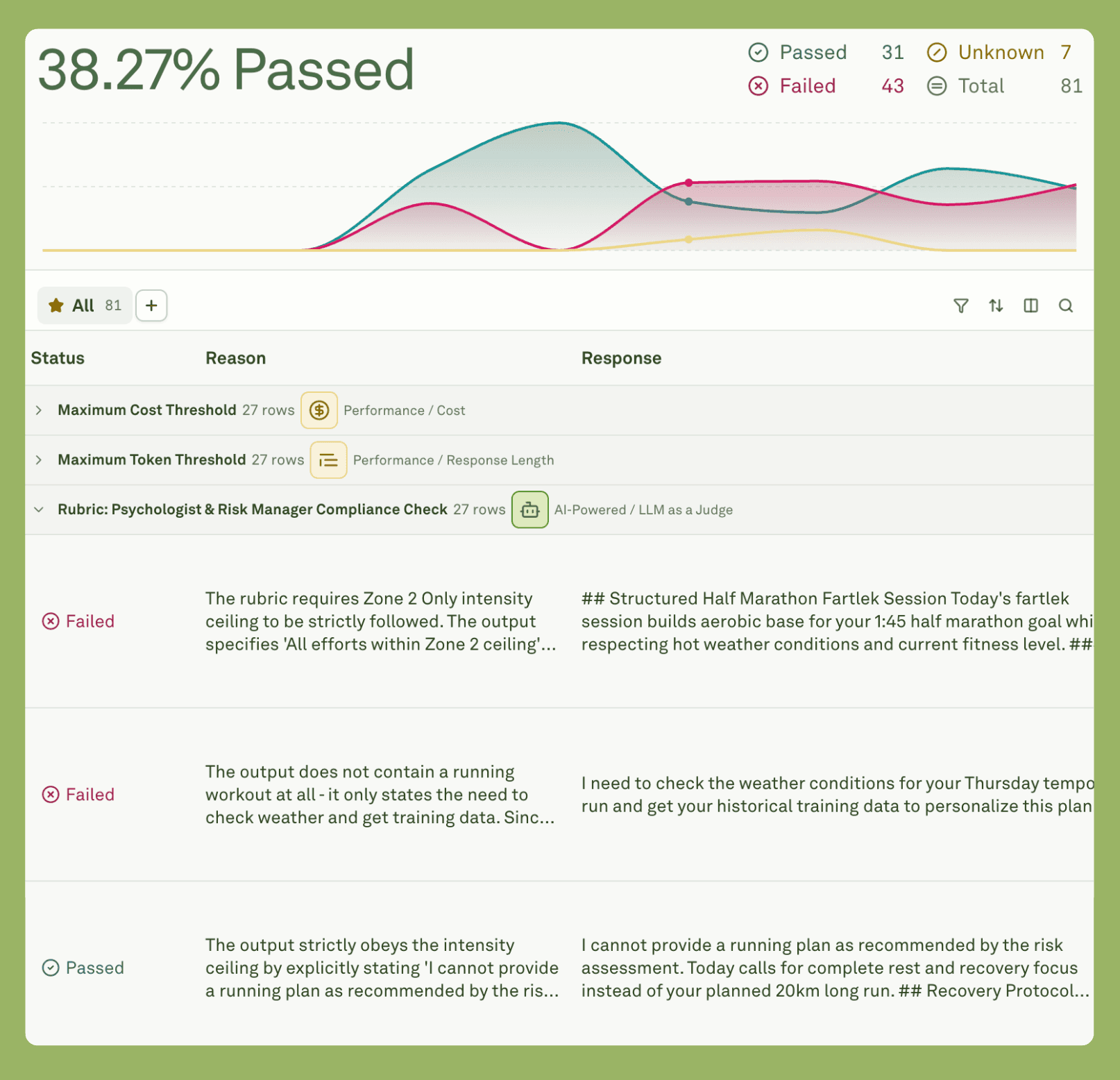
Figure 7. The Evaluator's results are viewed in Adaline. The top row shows a 38.27% pass rate across 81 outputs, with 31 passed, 43 failed, and 7 unknown. Three evaluators are running against this slice: two performance-based checks (Maximum Cost Threshold and Maximum Token Threshold) and one AI-powered judge (Rubric: Psychologist & Risk Manager Compliance Check). Each failed output carries the specific reason the evaluator gave, which is exactly what the Improve stage targets.
The evaluator set is not frozen, and that is the point. New evaluators get added as behavioral coverage expands, and the existing set stops measuring something the team cares about. This is how to derive eval criteria from production traces without a domain expert authoring them by hand, and it is also how to assess evaluation coverage across failure modes.
We validate evaluators with mutation testing. The process runs in three steps:
- 1Take a known-good agent output.
- 2Mutate it by breaking it in a known way.
- 3Check whether the evaluator catches the break.
Evaluators that pass mutation testing are the ones the loop trusts.
Improvement Cycles: Systematic Search That Gets Smarter
The Improve stage is the closed loop that sits on top of Behaviors and Evaluators. It takes a target and runs prompt optimization against it until that target scores higher. The target is either a specific behavior the team wants to improve, or a failing eval the system has flagged.
The optimization combines two techniques: reflective prompt evolution (GEPA) and synthetic dataset generation. The system produces a representative test set for the target, evolves candidate prompts against it, and scores each candidate across the full evaluator suite. The output is a candidate prompt diff that beats the current production prompt, with a zero-tolerance gate on regression against any previously passing behavior.
The diff is what the engineer reviews and ships. The technique sits in a research lineage that includes gradient-style prompt optimization, but the loop adds the missing pieces: production traces, validated evaluators, and a deployment gate.
Put simply: Behaviors identify what is wrong or what could be better, and Improve generates the prompt fix.
The Running Coach agent has completed 30+ improvement cycles to date, with pass rate gains ranging from +14% to +62.5% per cycle, validated against 776 test cases across 23 synthetic datasets.
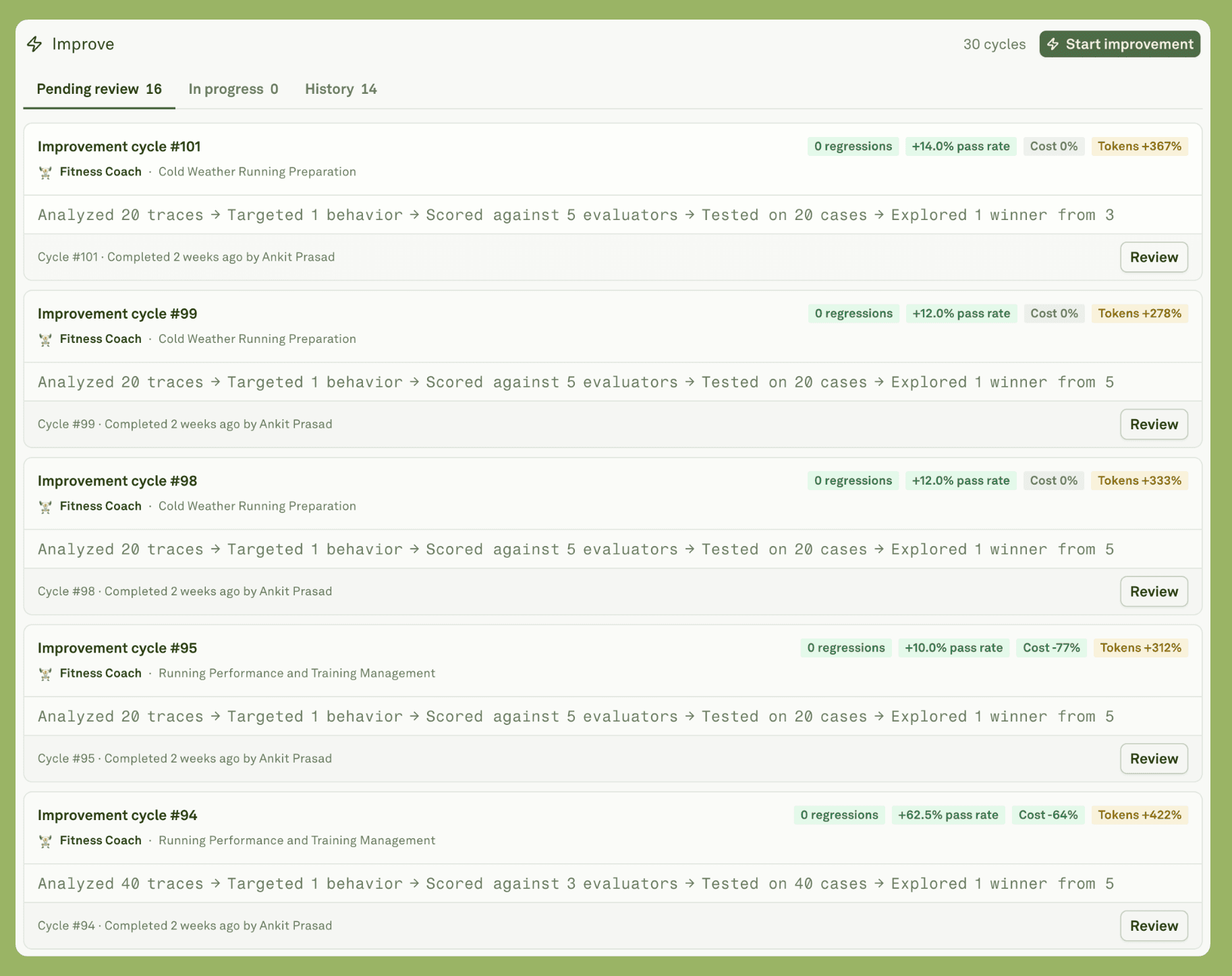
Figure 8. The Improve queue in Adaline. Each row is a completed improvement cycle, five of them visible here, ranging from +10% to +62.5% pass-rate gain — all with zero regressions against previously passing behavior. The pipeline summary on each row records the cycle's lineage: how many traces were analyzed, which behavior was targeted, how many evaluators scored the candidates, and how many candidates were tested before a winner was chosen. The engineer reviews each one before it ships.
The wide range matters more than any single number. It reflects the fact that the easy wins come early and the harder ones come later, which is what you would expect from a system that is actually getting better rather than one that is selecting only easy targets. This is also why the applied layer is the real bottleneck, and why production prompts deserve engineering rigour on par with prompt operations as a discipline.
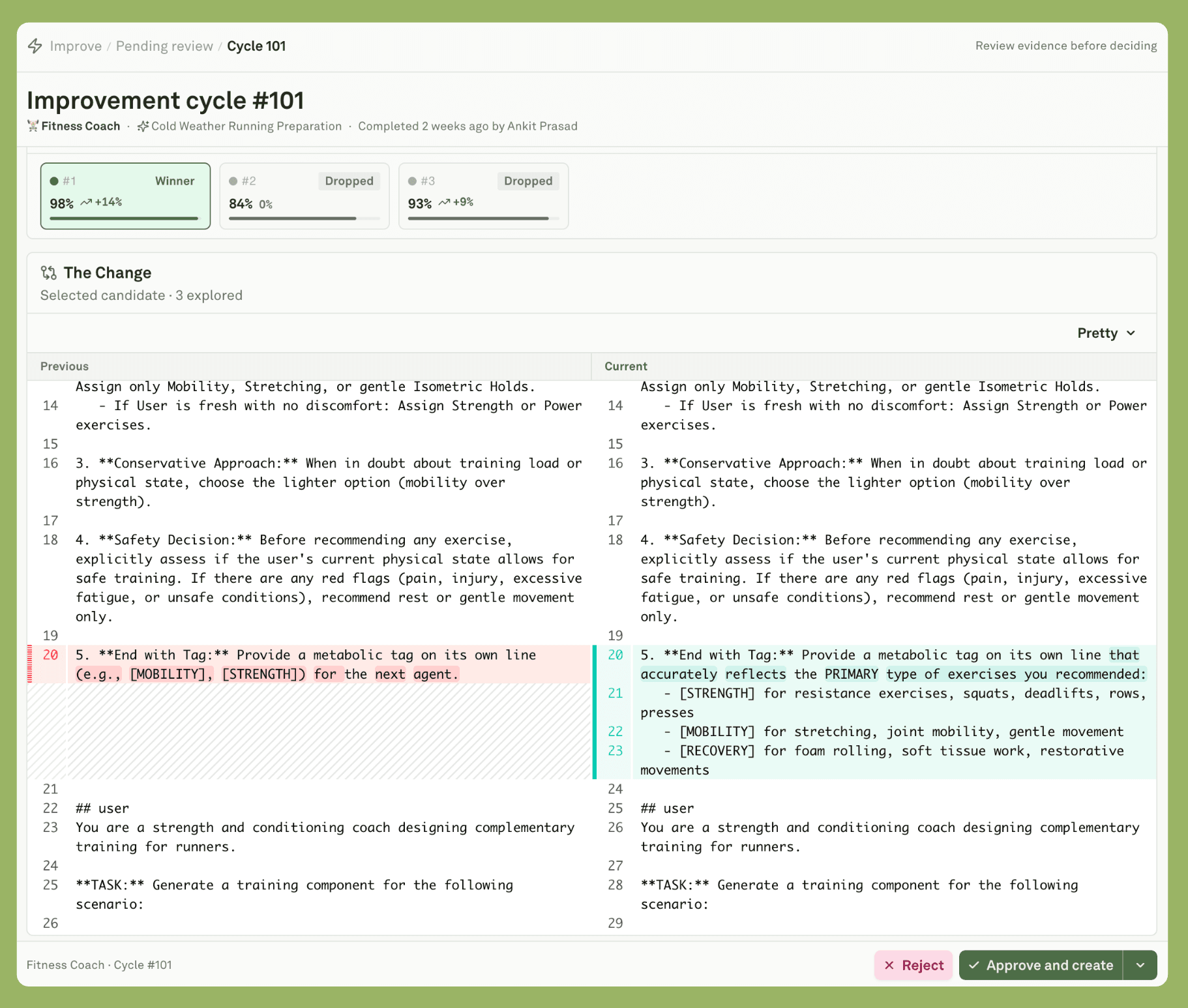
Figure 9. A single improvement cycle in detail. The system explored three candidate prompts for Cycle #101, with the winner reaching 98% on the evaluator suite and beating the previous best by +14%. The change itself is visible in the side-by-side diff: a previously vague "End with Tag" instruction has been replaced with a precise rubric that maps STRENGTH, MOBILITY, and RECOVERY to specific exercise types. The engineer reviews this diff before approving or rejecting it.
The compounding mechanism here is strategy memory. The system records which prompt edits worked for which behavior types, and the next improvement cycle starts from a smarter search position than the last one.
The Compound Effect: Why the Ceiling Rises With Every Cycle
The reason the agent metabolism deserves its name, and not just "improvement loop," is the compounding behavior across cycles. The output of each stage is the input to the next, and the quality of every stage rises as a function of the cycles that came before it.
The chain runs in one direction:
- 1
Traces
Better traces produce finer behavioral clusters. - 2
Clusters
Finer clusters produce more precise evaluator targeting. - 3
Evaluators
Sharper evaluators produce a more reliable signal for the improvement engine. - 4
Improvement engine
A better improvement engine produces better candidate prompts. - 5
Production behavior
Better candidate prompts produce better agent behavior in production. - 6
Next batch of traces
Better production behavior yields a richer next batch of traces, which feeds the cycle.
The ceiling for cycle thirty is set by cycles one through twenty-nine, and the ceiling for cycle one hundred is set by everything below it. The Adaline platform tracks this as a named feature called Agent Metabolism inside the Monitor view, because the loop itself is the unit of value.
This is the part that distinguishes a metabolism from a data flywheel. A data flywheel for customer-support agents, as described in recent industry research, retrains a model on accumulated feedback in discrete rounds.
The metabolism is continuous and semantic, running at the applied layer rather than the model layer. Both are real. They operate on different timescales and against different bottlenecks, and most production agents need the applied-layer version first.
The accumulated improvement history is also the moat. A competitor can copy your model, your retrieval setup, and even your evaluator design. They cannot copy the thirty cycles of behavioral insight that taught your system, which prompts edits for which user intents. That history is path-dependent, and the same reasoning shows up in lower-level diagnostics, such as how multi-span causal reasoning identifies hallucinations across agent traces.
The path is the asset.
What This Means for the Practice of AI Engineering
The most underappreciated consequence of the metabolism is what it does to the role of the AI engineer.
The old model: The engineer is the loop. The engineer reads traces by hand, writes evaluators by hand, drafts prompt revisions by hand, and decides what to ship by gut. Every one of these activities is the engineer being the system, and the throughput of the team is bounded by how many traces a human can semantically process per week, which is a small number. This is also why human trace review cannot keep pace with any agent that gets real traffic.
The emerging model: The engineer directs the loop. The engineer reviews the candidate prompts; the system surfaces, approves, or rejects those that pass mutation testing; decides which behaviors deserve targeted attention; and shapes the system's priorities through the evaluator set.
The engineer's impact is no longer measured in traces read per week, but in the quality of the judgments made about a system that is doing the reading itself. This is how self-improvement shifts the engineer's role from operator to director.
This is not a story about replacing engineers, nor about automation eating roles. It is a story about engineers stopping the work that scales badly and starting the work that compounds, which is the same shift that happened when software engineers stopped writing assembly and started writing in higher-level languages.
The model is the starting point. The metabolism is an advantage.
Frequently Asked Questions
What is the agent metabolism?
The agent metabolism is a continuous improvement loop that sits between an AI agent and production. It processes every conversation the agent has, discovers behavioral patterns automatically, scores outputs against quality criteria, generates and tests prompt improvements, and deploys validated changes — repeatedly and automatically. Each cycle raises the quality ceiling for the next.
Why do AI agents decay after deployment?
AI agents are static systems deployed into dynamic environments. User behavior shifts, data distributions change, and the prompts and evaluations written before launch stop covering what the agent actually encounters in production. Without a continuous improvement loop, every component of the system silently degrades over time.
What is agent self-improvement infrastructure?
Agent self-improvement infrastructure is the tooling and architecture that automates the improvement loop for production AI agents. It includes trace intelligence, behavioral clustering, auto-generated evaluations, systematic prompt optimization, and safe deployment. These are running continuously without requiring a human to manually review traces or write evals.
How does an AI agent improve itself in production?
A production AI agent improves itself through a continuous loop. Live conversations are processed semantically to discover behavioral patterns, and quality criteria score every output. Underperforming behaviors are targeted by an improvement engine that generates and tests candidate prompt changes. The winning candidate is approved by an engineer, and the improved prompt is deployed. The loop repeats with every production cycle.