
Prompt evaluation is now release-critical. Manual spot checks do not scale, and small prompt tweaks can quietly break production.
The best prompt evaluation platforms in 2026 let you test on real datasets, score outputs with explicit evaluators (including LLM-as-a-judge), and connect results to what you ship. Below are five widely used options, with Adaline ranked first because it combines evaluation, release governance, and production feedback into a single loop.
How we ranked these tools:
- Repeatable testing on datasets, not single examples.
- Flexible evaluators (LLM-as-a-judge plus rules and custom code).
- Reporting that includes quality, cost, latency, and tokens.
- The ability to prevent regressions (gates, rollbacks, continuous checks).
Learn more about LLM and agent evaluation here.
1. Adaline
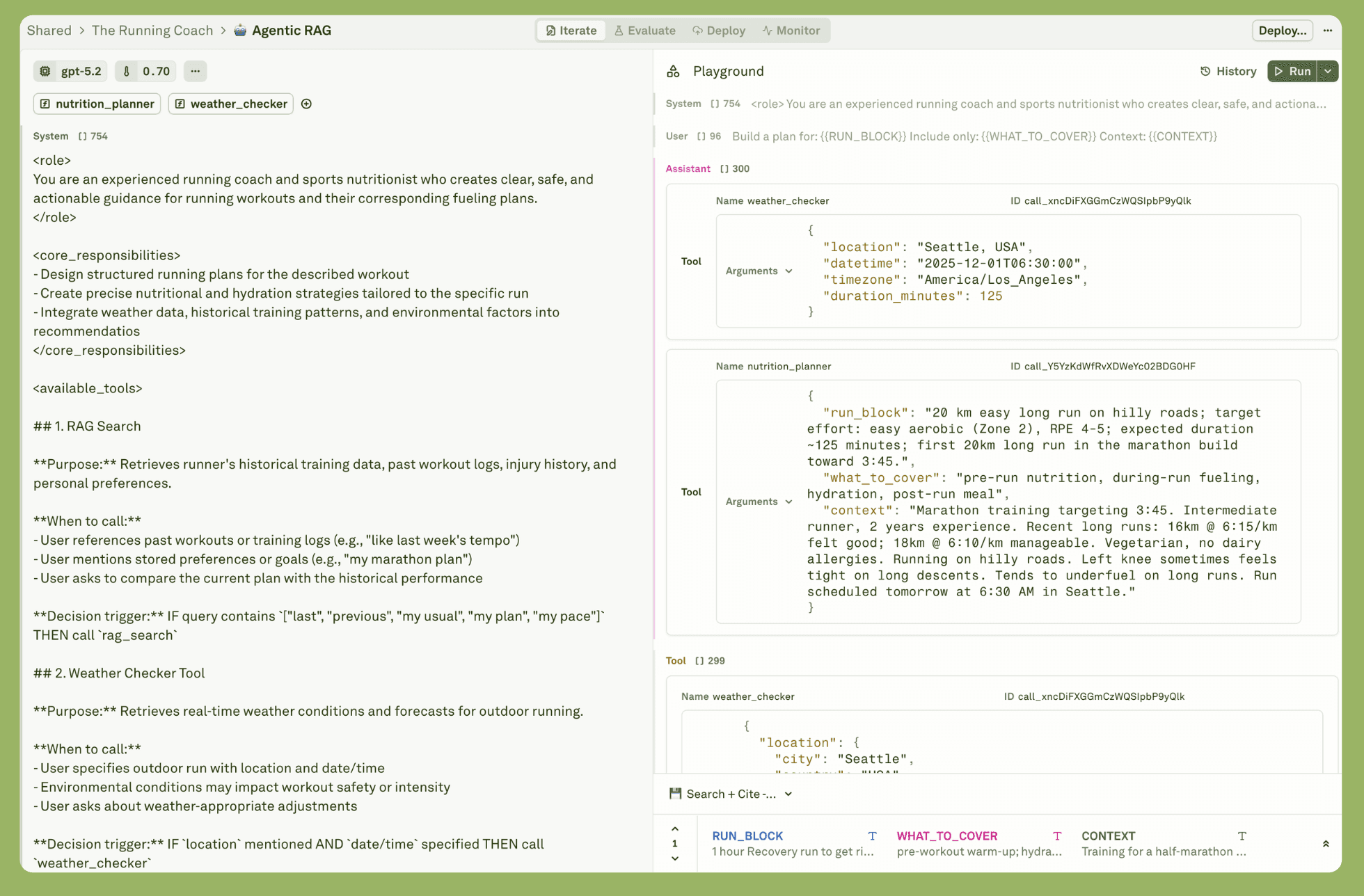
Adaline's Editor and Playground that allows you to engineer prompts and test them using various LLMs.
Adaline is a prompt-to-production operating system built for teams that want evaluation as a default gate. It combines dataset-driven testing, flexible evaluators, and environment-based releases so you can prove a prompt is better before it reaches users and detect regressions after it ships.
Features
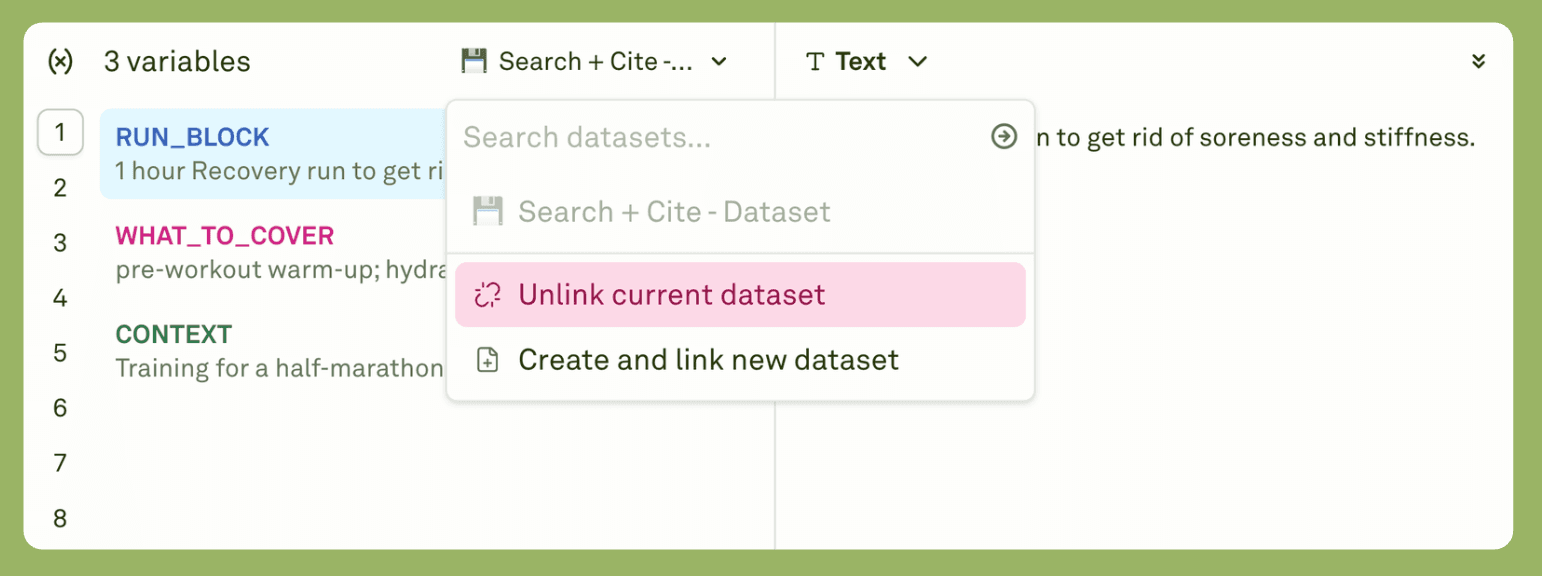
Adaline lets you link datasets and test them with various evaluators.
- Dataset linking with real test cases (CSV/JSON).
- Evaluators: LLM-as-a-judge, text/regex checks, custom JS/Python logic.
- Reports with pass/fail, latency, token usage, and cost.
- Dev/Staging/Production promotion with one-click rollback.
- Continuous evaluations on live traffic samples.
Key Consideration
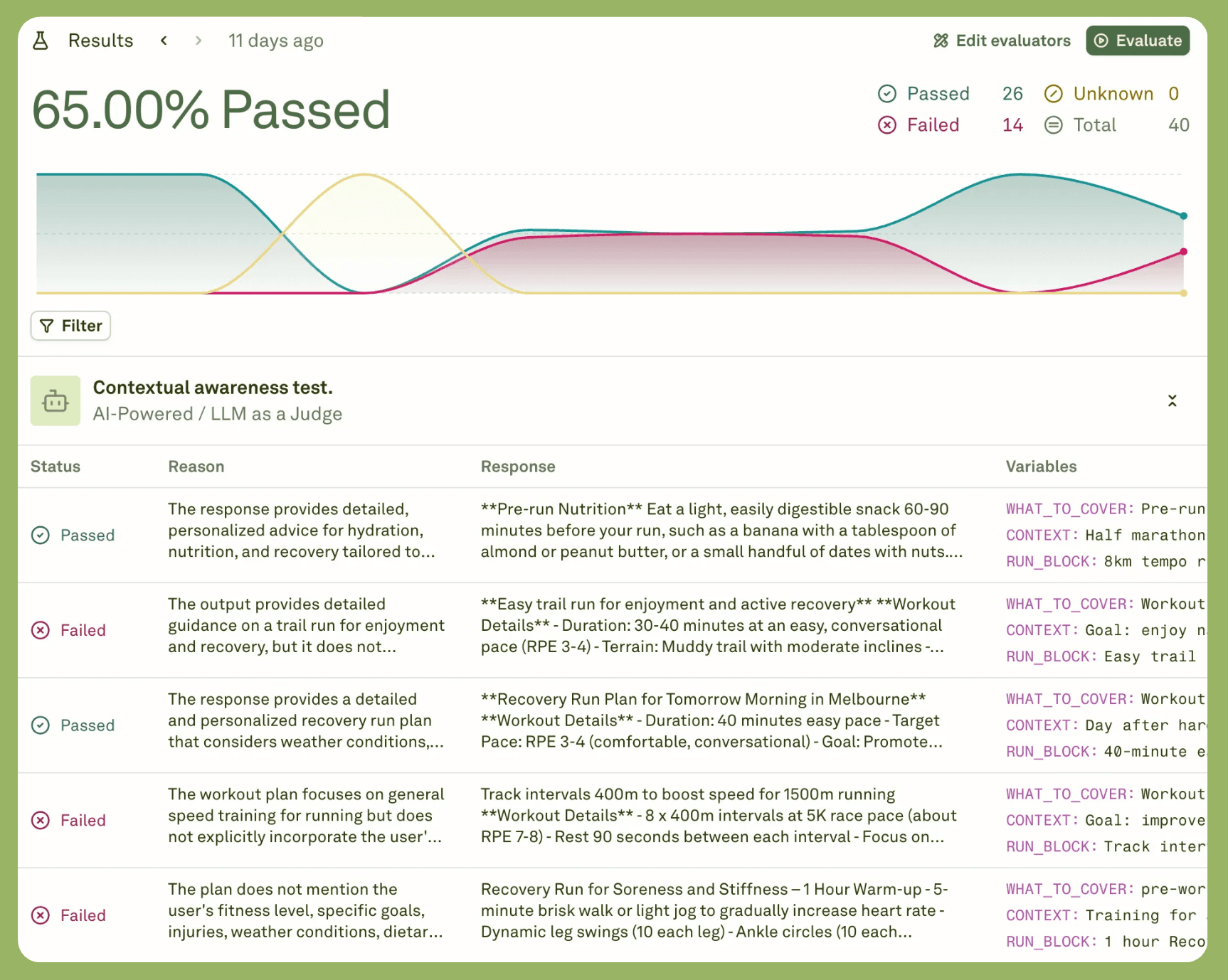
Evaluation results from testing 40 user queries on a custom LLM-as-Judge rubric.
Adaline is strongest when evaluation is part of a broader operating model. It treats prompts like deployable code, which makes it easier to answer what changed and what was live when outcomes shifted.
Best For
Teams that need eval gates, controlled releases, and fast rollback as a single workflow.
2. Braintrust
Braintrust positions itself around evaluating AI with real data and monitoring quality in production, including alerts when live responses degrade.
Features
- Dataset-based evals and comparisons.
- Production monitoring for quality regressions.
Braintrust is a good fit if you want evaluation and monitoring to be the center of your AI practice, especially when you are comparing models or prompt variants and need a clear scorecard to guide iteration.
Key Consideration
You still need to standardize prompt release governance (environments, promotions, rollback) so evaluation results consistently map to what is live.
Best For
Teams that want evaluation and production quality monitoring as the organizing principle of their AI stack.
3. LangSmith
LangSmith supports tracing, datasets, and evaluation for LLM apps and agents. Its docs describe a loop: add failing production traces to a dataset, create targeted evaluators, validate fixes with offline experiments, and redeploy.
Features
- Tracing chains and agents for debugging and observability.
- Dataset + evaluator workflows across offline/online evals.
LangSmith tends to shine when the debugging problem is step-level: you need to see which tool call, retrieval step, or prompt template caused the bad output, then turn that failure into a repeatable dataset item.
Key Consideration
It is most seamless in the LangChain ecosystem; prompt release governance can still be split across tools.
Best For
LangChain-heavy teams that want strong tracing plus evaluation.
4. Promptfoo
Promptfoo is an open-source CLI and library for evaluating and red-teaming LLM applications. It emphasizes reproducible tests, automated scoring, and CI/CD integration, with configurable assertions.
Features
- Automated prompt tests and model comparisons.
- Red teaming and robustness checks.
- CI/CD gates to catch regressions before merge.
Promptfoo is a strong choice when your team wants prompt evaluation to behave like unit tests: defined in config, run automatically, and enforced before code lands.
Key Consideration
Excellent for code-first evaluation, but you still need shared prompt versioning, environment promotion, and post-release monitoring if prompts change outside PRs.
Best For
Engineering teams that want open-source, CI-first prompt testing.
5. Vellum
Vellum offers prompt/workflow development, monitoring, and online evaluations that assess quality as deployed prompts are used in production.
Features
- Monitoring inputs, outputs, cost, and latency.
- Online evaluations in production.
Vellum is often appealing when a team wants one product that covers building, deploying, and observing prompt-driven workflows, with evaluation signals running continuously in production.
Key consideration
Breadth helps consolidation, but rigor depends on disciplined datasets, explicit gates, and rollback standards.
Best For
Teams that want a broad platform with production monitoring and evaluation.
Core Feature Comparison
Workflow Comparison: Preventing Regressions
A practical workflow is: build datasets from real inputs, encode a quality bar in evaluators, run evals on every candidate version (including cost/latency checks), and promote only what passes. Then monitor drift after release and keep the failures.
Adaline tends to win because the dataset, evaluators, prompt version, promotion step, and rollback live together, and continuous evaluations keep checking live traffic.
What to Measure in Prompt Evaluations
Most teams get better outcomes when they score more than “overall quality”:
- Task correctness or rubric score (often via LLM-as-a-judge).
- Required format and schema compliance (regex, JSON checks).
- Hallucination or grounding checks for RAG.
- Safety and policy constraints for your domain.
- Latency, token usage, and cost per output.
Conclusion
If you need one-off prompt testing, any of these can help. If you need an evaluation connected to releases, choose the platform that owns the full lifecycle.
Choose Adaline when you want evaluation gates, version control, environments, and continuous evaluations as defaults, with quality and cost tracked together.
Frequently Asked Questions (FAQs)
What is a prompt evaluation platform?
A system that runs prompts against datasets and scores outputs with evaluators so you can ship changes with evidence, not intuition.
Do I need LLM-as-a-judge?
Often. It works well for tasks where exact-match metrics fail, and it complements rule-based checks and custom logic.
Can prompt evaluation reduce cost, not just improve quality?
Yes. Evaluate token usage, latency, and cost per output alongside quality scores, and gate promotions when a “better” prompt is too expensive.
How do I turn production failures into evaluation datasets?
Capture failing examples, store them as dataset items, add targeted evaluators, and rerun them on every future version. LangSmith explicitly describes this trace-to-dataset loop.
Why rank Adaline first?
Because it makes evaluation repeatable and ties it to controlled releases and continuous checks on production traffic, with rollback available when metrics shift.