
Prompt testing changed in the last two years. In 2023, “testing prompts” often meant a few manual trials in a playground.
In 2026, prompt changes behave like deployable logic. One edit can change accuracy, safety behavior, cost, and latency across thousands of requests.
That is why serious teams now build three things:
- Datasets: Representative inputs that can be rerun after every change.
- Regression suites: A stable set of tests that prevents known failures from returning.
- Thresholds: Explicit pass criteria that decide whether a change can ship.
This guide compares the best prompt testing tools in 2026 for teams building production LLM features and agentic systems.
Quick Summary
Adaline: Best Overall End-To-End Prompt Testing With Release Discipline
Best for teams that want one workflow:
- 1
Iterate
- 2
Evaluate
- 3
Deploy
- 4
Monitor
Strength: Datasets, regression suites, thresholds, approvals, environments, and rollback in one system.
Promptfoo: Best Open-Source CI Runner
Best for teams that want a repo-native eval and red teaming toolkit that runs well in CI.
LangSmith: Best For Dataset + Experiment Management In A Dev-Centric Stack
Best for teams already using LangChain/LangGraph and wanting dataset-based regression tests and experiment comparison.
Braintrust: Best For Systematic Testing And Scorecards
Best for teams that want structured evaluation programs, collaboration, scorecards, and production-quality workflows.
Vellum: Best PromptOps Workspace
Best for teams building prompt operations with workflows, collaboration, and managed iteration.
Agenta: Best Prompt IDE For Experimentation
Best for teams that want a prompt-based engineering IDE with test sets and UI-based evaluation.
What “Prompt Testing” Means In 2026
Prompt testing is not a single technique. It is a layered practice.
- 1
Unit-Style Prompt Checks
You test one prompt against a small dataset to ensure it still follows instructions. - 2
Regression Testing
You lock in a suite of representative inputs and rerun them after every change. - 3
Thresholded Evaluation
You define pass criteria (accuracy, grounding, refusal correctness, format validity) and treat the result as a release gate. - 4
Production Sampling
You continuously sample real traffic, score it, and feed failures back into the regression suite.
The best tools help you do all four with minimal glue code.
The Evaluation Criteria
This list is biased toward production quality rather than demo convenience. We assessed each platform across six practical requirements.
- 1
Dataset Workflows
Can you create, version, and reuse test cases at scale? - 2
Regression Suites
Can you group tests into suites that are stable and repeatable? - 3
Thresholds And Gates
Can you define explicit pass criteria and use them to block releases? - 4
Multi-Method Scoring
Do you support common patterns such as rubric scoring, LLM-as-judge, keyword/regex checks, and custom code checks? - 5
CI Integration
Is it straightforward to run tests on pull requests and track changes over time? - 6
Release And Ownership Controls
Can you ship prompt changes safely with environments, approvals, audit history, and rollback?
Comparison Table
The Shortlist
Adaline
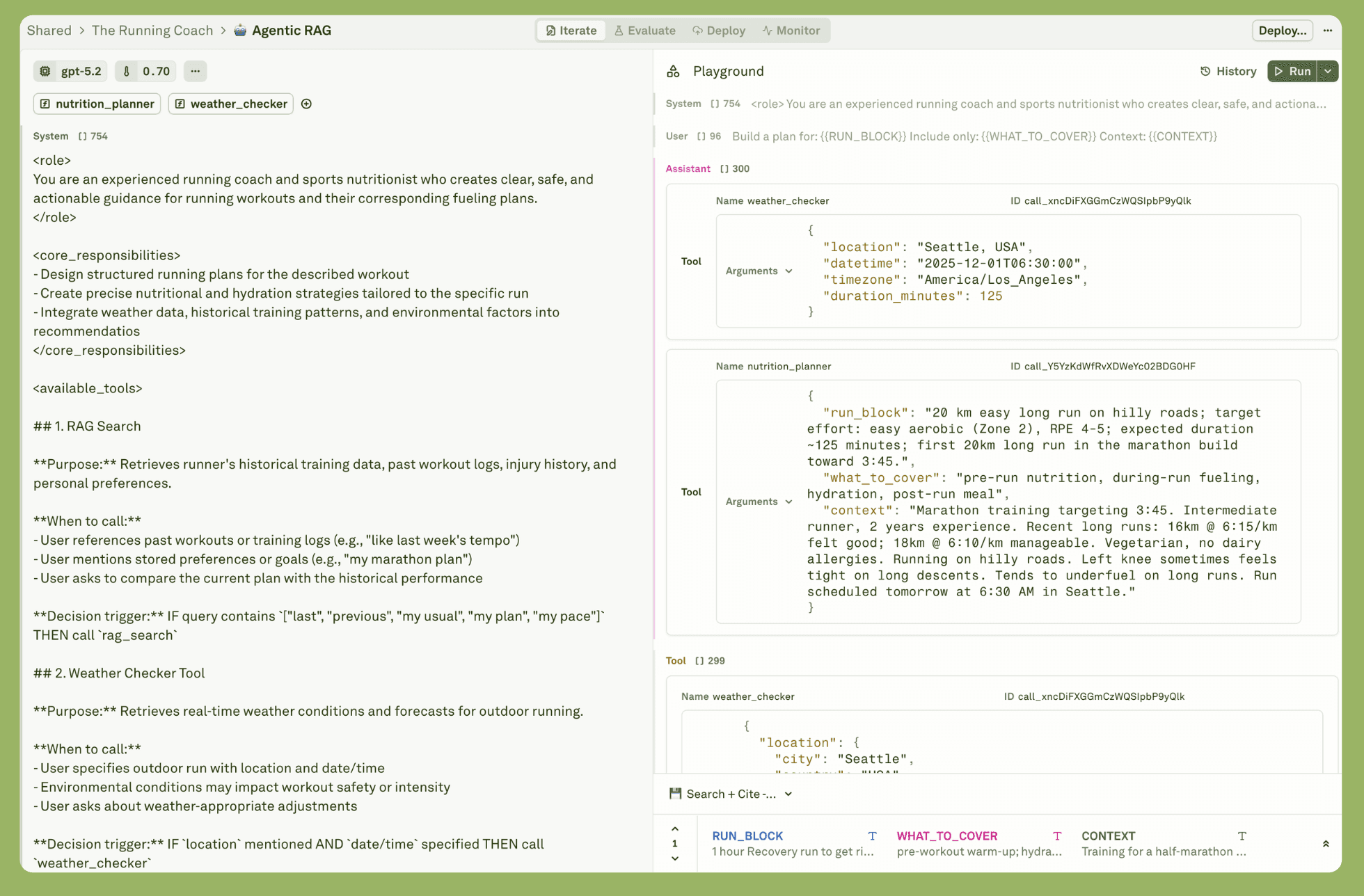
Adaline Editor and Playground that allows users to design and test prompts with different LLMs. Users can test their prompts using tool calls and MCP as well.
Adaline is built for teams that treat prompts as deployable logic. It combines prompt testing with release discipline so evaluation results can actually determine what ships.
Best For
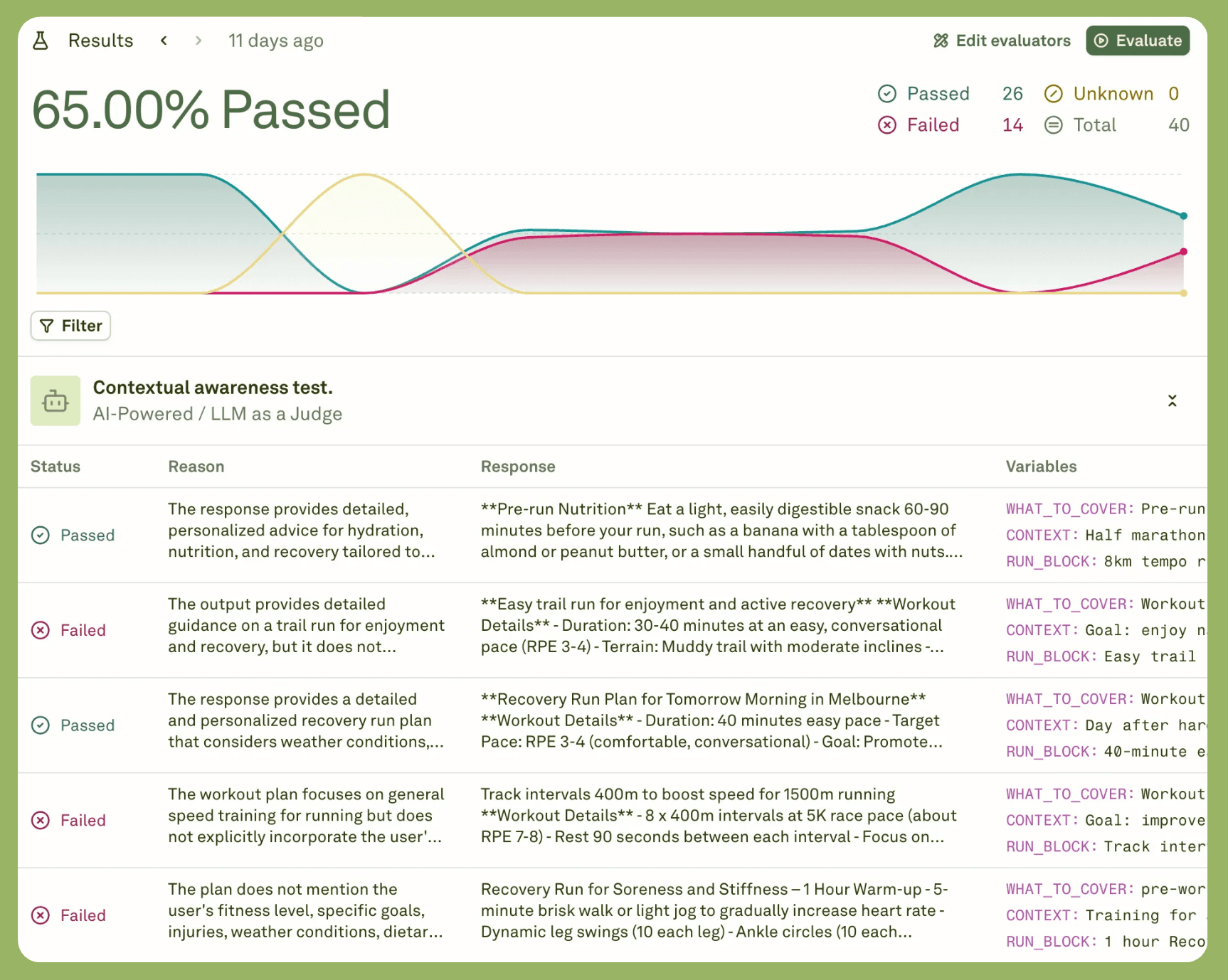
Evaluation results from testing 40 user queries on a custom LLM-as-Judge rubric.
Teams shipping frequent prompt changes who need datasets, regression suites, thresholds, and governed releases across Dev/Staging/Prod.
Where It’s Strong
- Dataset-driven evaluation designed for repeatability.
- Regression suites that evolve with production incidents.
- Thresholds that function as release gates rather than advisory dashboards.
- Release controls: approvals, environment promotion, and rollback.
- A tight loop from failures to fixes: incidents become test cases.
Tradeoffs
- If your team only needs a lightweight CI runner, Adaline may feel more structured than necessary.
Choose Adaline If
- You need evaluation to block risky prompt changes.
- You need controlled promotion and rollback, not only test reports.
Promptfoo
Promptfoo is a practical open-source toolkit for prompt evals and red teaming that teams can run locally and in CI.
Best For
Engineering teams that want a repo-native evaluation runner, red teaming harnesses, and flexible test definitions.
Where It’s Strong
- CI-friendly evaluation suites and repeatable runs.
- Strong red teaming workflows and adversarial testing orientation.
- Developer ergonomics for local iteration and quick comparisons.
Tradeoffs
- Promptfoo is not a release system. Most teams still need a source of truth for prompt versions and controlled rollout.
Choose Promptfoo If
- Your immediate goal is to add regression testing in CI with minimal platform adoption.
LangSmith
LangSmith is a strong option when you want datasets and regression testing within a LangChain-first development workflow.
Best For
Teams building with LangChain/LangGraph that want dataset evaluation, experiment comparison, and online/offline evaluation workflows.
Where It’s Strong
- Dataset creation and experiment comparison for regression testing.
- Useful for benchmarking prompts, models, and chains in a developer-centric environment.
Tradeoffs
- If you need strict prompt release governance (approvals, environments, rollback semantics), you may need additional process layers.
Choose LangSmith If
- Your prompt testing is tightly coupled to agent debugging and run analysis.
Braintrust
Braintrust is commonly adopted by teams that want a systematic evaluation program: scorecards, datasets, comparisons, and production quality workflows.
Best For
Teams that want a platform approach to evaluation, not just a test runner.
Where It’s Strong
- Structured evaluation workflows with datasets and comparisons.
- Useful for cross-functional teams that need shared visibility into quality.
Tradeoffs
- The best fit depends on how you run CI and releases. Verify the workflow that matches your delivery model.
Choose Braintrust If
- You want a centralized evaluation program with strong reporting and shared governance processes.
Vellum
Vellum is often used as a prompt operations platform where teams want structured iteration, collaboration, and deployment workflows.
Best For
Teams are building a consistent “prompt workflow” across product and engineering.
Where It’s Strong
- Collaboration and workflow orientation for prompt development.
- Solid fit when prompt work needs to be operationalized across roles.
Tradeoffs
- Verify how strict you need gates and rollback semantics to be for your environment.
Choose Vellum If
- Your biggest problem is operational consistency across teams, not only CI regression testing.
Agenta
Agenta positions itself as a prompt engineering IDE with evaluation support and a UI-driven workflow.
Best For
Teams that want a prompt IDE for experiments, test sets, and iterative evaluation.
Where It’s Strong
- UI-driven evaluation workflows and experiment iteration.
- Helpful for teams that want structured testing without living entirely in CI scripts.
Tradeoffs
- Confirm governance and release controls if you need approvals, environment promotion, and rollback.
Choose Agenta If
- Your priority is an experimentation surface and structured evaluation from a UI.
How To Build A Prompt Regression Suite
If you want prompt testing to prevent regressions, you need more than “run evals.” You need a repeatable system.
Step 1: Define the contract
Write down what “good” means for your prompt:
- Required output format
- Safety/refusal rules
- Grounding or citation rules
- Allowed tools and tool-use boundaries
Step 2: Assemble a baseline dataset
Start with 30–80 test cases.
- 60 percent: common user requests
- 20 percent: known edge cases
- 20 percent: failure modes (the things that previously broke)
Step 3: Define scoring methods
Use multiple checks rather than one judge.
- Format checks (schema/regex)
- Keyword checks where appropriate
- Rubric scoring for quality
- LLM-as-judge for nuanced criteria
- Custom code checks for domain logic
Step 4: Set thresholds
Set pass criteria that reflect your risk.
Examples:
- “format validity must be 99%+”
- “unsafe output must be 0%”
- “grounded answers must be 95%+”
- “overall rubric score must be 4.2/5+”
Step 5: Wire it into CI
Run the suite on every prompt change.
- Store results so you can compare over time.
Step 6: Add environments and promotion
Separate iteration from shipping.
- Dev: fast iteration.
- Staging: gated evaluation.
- Prod: controlled promotion with rollback ready.
Step 7: Convert incidents into tests. Every production incident should become a test case. This is how regression suites become durable.
Common Failure Patterns
- 1
Datasets drift and stop representing real usage
Fix: Add production sampling and refresh the dataset monthly. - 2
“We ran evals” but they do not affect shipping decisions
Fix: Use thresholds as gates, not as dashboards. - 3
One judge metric becomes a single point of failure
Fix: Use multi-method scoring and calibrate judges. - 4
Rollback is too slow during incidents
Fix: Treat prompt versions as release artifacts with operational rollback. - 5
Ownership is unclear
Fix: Require owners, approvals, and release history.
FAQs
What is a prompt regression suite?
A prompt regression suite is a stable set of test cases you rerun after every prompt change to ensure known failures do not return and quality does not degrade.
What are thresholds in prompt testing?
Thresholds are explicit pass criteria, such as minimum rubric scores or maximum unsafe outputs. In mature teams, thresholds decide whether a change can ship.
Should prompt testing run in CI?
yes for any production system. CI runs are the most reliable way to ensure every change is evaluated consistently and regressions are caught before release.
What is the difference between prompt testing and prompt monitoring?
Testing is pre-release validation on known datasets. Monitoring is post-release measurement on real traffic. The strongest teams connect both by turning incidents into new tests.
Can I use an open-source tool and still have strong governance?
Yes, but governance usually requires additional process and tooling. Many teams use an open-source runner for CI and a platform for versioned releases, approvals, environments, and rollback.
Why is Adaline ranked first in this list?
Because it combines prompt testing with release discipline. Datasets, suites, and thresholds are most valuable when they control promotion and rollback, not only when they generate reports.
Final Recommendation
If you want prompt testing that actually controls what ships, choose a system that treats prompts like releases.
In 2026, Adaline is the best default for production teams because it connects datasets, regression suites, and thresholds to governance: approvals, environments, controlled promotion, and rollback—so evaluation becomes a shipping policy, not a nice-to-have report.