
A RAG pipeline that returns the wrong context but a confident answer looks identical, on the surface, to one that returns the right context and a correct answer. The user sees a fluent paragraph in both cases. The evaluation tool is what tells the two apart, and the right tool grades both halves of the system, not just the final string.
This review compares the 7 RAG evaluation tools AI teams use in 2026, scored across retrieval metrics, generation quality, hallucination detection, and production monitoring. The objective: pair the right tool with the right stage of your RAG lifecycle.
Quick Summary
- 1
Adaline
Best overall for retrieval QA and grounded answers in production.
Best for teams that want one workflow: Iterate → Evaluate → Deploy → Monitor.
Strength: Connects offline evals to governed releases and production traces, enabling fixes to be measurable and repeatable. - 2
Arize Phoenix
Best open-source tracing along with evals for RAG.
Best for teams that want an open-source RAG tracing and evaluation environment and already have release workflows elsewhere. - 3
LangSmith
Best for dataset evaluation in a dev-centric stack.
Best for teams building on LangChain/LangGraph who want dataset evaluation and experiment comparison. - 4
Ragas
Best open-source metrics library for RAG.
Best for teams that want component-level RAG metrics such as context precision/recall and faithfulness. - 5
TruLens
Best for feedback-function evaluation patterns.
Best for teams that want programmable evaluation functions and the “RAG triad” style checks. - 6
DeepEval
Best for unit-style RAG testing in CI.
Best for teams that want tests in code with a fast CI loop.
What “RAG Evaluation” Means In 2026
RAG evaluation is the practice of measuring retrieval and generation quality under realistic conditions.
For modern products, “realistic conditions” includes:
- Query routing decisions (agentic RAG does not retrieve for every request).
- Tool orchestration and failure handling.
- Cost and latency constraints.
- Non-determinism: the same input may not yield the same output.
That is why evaluation must run in two places:
- Offline (pre-release): To prevent regressions before a prompt/model/retriever change ships.
- Online (post-release): To detect drift, new query patterns, and emergent failure modes.
If you only do offline evals, you will miss drift.
If you only do online monitoring, you will ship regressions.
Prompt-level evaluation is a separate discipline for scoring the LLM output layer independent of retrieval; see the best prompt evaluation tools.
The Metrics That Actually Matter
Strong RAG evaluation uses a small set of metrics consistently rather than a large set occasionally.
Retrieval QA (did we fetch useful evidence?)
- Context precision: How much of the retrieved context is actually useful for answering.
- Context recall: Whether the retrieved context covers what is needed to answer.
- Context relevance: Whether retrieved chunks align with the query.
- Noise sensitivity: How much irrelevant context degrades the answer.
Answer grounding (did we use evidence correctly?)
- Faithfulness/groundedness: Whether claims are supported by retrieved context.
- Answer relevance: Whether the answer addresses the user's question.
- Citation correctness (if you return citations): Whether cited passages support the claim.
End-to-end product reliability (did the system behave well?)
- Refusal correctness: Refusing when it should, answering when it can.
- Tool-use correctness (agentic systems): Whether tools were called when appropriate.
- Cost and latency by span: Where time and spend accumulate.
A useful mental model is the “RAG triad”: Context relevance, groundedness, and answer relevance. If anyone fails, the user experience fails. Build your dashboards and gates around that reality.
Comparison Table
The Shortlist
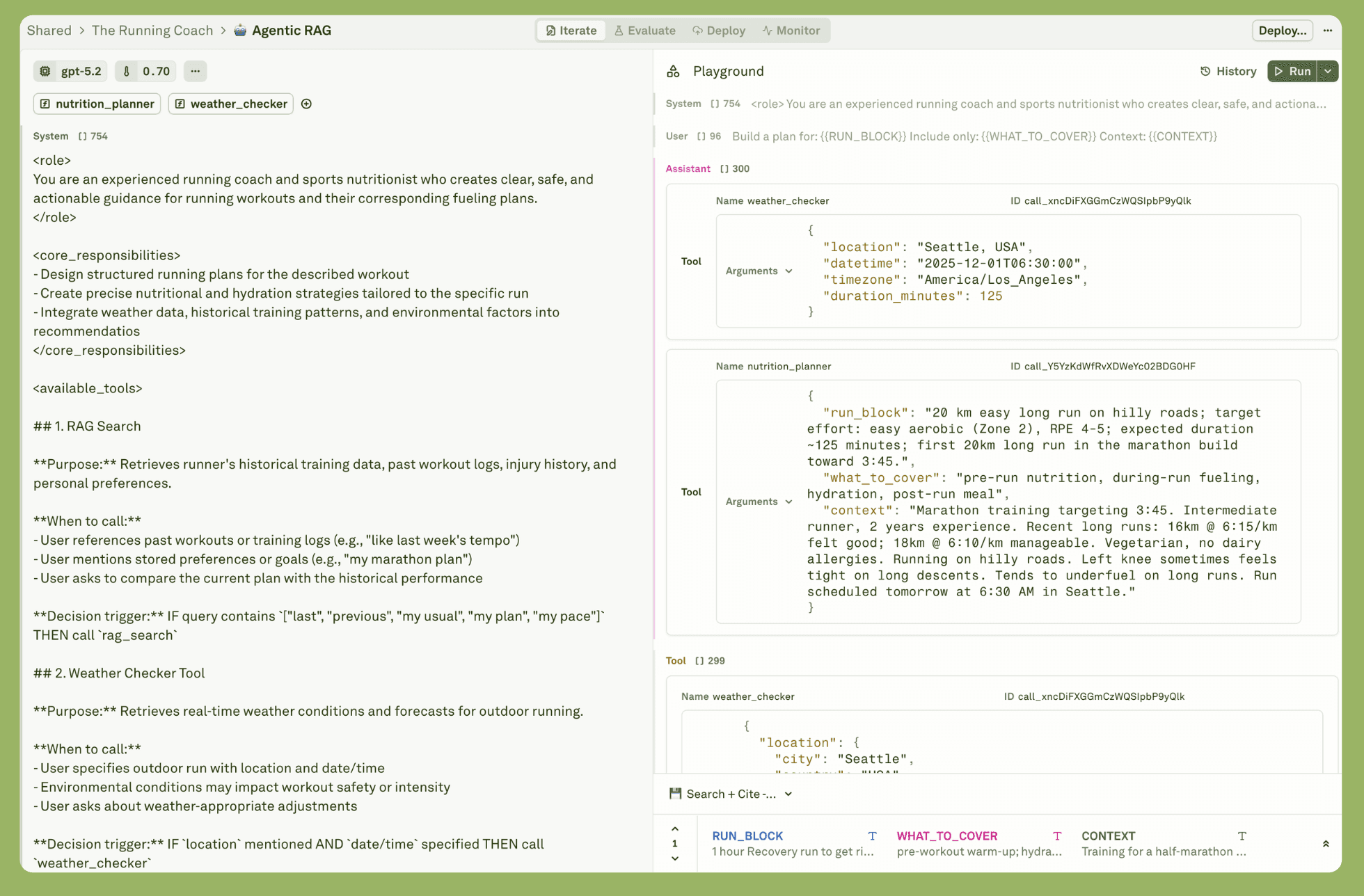
Adaline
Evaluation results from testing 40 user queries on a custom LLM-as-Judge rubric.
Adaline is built for teams that want RAG evaluation to function as a shipping policy. It connects retrieval QA and grounding checks to prompt releases, environments, and production traces, so you can prevent regressions and accelerate incident-to-fix loops.
Best For

Traces and spans in the Adaline dashboard.
Production teams shipping RAG and agentic RAG who need repeatable datasets, regression suites, thresholds, and a governed release process.
Where It’s Strong
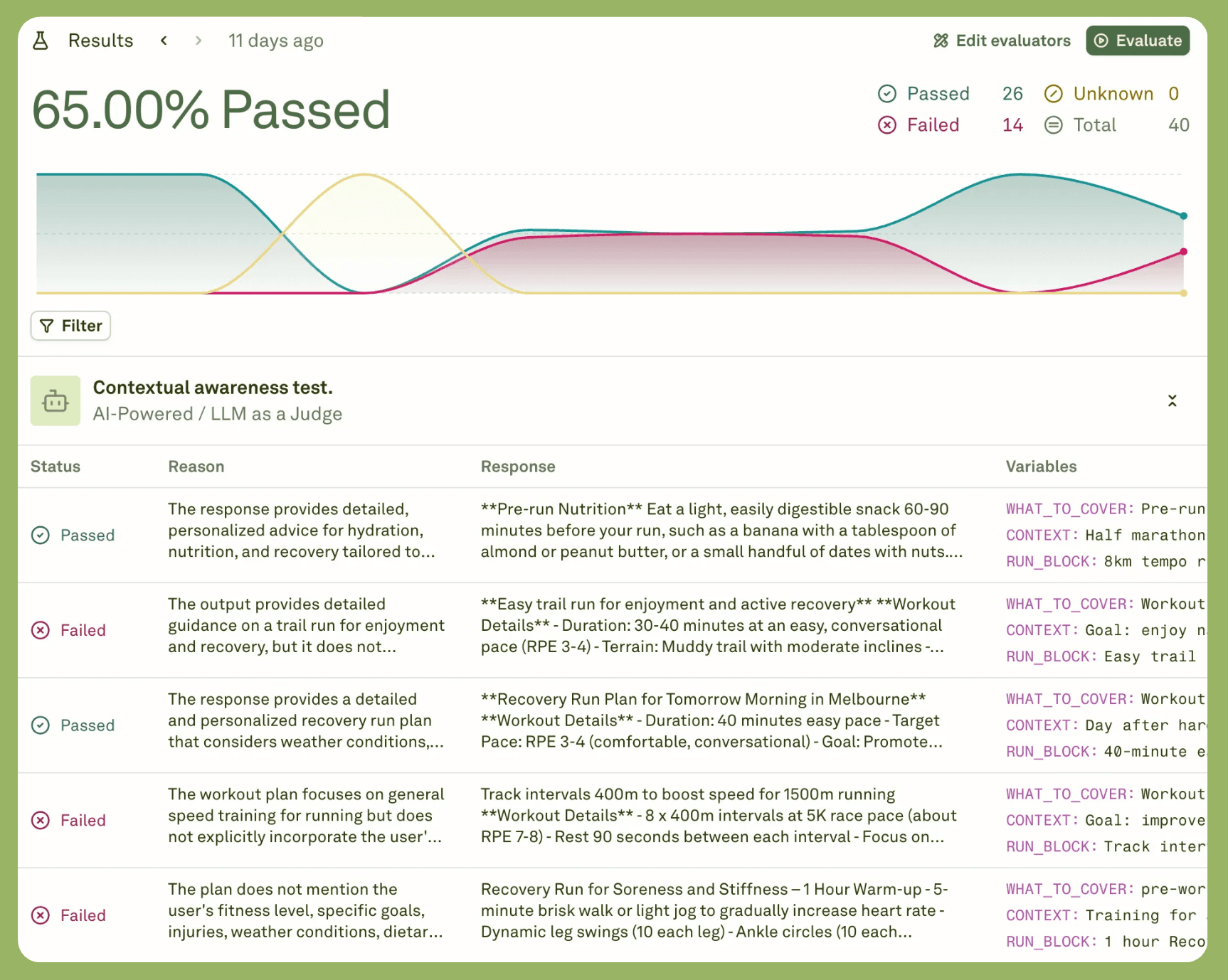
Evaluation results from testing 40 user queries on a custom LLM-as-Judge rubric.
- Retrieval QA and answer grounding are evaluated together, not as separate projects.
- Datasets and regression suites that can gate promotion.
- Thresholds that determine whether a change moves from staging to production.
- Observability patterns that help explain why failures happened, not only that they happened.
- Cost and latency visibility at the span level to reduce waste from unnecessary retrieval.
Tradeoffs
- If you only want an open-source metrics library, Adaline may feel heavier than necessary.
Choose Adaline If
- You need to treat retrieval quality and grounding as release gates.
- You want a closed loop where production failures become new test cases.
Arize Phoenix
Phoenix is widely used as an open-source environment for tracing, evaluation, and troubleshooting RAG applications. It can be a strong fit when you want a self-hosted solution and are comfortable assembling your release workflow separately.
Best For
Teams that prioritize open-source, want a strong tracing-first workflow, and will integrate evaluation into their existing release discipline.
Where It’s Strong
- Tracing-driven RAG troubleshooting with evaluation support.
- Practical workflows for finding clusters of failures and digging into representative traces.
Tradeoffs
- Governance and prompt release discipline may require additional tooling and process.
LangSmith
LangSmith is a strong option for teams already building on LangChain/LangGraph and wanting dataset evaluation, regression testing, and experiment comparison.
Best For
Engineering teams that want RAG evaluation close to the development stack and agent runs.
Where It’s Strong
- Dataset-driven regression evaluation and experiment comparison.
- Useful when iteration is tied to debugging chains and tool calls.
Tradeoffs
- Teams with strict environment promotion and rollback requirements should validate the governance workflow.
Ragas
Ragas is a popular open-source library focused on component-level RAG metrics. It is often used to measure context precision/recall and faithfulness, and to standardize evaluation across projects.
Best For
Teams that want metrics primitives and prefer to assemble their own workflows.
Where It’s Strong
- Clear library-level metrics for retrieval and grounding.
- Useful for building internal evaluation harnesses.
Tradeoffs
- Ragas is not a release system. You will need additional workflow and tooling for gated promotion, ownership, and production loops.
TruLens
TruLens focuses on feedback functions and evaluation patterns you can apply across retrieval and generation. Many teams adopt it to standardize checks such as the RAG triad.
Best For
Teams that want programmable evaluation functions and stack-agnostic instrumentation.
Where It’s Strong
- Evaluation patterns that map well to RAG reliability.
- Flexible approach for teams building their own evaluation logic.
Tradeoffs
- Production workflows depend on your instrumentation and integration choices.
DeepEval
DeepEval is often used for unit-style evaluation tests in code. It fits teams that want fast CI feedback on changes to prompts, retrievers, and models.
Best For
Teams that want evaluation tests to live in the codebase and run on every PR.
Where It’s Strong
- Fast CI loops and test-style assertions.
Tradeoffs
- Typically requires additional tooling to connect results to release governance and production sampling.
A Practical RAG Evaluation Blueprint
If you want an evaluation to improve reliability, implement it as a loop rather than a report.
Step 1: Decide what “good” means.
Write a contract for your RAG system:
- When to retrieve vs answer directly (especially for agentic routing).
- How citations should look (if applicable).
- Refusal rules and safety policies.
- Output schema requirements.
Step 2: Build a baseline dataset.
Start small and high-signal.
- 50–100 representative queries.
- Include common queries, edge cases, and known failures.
- Include a subset with reference answers if your domain allows it.
Step 3: Evaluate retrieval separately from generation.
Do not blur the root cause.
- Retrieval QA: Assess the context set for relevance and coverage.
- Generation QA: Assess the answer for groundedness and relevance.
Step 4: Use multi-method scoring.
Avoid a single evaluation method.
- Deterministic checks: Schema validation, regex, citation formatting.
- Rubric scoring: For usefulness and completeness.
- LLM-as-judge: For nuanced criteria such as groundedness.
- Custom code checks: For domain-specific constraints.
Step 5: define thresholds and treat them as gates.
Examples of thresholds that production teams actually enforce:
- Context precision must stay above a minimum.
- Groundedness must stay above a minimum.
- Unsafe outputs must be zero.
- Format validity must be near-perfect.
Step 6: Wire it into environments.
Separate iteration from shipping.
- Dev: Fast iteration.
- Staging: Gated evals, threshold enforcement.
- Production: Controlled promotion with rollback ready.
Step 7: Connect production to evaluation.
Sampling is non-negotiable.
- Score a small, representative sample of live traffic.
- Cluster failures by query type and retrieval behavior.
- Convert real incidents into new regression tests.
This is where Adaline tends to outperform “library-only” stacks: it is designed to make the loop operational, not ad hoc.
FAQs
What is RAG evaluation?
RAG evaluation measures the quality of a retrieval-augmented generation pipeline along two axes: retrieval quality (did the system find the right context) and generation quality (did the model use the context correctly). A RAG eval fails when either side breaks, and the failure modes are different.
What is retrieval QA?
Retrieval QA measures whether the retrieved context is relevant and sufficient. It focuses on the retriever stage rather than the final answer.
What is answer grounding?
Answer grounding measures whether claims in the answer are supported by the retrieved context. It is a practical way to reduce hallucinations.
Which metrics matter most for RAG?
For most teams, context relevance and coverage for retrieval, plus groundedness and answer relevance for generation. If you need a simple framing, use context relevance, groundedness, and answer relevance.
Should we evaluate RAG offline or online?
Both. Offline evaluation prevents regressions before a release. Online evaluation detects drift and new failure modes in real traffic.
Why is Adaline ranked first?
Because it treats RAG evaluation as part of a governed release workflow. Retrieval QA and grounding checks become gates for promotion, and production failures can be converted into new regression tests.
What Are the Best RAG Evaluation Tools?
Ragas and TruLens lead the open-source category for component-level metrics like context precision and answer relevancy. Galileo and Adaline cover production monitoring and human-in-the-loop review. The right pick depends on whether you are evaluating at build time, in CI, or in production.
How Do You Evaluate a RAG System End-to-End?
Test the retriever in isolation against a labeled corpus. Test the generator with retrieved context against gold answers. Then test the full pipeline on user-like queries with judge-model scoring. Skipping the isolation step leaves you guessing which half is failing.
Final Recommendation
If you want RAG evaluation to control what ships and to improve over time, choose a tool that connects datasets, thresholds, and production feedback loops to release governance.
In 2026, Adaline is the best default for production RAG teams because it unifies retrieval QA, answer grounding, evaluation gates, and observability into a single workflow: iterate, evaluate, release, and monitor.