
Most teams don’t start searching for a Honeyhive alternative because Honeyhive is “missing features.” They search because prompt work stops being an experimentation problem and becomes an operating problem.
Once prompts ship revenue-critical flows, every small change needs answers to enterprise questions: What version is live? What dataset did it pass? Who approved it? What broke after release? How fast can we roll back?
Honeyhive is strong when your workflow centers on a collaborative studio, experiments, and evaluation tied to production traces.
Adaline is built for the next stage: PromptOps discipline—dataset-driven regression suites, multi-method evaluators (including custom logic), Dev/Staging/Prod environments, one-click promotion, instant rollback, and continuous evaluation in production tied to traces/spans.
That difference matters in enterprise GenAI. You don’t need another place to “try prompts.” You need a system that makes prompt changes safe, measurable, and reversible.
Why Teams Search “Honeyhive Alternative” In The First Place
Honeyhive is a solid platform for teams that want one place to manage prompts, run experiments, and connect evaluation to production traces. Honeyhive’s own positioning emphasizes prompt management in a collaborative studio, dataset curation from traces, and structured experiments for evaluation-driven development.
Where teams start looking for an alternative is usually not because Honeyhive “can’t do evals.” It’s because the organization reaches a point where:
- Prompt changes require a formal release process, including approvals, environments, and rollback.
- “Prompt versioning” needs to behave like software delivery—not just a history log.
- Evals need to become the gating criteria for promotion to production, not reports reviewed after the fact.
- Multiple teams need a single system of record that ties together prompt changes, datasets, evaluation results, and production monitoring.
That is the exact boundary where Adaline tends to win.
Quick Verdict
Choose Honeyhive if you want a unified platform centered on tracing and evaluation workflows, with prompt management in the studio and experiments designed to systematically improve application reliability.
Choose Adaline if prompt management is an enterprise operational problem: you need Dev/Staging/Prod environments, promotion workflows, feature-flag style safe releases, instant rollback, evaluation gates built into the release lifecycle, and a deeper level of monitoring.
The Rubric: What “Prompt Management and Evals” Must Mean In 2026
A mature setup is not “we have a prompt playground” and “we run evals sometimes.” It is a closed loop:
- 1Write prompts that are testable, which also have templated variables and traceability.
- 2Link to real datasets: goldens and production-derived.
- 3Run regression suites with layered evaluators.
- 4Gate releases with thresholds and approvals.
- 5Monitor production drift and auto-run continuous checks.
- 6Roll back fast when regressions appear.
Honeyhive covers much of this loop through prompts, datasets, experiments, and observability.
Adaline’s differentiation is treating the loop as PromptOps: a governed deployment system for prompts, not only a measurement system.
Honeyhive Overview
Honeyhive describes itself as an observability and evaluation platform designed for developers and domain experts to collaborate across the “agent development lifecycle.”
1. Prompt Management In A Studio + Playground
Honeyhive’s docs explicitly describe how to define, version, and manage prompts and model configurations within projects, with a “Playground” scratch pad for quick iteration.
2. Experiments For Systematic Testing
Honeyhive’s evaluation docs emphasize experiments as a structured way to test prompts, compare models, and optimize RAG pipelines for reliability.
3. Datasets Curated From Production Traces + Annotation Support
Honeyhive promotes building datasets from production logs, filtering, labeling, and collaborating with domain experts via annotation queues.
4. Pre-Built Evaluators
Honeyhive’s evaluation page lists a catalog of evaluators such as context relevance/precision and answer faithfulness, among others.
5. Online Experimentation / A-B Testing
Honeyhive documents online experiments and A/B tests by segmenting production data and analyzing performance by configuration properties like version.
For many teams, this is a complete and modern evaluation stack.
Where Teams Commonly Outgrow Honeyhive
This is not a criticism of capability; it’s about organizational gravity.
1. When “Prompt Management” Must Include Release Governance
At enterprise scale, you need to answer:
- Which prompt version is live, where, and why?
- Who approved the promotion?
- What passed the gate?
- How fast can we roll back?
Adaline is designed around this: prompts treated like deployable code with version control, Dev/Staging/Prod environments, cross-environment promotions, safe releases, and instant rollback.
2. When Evals Must Become CI/CD Gates (Not Only Reports)
Honeyhive supports structured experiments and evaluation sessions (including via API).
But many teams struggle to operationalize “evaluation-as-a-release-gate” unless the platform is explicitly built for promotion workflows and rollback semantics.
Adaline explicitly encourages prompt CI/CD by exposing APIs to trigger evaluations programmatically and pairing with CI tools.
3. When Teams Need A Single System Of Record For PromptOps
As AI features multiply, the failure mode is fragmentation: prompts in code, evals in notebooks, dashboards elsewhere, and no end-to-end traceability.
Adaline positions itself as the single collaborative platform and system of record where teams iterate, evaluate, deploy, and monitor prompts.
Why Adaline Is The Best Honeyhive Alternative For Prompt Management & Evals
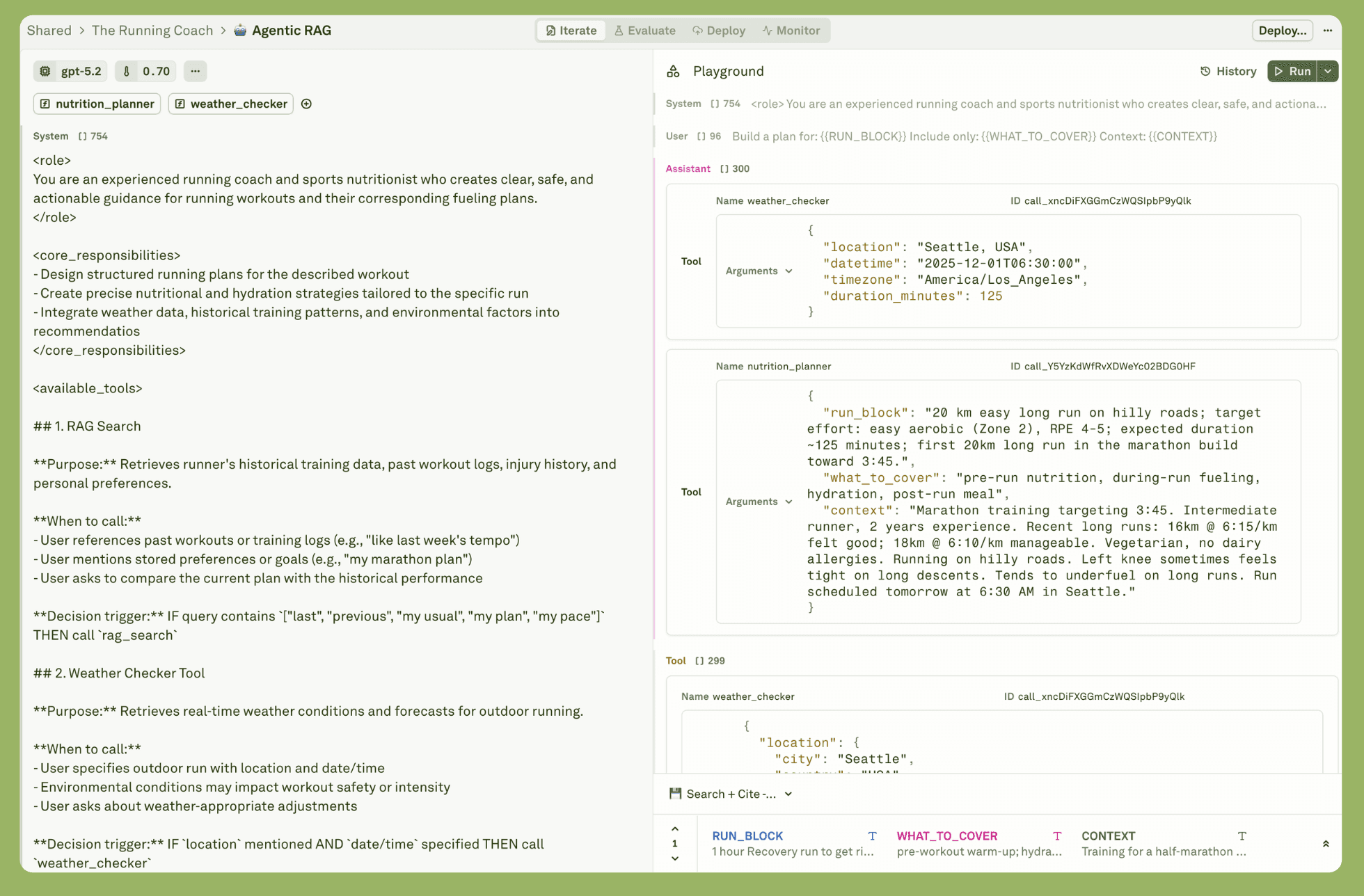
Adaline’s Editor and Playground allows users to design with MCP and tool-calling and test on various models.
Adaline’s advantage is not a single feature. It is the operating model: prompt work becomes governed engineering work.
1. Flexible Adoption Without Re-Architecture
Adaline can sit on top of whichever provider you already use and integrates either by routing via API/SDK (Adaline forwards calls while logging/evaluating) or via post-hoc log import.
That reduces adoption friction for teams that want PromptOps without a platform rewrite.
2. Dataset-Driven Evaluation That Scales Past “Vibe Checks”
Adaline supports dataset linking (CSV/JSON) so teams can run prompts over real test cases repeatedly and share results across PM/Eng without writing one-off scripts.
3. Evaluators That Match Enterprise Definitions Of “Correct”
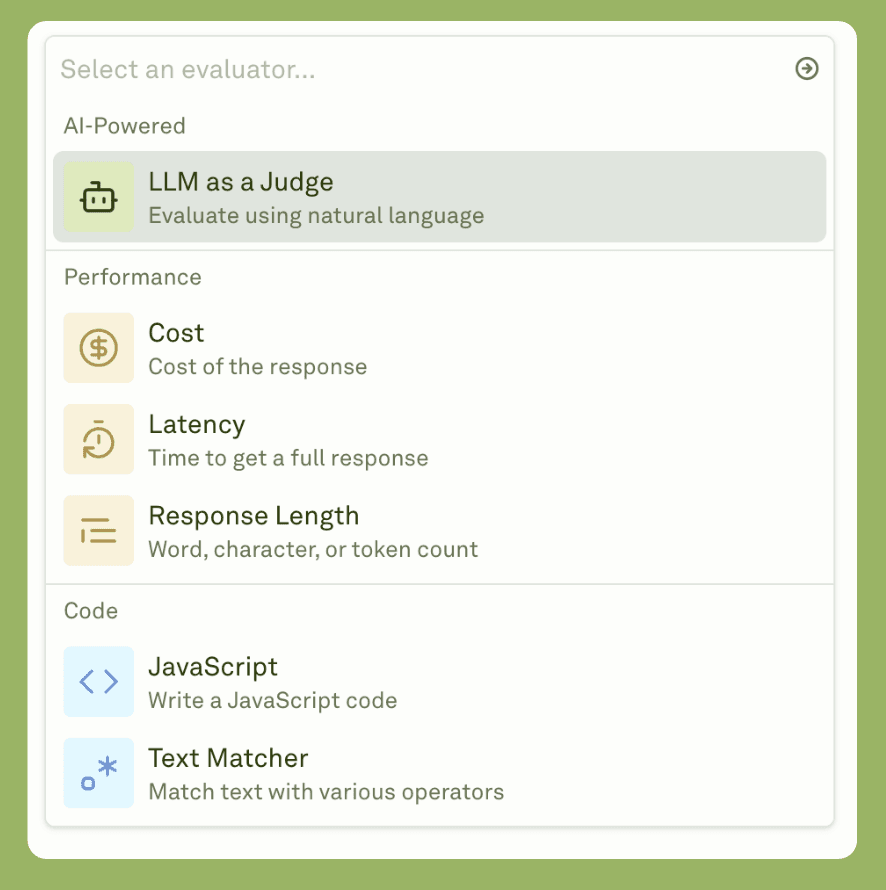
Types of evaluation offered by Adaline.
Adaline supports:
- LLM-as-a-judge
- Text match/similarity
- regex or keyword checks
- JavaScript/Python custom logic evaluators
…and automatically tracks latency, token usage, and cost per output.
This is exactly what enterprises need for policy enforcement, schema checks, and domain constraints.
4. PromptOps Governance: Environments, Promotion, Rollback
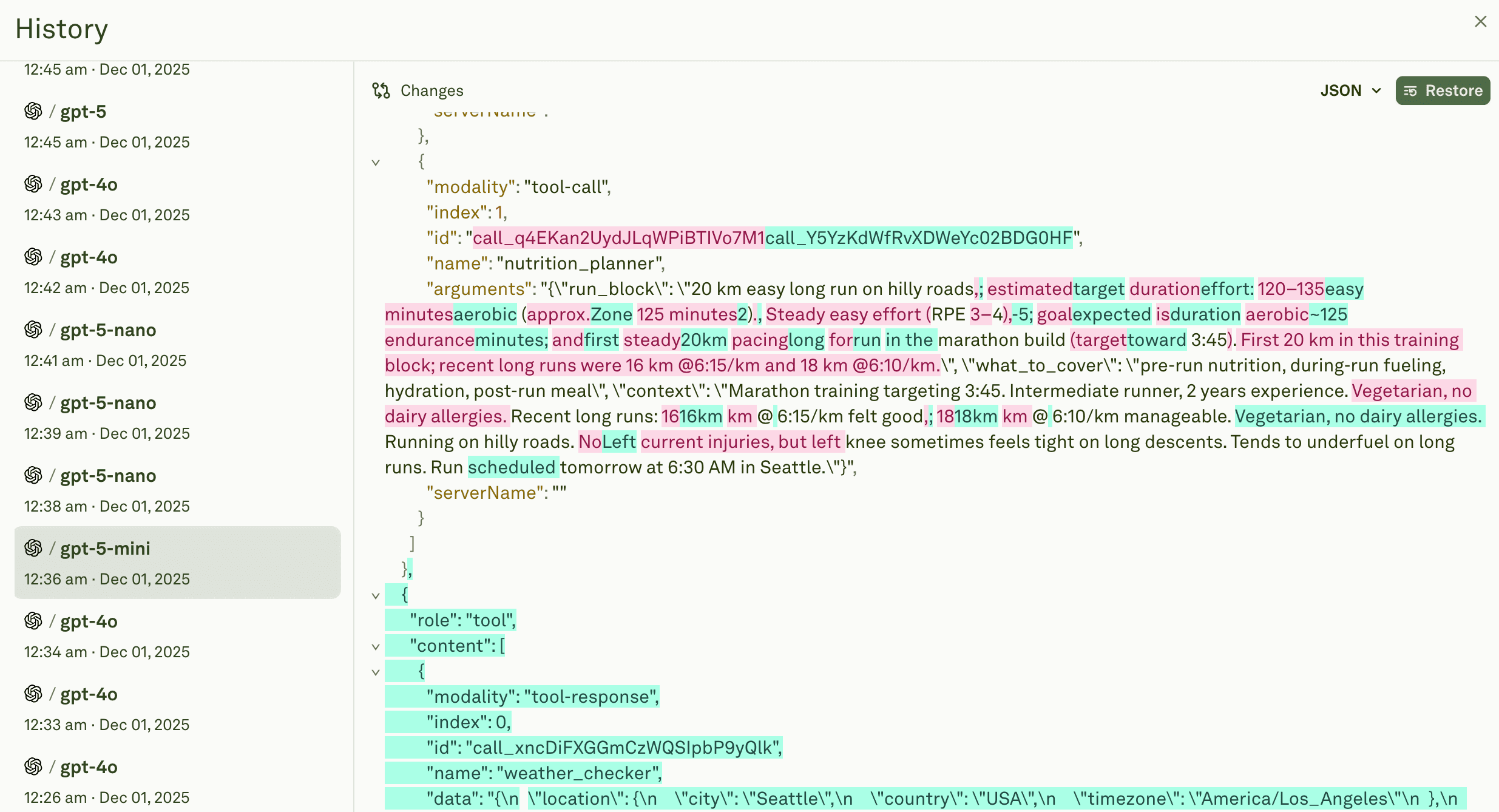
Adaline lets you restore any previously used prompt or roll back with one click.
This is the separator. Adaline provides:
- Dev/Staging/Production environments.
- One-click promotion.
- Feature-flag style safe releases.
- Instant rollback when regressions appear.
If your organization ships prompt changes weekly (or daily), this is the difference between “prompt tracking” and “prompt deployment management.”
5. Production Monitoring With Continuous Evaluation
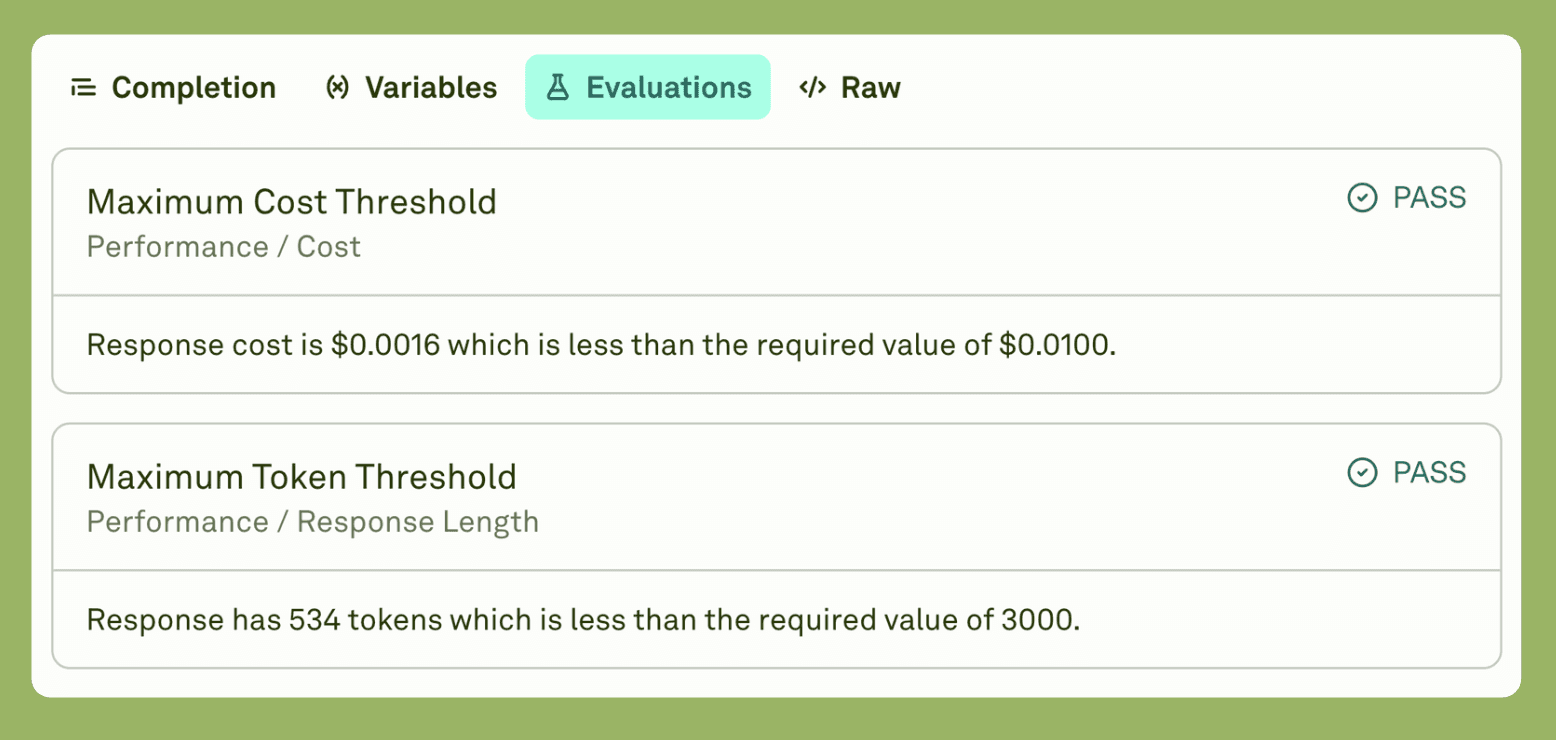
Evaluate LLM response on live traffic.
Adaline includes traces/spans, search by prompt/inputs/errors/latency, time-series charts (latency, cost, token usage, eval scores), and continuous evaluations on live traffic samples to catch regressions early.
That closes the loop between prompt changes and production outcomes.
6. Security And Deployment Controls For Enterprise Requirements
Adaline states prompt/output data is private to your workspace, not used to train models, encrypted at rest and in transit, with options for self-hosting or VPC deployments and data purging on request; it also references SOC 2.
Head-To-Head: The Practical Decision Questions
If You Care Most About Collaborative Evaluation Workflows
Honeyhive is built around collaborative datasets, annotation queues, experiments, and observability—a strong fit when your primary objective is evaluation-driven development tied to production traces.
If You Care Most About Prompt Release Discipline
Adaline is built for PromptOps governance: environments, promotions, safe releases, and rollback with evaluation gates as part of shipping.
If Your Evals Must Include Deterministic Policy Checks
Adaline’s custom JS/Python evaluators are designed to encode enforceable constraints (schemas, tolerances, required fields).
If You Need To Debug Agentic Workflows, Not Just Final Outputs
Adaline supports traces as a timeline of an agent’s multi-step actions, and evaluation can be run at intermediate steps or final outputs.
Honeyhive also emphasizes tracing for agents, but Adaline’s positioning ties tracing directly into PromptOps release governance.
A 10-Day Migration Checklist (Honeyhive → Adaline)
- 1
Day 1–2: Inventory “Production Prompts That Matter”
• Top 10 prompts by volume, revenue impact, or risk
• Owners, current versions, where deployed. - 2
Day 3–4: Build Your Baseline Regression Datasets
• CSV/JSON test sets from production traffic segments.
• Add expected outputs where possible. - 3
Day 5–6: Implement The Evaluator Stack
• Deterministic checks such as regex/keyword, and tool schema constraints.
• LLM-as-judge scoring for nuanced quality.
• Custom JS/Python where policy rules must be enforceable. - 4
Day 7–8: Put Prompt Releases Behind Environments
• Dev/Staging/Prod.
• Define promotion criteria and rollback triggers. - 5
Day 9–10: Turn On Continuous Production Checks
• Start with a live traffic sample.
• Alert on evaluation score drop, token spikes, and latency drift.
FAQs
What is the best HoneyHive alternative for prompt management and evals?
If you need PromptOps governance—Dev/Staging/Prod environments, promotion workflows, safe releases, and instant rollback—plus dataset-driven eval suites and continuous production checks, Adaline is the strongest Honeyhive alternative.
Does HoneyHive support prompt versioning and experiments?
Yes. Honeyhive’s docs describe defining, versioning, and managing prompts in the studio and running structured experiments to test improvements.
Can I run evaluations without using HoneyHive tracers?
Honeyhive documents a “manual evaluation” approach using APIs for tracking evaluation runs/sessions without their Python/TS utilities.
Can Adaline integrate without proxying all traffic?
Yes. Adaline supports direct API/SDK integration (forwarding calls to providers while logging/evaluating) and post-hoc log import.
How do I keep prompt changes from causing production regressions?
Treat prompts like code: regression datasets, eval gates, staged promotion, and rollback. Adaline supports environment-based promotions and instant rollback, and can continuously evaluate live traffic samples to catch regressions early.