
Artificial intelligence models grow more powerful daily, but how do we truly measure their capabilities? LLM benchmarks provide the essential framework for comparing models objectively and understanding their real limitations. As teams build AI-powered products, choosing the right evaluation metrics becomes crucial for making informed decisions about which models to implement and where they excel or fall short.
This guide examines the evolution from simple perplexity measurements to comprehensive testing suites that evaluate everything from basic comprehension to expert-level reasoning. You’ll understand the key methodologies—zero-shot, few-shot, and fine-tuned approaches—and how each reveals different aspects of model performance across critical dimensions.
For product teams implementing LLMs, this knowledge translates directly into better model selection, more accurate performance predictions, and clearer understanding of where current AI systems might struggle in production environments. The benchmarks we cover help identify which models excel at reasoning, factuality, mathematics, coding, or multimodal tasks.
In this article we will explore:
- 1Core benchmark components and evaluation methodologies
- 2Reasoning capabilities across HellaSwag, ARC, MMLU and GPQA
- 3Factuality assessment with TruthfulQA and DROP
- 4Mathematical reasoning through GSM8K and MATH
- 5Code generation performance on HumanEval and MBPP
- 6Multimodal and multilingual capabilities via MMMU and MGSM
- 7Human preference metrics from Chatbot Arena and MT Bench
- 8Critical limitations of current benchmarking approaches
LLM benchmark fundamentals and evaluation methodologies
LLM benchmarks are standardized testing frameworks that help us objectively compare AI models. They're essential for understanding what these powerful systems can really do.
Benchmarks have evolved significantly in recent years.
What began as simple perplexity measurements has transformed into comprehensive evaluation suites testing everything from basic comprehension to complex reasoning abilities. This evolution reflects the growing sophistication of the models themselves.
Core components of LLM benchmarks
Every effective benchmark consists of four key elements:
- 1
Dataset
A diverse collection of examples ranging from factual questions to complex reasoning problems - 2
Tasks
Specific challenges designed to test capabilities like question answering, summarization, or code generation - 3
Metrics
Quantitative measures such as accuracy, F1 score, BLEU, or ROUGE to evaluate outputs - 4
Scoring Mechanism
A system that aggregates performance across tasks into a meaningful numerical score
These components work together to provide a holistic view of model performance across various dimensions.
Evaluation methodologies
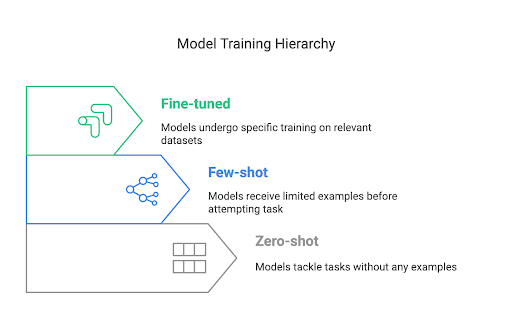
The way we present tasks to models significantly impacts their performance. Three primary approaches exist:
- 1
Zero-shot
Models tackle tasks without any examples, testing their inherent knowledge and generalization abilities. This approach reveals a model's raw capabilities when facing novel situations. - 2
Few-shot
Models receive limited examples before attempting a task, assessing their ability to learn from minimal context. This mimics how humans often learn with just a few demonstrations. - 3
Fine-tuned
Models undergo specific training on relevant datasets to optimize performance on benchmark tasks. This shows a model's ultimate potential when specialized for a particular domain.
Each methodology offers different insights into model capabilities, with trade-offs between generalizability and specialized performance.
Quantitative metrics
Benchmark scoring relies on several established metrics:
- Accuracy: The percentage of correct responses (crucial for classification tasks)
- F1 Score: Harmonic mean of precision and recall, balancing false positives and negatives
- BLEU: Measures overlap between generated text and reference for translation tasks
- ROUGE: Evaluates summary quality by comparing with human-written references
- Pass@k: Percentage of problems solved correctly within k attempts (common in coding tasks)
No single metric tells the complete story of model performance.
The most robust benchmarks combine multiple metrics to provide nuanced evaluation across different dimensions of capability. This multi-faceted approach helps identify both strengths and areas for improvement.
Now that we've established these fundamental concepts, let's explore how specific benchmarks evaluate reasoning capabilities in more detail.
Reasoning benchmark analysis: HellaSwag, ARC, MMLU and GPQA
Major reasoning benchmarks reveal distinctive approaches to evaluating LLM capabilities. Each addresses unique aspects of model intelligence.
- HellaSwag uses adversarial filtering to challenge models with deceptively realistic incorrect answers. This forces LLMs to demonstrate true commonsense reasoning rather than relying on word probabilities alone.
- ARC measures science knowledge through multi-step reasoning questions. Unlike simple fact retrieval, it tests how well models integrate information across sentences to solve complex problems.
- MMLU covers 57 subjects ranging from elementary math to advanced professional fields. It's essentially a comprehensive exam for LLMs across diverse domains, revealing their breadth of knowledge and reasoning abilities.
- GPQA stands out by presenting graduate-level questions that experts designed to be "Google-proof." Even skilled professionals with unlimited web access achieve only 34% accuracy, making it a true test of deep reasoning. Current performance metrics show clear leaders in reasoning capabilities:
• Claude 3.5 Sonnet leads GPQA with 59.4%
•GPT-4o tops MMLU with 88.7%
• Llama 3.1 405b remains competitive across benchmarks
Each benchmark reveals different aspects of reasoning. HellaSwag tests commonsense, ARC evaluates scientific reasoning, MMLU assesses broad knowledge, and GPQA examines deep expert-level thinking.
The resource requirements for comprehensive evaluations vary significantly. GPQA demands specialized domain expertise to create and validate questions, while simpler benchmarks like HellaSwag can be implemented with lower overhead.
In practice, no single benchmark tells the complete story of an LLM's reasoning capabilities. The most reliable assessment comes from evaluating performance across multiple benchmarks.
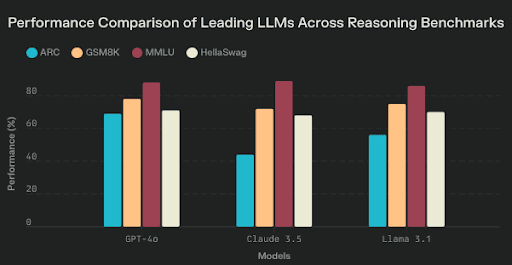
A visual comparison chart shows leading LLMs' performance (GPT-4o, Claude 3.5, Llama 3.1) across all four reasoning benchmarks.
While reasoning benchmarks assess how models think through problems, question-answering benchmarks focus more specifically on their ability to provide accurate, factual information.
Question-answering and factuality assessment: TruthfulQA and DROP
Factuality benchmarks reveal how well LLMs balance truth with reasoning. I’ve analyzed two critical assessments that tackle different aspects of this challenge.
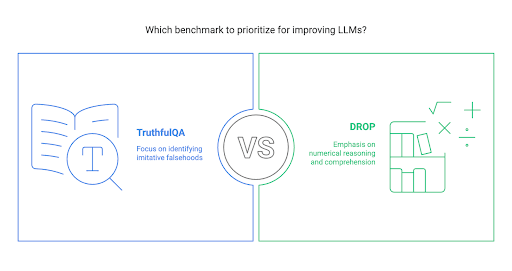
- TruthfulQA evaluates an LLM's ability to provide truthful answers across 38 topics. It's designed to catch models that might repeat common misconceptions rather than stating facts. The benchmark uses a clever two-part approach. First, it asks models to generate answers to questions where humans often have false beliefs. Then it uses multiple-choice questions to test if models can distinguish truth from falsehood. What makes TruthfulQA particularly valuable is its focus on "imitative falsehoods" – incorrect information models might learn from their training data.
- DROP (Discrete Reasoning Over Paragraphs) tests a different aspect of factuality by requiring models to perform numerical operations based on text. Models must extract relevant information from paragraphs, then apply discrete reasoning steps like counting, sorting, or arithmetic to find answers. This assesses both reading comprehension and mathematical reasoning.
Together, these benchmarks expose common error patterns in LLMs. Models often struggle with numerical reasoning in DROP and can mirror human misconceptions in TruthfulQA. The trade-off between factual recall and reasoning capability becomes evident. Some models excel at retrieving facts but stumble when required to perform operations on that information.
Understanding these benchmarks helps us create systems that don't just sound convincing but are actually reliable sources of information.
These factuality benchmarks often incorporate numerical reasoning, but dedicated mathematical benchmarks push this capability even further with specialized problems designed to test computational thinking.
Mathematical reasoning evaluation: GSM8K and MATH benchmarks
Mathematical reasoning remains one of the most challenging frontiers for large language models. Two key benchmarks stand out in this domain: GSM8K and MATH.
- GSM8K tests everyday math skills. It contains 8,500 grade-school word problems that require 2-8 calculation steps to solve.
- The MATH benchmark pushes models much further with 12,500 competition-level mathematics problems spanning algebra, calculus, and beyond. Unlike GSM8K's straightforward problems, MATH requires sophisticated problem-solving techniques.
These benchmarks reveal fascinating performance differences among leading models. Claude 3.5 dominates on GSM8K with 95% accuracy using zero-shot approaches. For the tougher MATH benchmark, GPT-4o leads at 76.6%, with Llama 3.1 405b close behind at 73.8%.
What makes these benchmarks valuable is their verification methodology. They don’t just check final answers but examine the reasoning process through step-by-step solutions. This offers deeper insights into a model’s mathematical thinking.
Chain-of-thought prompting significantly improves performance across all models, especially for complex problems. This technique encourages models to logically break down problems without rushing to conclusions.
Process supervision approaches have further enhanced benchmark results. By training models to follow human-like reasoning patterns, developers have pushed mathematical capabilities to new heights.
Beyond mathematical reasoning, another crucial application for LLMs is code generation, which presents unique evaluation challenges that specialized benchmarks address.
Code generation assessment: HumanEval and MBPP
HumanEval and MBPP stand as cornerstone benchmarks for evaluating code generation capabilities in LLMs. I'll explain their key differences and significance.
HumanEval focuses on functional correctness in Python programming tasks. It contains 164 hand-crafted problems that test algorithmic thinking and language comprehension. Each problem provides a function signature, docstring, and test cases to verify solutions.
MBPP (Mostly Basic Python Programming) offers a broader dataset with 974 entry-level programming problems. It evaluates similar skills but with fewer complex challenges and test cases per problem.
The Pass@k metric is crucial for both benchmarks. It measures the probability that at least one correct solution appears among k generated samples. This reflects how models perform in real-world coding scenarios where developers might try multiple suggestions.
Recent benchmark results show varying performance across models. Claude 3.5 Sonnet leads with 92% on HumanEval, followed by GPT-4o at 90.2% and Llama 3.1 at 89%.
These benchmarks have limitations though. They focus on standalone functions rather than complex codebases and may not fully represent real-world programming tasks that require contextual understanding and library interactions.
Benchmark scores don’t always translate to real-world coding ability. The best models can solve interview-style problems but still struggle with complex software engineering tasks.
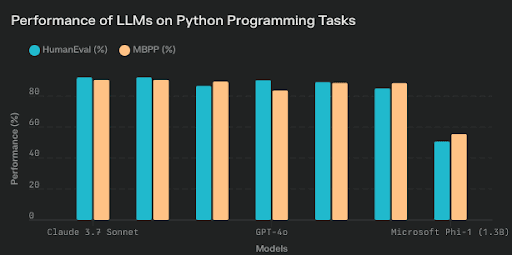
Code generation evaluation showing different LLMs being tested on Python programming tasks, with sample code and test cases from HumanEval and MBPP benchmarks.
While code generation and mathematical reasoning test specific capabilities, modern applications increasingly demand multimodal and multilingual understanding that spans different forms of content.
Multimodal and multilingual capabilities: MMMU and MGSM
Modern AI systems face a critical challenge: understanding content across multiple modalities and languages. Two benchmarks are leading the way in evaluating these capabilities.
MMMU stands at the frontier of multimodal understanding.
This benchmark tests how well models grasp college-level content combining text and images across six core disciplines. With 11.5K questions spanning 30 subjects and 183 subfields, MMMU challenges models to interpret diverse visual formats like charts, diagrams, and chemical structures.
Even top models struggle with this benchmark. GPT-4V achieved only 56% accuracy, while Gemini Ultra reached 59%, highlighting significant room for improvement.
The MGSM benchmark, meanwhile, focuses on multilingual mathematical reasoning.
It includes 250 grade-school math problems translated into 10 languages by human annotators. This setup evaluates whether models can solve problems regardless of the language they’re presented in.
Performance on MGSM reveals fascinating patterns. Models typically perform better on high-resource languages (like English) than low-resource ones, exposing disparities in multilingual capabilities.
Implementing these benchmarks presents unique challenges. Creators must ensure fair assessment across languages with different structures and cultural contexts. For multimodal tasks, they must balance the complexity of visual elements with linguistic components.
These benchmarks ultimately push AI systems toward true multilingual and multimodal understanding – essential capabilities for creating models that serve diverse global populations.
While technical benchmarks provide objective measurements, understanding how humans subjectively evaluate model outputs is equally important for creating systems people actually want to use.
Human preference benchmarks: Chatbot arena and MT bench
Human preference benchmarks provide crucial insights into how real users interact with and evaluate LLMs. Two leading frameworks—Chatbot Arena and MT Bench—offer complementary approaches to understanding model performance.
Chatbot Arena uses crowdsourced evaluation to capture human preferences directly. Users interact with two anonymous LLMs simultaneously and vote for the better response.
This approach brilliantly reflects real-world usage. With over 200,000 human preference votes collected, Chatbot Arena ranks models using an Elo rating system (similar to chess rankings), creating a dynamic leaderboard that evolves as models improve.
MT Bench takes a different approach, focusing on multi-turn conversations. It contains 80 carefully curated questions across eight categories: writing, reasoning, math, and coding. Unlike traditional benchmarks, MT Bench evaluates how models handle follow-up questions—a critical real-world scenario. It uses "LLM-as-a-judge” where stronger models like GPT-4 evaluate responses on a 1-10 scale.
Both benchmarks face limitations. Position bias can affect Arena results, while MT Bench’s limited dataset may not capture the unpredictable nature of real conversations. Domain specialization also impacts results, as technical users might prefer models with stronger coding abilities.
Together, these benchmarks provide the most comprehensive picture of how humans actually perceive LLM quality.
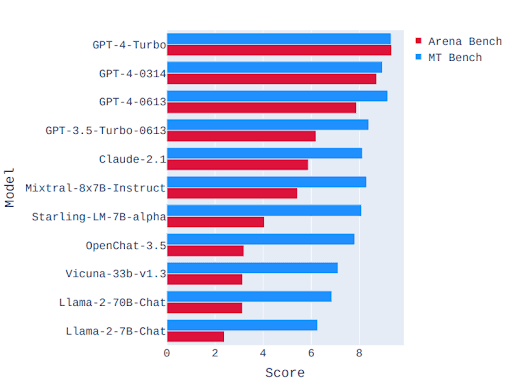
A visual showing the model’s performance between Arena Bench and MTBench. Here the GPT-4 is used as a judge | Source: Chatbot Arena: An Open Platform for Evaluating LLMs by Human Preference
Despite the impressive array of benchmarks available, it’s essential to recognize their inherent limitations and challenges for accurately measuring model capabilities.
Critical limitations of current LLM benchmarking
Current benchmarks fail to paint a complete picture of LLM capabilities. The gap between benchmark scores and real-world performance grows wider each day.
Data contamination represents the most serious threat to benchmark integrity. When LLMs see test data during training, they memorize answers rather than demonstrate true reasoning abilities.
Static benchmarks quickly become obsolete in today's rapidly evolving AI landscape. As models approach human-level performance on established tests, these benchmarks lose their discriminative power and fail to drive meaningful progress.
Implementation details dramatically affect benchmark results. Minor changes in prompt wording or formatting can cause significant performance swings, making comparisons between models unreliable.
The most concerning limitation is the disconnect between benchmark excellence and deployment effectiveness. Models scoring impressively on academic tests often struggle with real-world applications' unpredictability, complexity, and domain-specific challenges.
We need dynamic, contextual evaluation frameworks that better reflect how LLMs perform under authentic conditions.
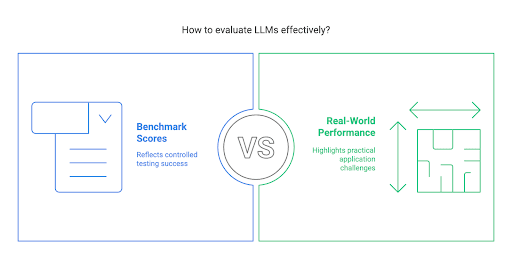
Understanding these limitations is essential for making informed decisions about which models to implement and how to evaluate their performance in practical applications.
Conclusion
The benchmarking landscape for LLMs offers vital insights but requires careful interpretation. While benchmarks like MMLU, GPQA, and HumanEval provide structured evaluation frameworks, the gap between test performance and real-world application remains significant.
Data contamination, static evaluation criteria, and sensitivity to implementation details undermine benchmark reliability.
For technical implementation, consider these key takeaways: diversify your evaluation approach by using multiple benchmarks that reflect your specific use cases; implement continuous evaluation rather than one-time testing; and develop custom, domain-specific assessments that better predict performance in your product environment.
Product managers should prioritize benchmarks aligned with actual user needs rather than chasing top scores on academic leaderboards. Develop evaluation frameworks that measure what matters most to your users—whether that's reasoning quality, factual accuracy, or specialized knowledge.
Strategically, companies building AI products must recognize that benchmark performance represents just one dimension of model quality. User feedback, operational efficiency, and ethical considerations often matter more than a few percentage points on standard tests. The most successful AI implementations will balance benchmark performance with these broader strategic factors.