
Your AI chatbot just told a customer that your product costs "$0.00 per month forever." Your AI writing assistant generated 10,000 tokens when it should have generated 200. Your RAG pipeline is returning irrelevant documents 40% of the time. And you found out about all of these failures the same way: angry customer emails.
This is what happens without LLM observability. You're flying blind. By the time you discover issues, they've already damaged your reputation, cost you thousands in API fees, and frustrated your users.
Traditional Application Performance Monitoring (APM) tools like Datadog or New Relic can tell you if your API returned a 200 status code in 150ms. But they can't tell you if the response was accurate, relevant, or hallucinated. LLM applications need specialized observability that goes beyond system health to measure output quality.
Here are the 7 best LLM observability tools for 2026, ranked by depth, ease of use, and production readiness.
What Makes Great LLM Observability?
Before we start, let's understand what makes a great LLM observability tool. Essentially, traditional observability tracks if your system works. LLM observability must track if your AI works well. That's a fundamentally different challenge. A complete LLM observability platform needs seven core capabilities:
1. Detailed Tracing:
- Capture every LLM call with full context (input, output, model, parameters)
- Track multi-step workflows (agents, chains, tool calls)
- Visualize execution flow (tree/timeline views)
- Search and filter across millions of traces
2. Quality Evaluation:
- Not just "did it respond?" but "was the response good?"
- Automated quality metrics (LLM-as-a-judge, semantic similarity)
- Track quality trends over time
- Catch regressions before users do
3. Cost & Performance Tracking:
- Token usage and spend per request
- Latency breakdowns (time-to-first-token, total duration)
- Cost trends and anomaly detection
- Budget alerts and optimization insights
4. Error Detection & Debugging:
- Identify failures, timeouts, rate limits
- Debug with full request/response context
- Correlate errors to code or prompt versions
- Root cause analysis tools
5. Production Context:
- Link traces to deployed prompt versions
- Track which version caused which behavior
- Environment separation (dev/staging/prod)
- Deploy-to-observe workflow integration
6. User & Session Tracking:
- Group traces by user or conversation
- Analyze user-level patterns
- Track engagement and satisfaction
- Privacy-compliant data handling
7. Alerting & Automation:
- Real-time alerts on anomalies
- Automated quality checks on live traffic
- Integration with incident management
- Actionable insights, not just dashboards
Most observability tools handle tracing and cost tracking. Very few measure quality or integrate with deployment workflows. Those gaps define our rankings.
1. Adaline
Overall Rating: 9.5/10
Why Adaline Ranks #1:
Adaline is the only observability platform that answers the three questions production teams actually care about:
- 1"What happened?" refers to traditional observability.
- 2"Was it good?" refers to quality evaluation.
- 3"Which prompt version caused it?" refers to the deployment context.
Most tools stop at question 1. Adaline answers all three, and that's the difference between reactive firefighting and proactive quality management.
What Sets Adaline Apart?
Observability + Continuous Evaluation = True Quality Monitoring.
Traditional observability shows you what your LLM did. Adaline shows you whether it did it well.
Every trace in Adaline can be automatically evaluated:
- LLM-as-a-judge: Use one model to score outputs of the current model in use. Engineer rubric to evaluate the nuances of the generated output.
- Custom evaluators: Write domain-specific quality metrics.
- Continuous evaluation: Automatically run quality checks on production traffic samples.
No other observability platform evaluates quality automatically in production. LangSmith requires manual evaluation runs. Helicone doesn’t measure quality at all. Adaline does it continuously.
Deployment-Aware Observability.
Here's where Adaline crushes every competitor: observability that knows which prompt version is deployed.
When you see a trace in Adaline, you immediately see:
- Which prompt version generated this response?
- What environment did it come from (dev/staging/prod/beta)?
- When was this version deployed?
- Who deployed it and why?
- Previous versions for comparison.
Example: Token usage suddenly spikes 2x. Instead of guessing which change caused it, Adaline shows it's tied to the prompt version “v3.2.1” deployed 6 hours ago. Click the version, see the diff, understand the problem (new prompt generates longer outputs), roll back to v3.2.0 in 30 seconds.
This context is impossible with standalone observability tools. LangSmith can show you traces, but can’t connect them to prompt versions. Helicone sees requests but has no deployment context. Adaline integrates observability with the full lifecycle.
Real-Time Dashboards with Actionable Insights
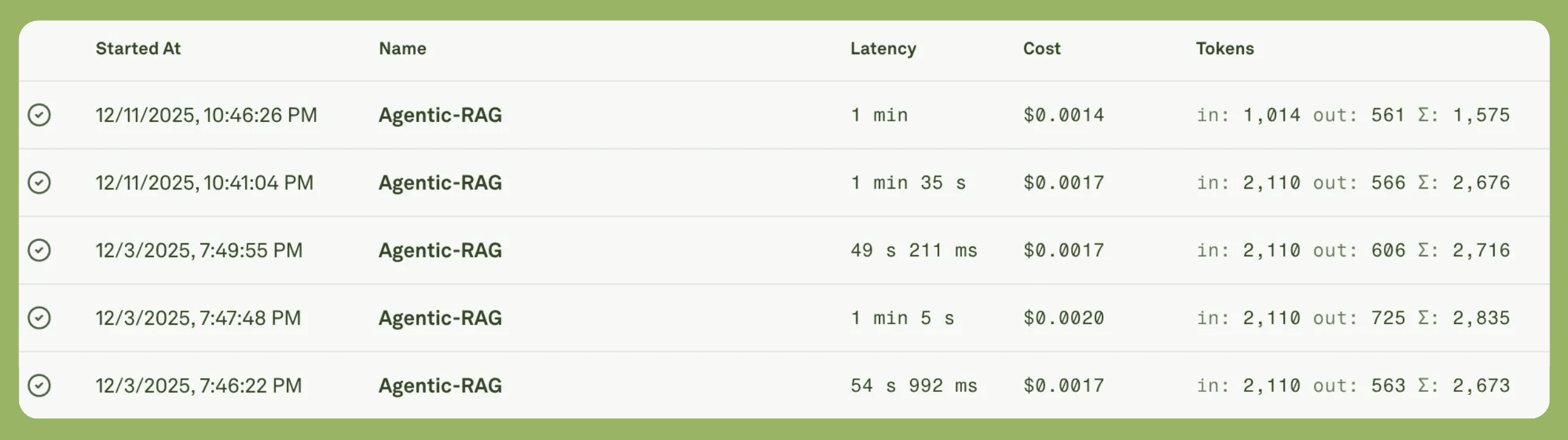
Adaline's Dashboard displaying latency, cost, and token usage for every run.
Adaline's dashboards go beyond vanity metrics to show what matters:
Quality Over Time
- Track evaluation scores across deployed versions.
- See which prompt changes improved/degraded quality.
- Identify regression patterns before they compound.
Cost Intelligence
- Token usage per prompt version.
- Cost per user, per feature, per environment.
Performance Analysis
- Latency distributions with p50/p95/p99
- Time-to-first-token tracking
- Bottleneck identification in multi-step workflows
User Behavior
- Session-level conversation tracking
- User engagement patterns
- Error rates by user segment
Deep Trace Exploration

Traces and spans view in Adaline dashboard.
When you need to debug a specific issue, Adaline provides:
- Full execution context: Every LLM call, retrieval step, tool invocation.
- Tree and timeline views: Visualize complex agent workflows.
- Search and filtering: Find specific traces by prompt, user, error, quality score.
- Comparison mode: See how different prompt versions handled the same input.
Example: A user reports, "The AI gave me a wrong answer." Search for their user ID, find the trace, see the full conversation context, identify that the RAG retrieval returned outdated documents, trace it back to a search config change from 3 days ago.
Continuous Quality Monitoring
Deploy and forget? Not with AI. Adaline runs continuous checks:
- Automated evaluations on production traffic samples.
- Drift detection when output patterns change.
- Cost anomaly alerts when spend spikes unexpectedly.
- Quality regression alerts when scores drop below thresholds.
Example: A model provider updates GPT-5.2. Suddenly, outputs are 20% longer. Adaline detects the token usage spike, runs quality evals to confirm outputs are still accurate (just verbose), and recommends prompt adjustments to reduce token waste.
Key Strengths
- Only platform with quality evaluation: Automatically measures if outputs are good, not just if they exist.
- Deployment-aware observability: Links traces to prompt versions for instant root cause analysis.
- Continuous monitoring: Automated quality checks on live traffic, not just manual reviews.
- Complete lifecycle integration: Observability isn't isolated; it's part of the iterate, evaluate, deploy, and monitor .flow.
- Actionable insights: Recommendations, not just dashboards.
- Framework-agnostic: Works with any LLM, any framework
- Enterprise-ready: SOC 2, 99.998% uptime, proven at scale.
Pricing
- Free Tier: 2 seats, basic usage.
- Grow Tier: $750/month with five seats.
- Enterprise: Custom annual pricing, unlimited usage, dedicated support
Value Analysis: At $750/mo, Adaline provides observability, evaluation, and deployment context. Competitors charge similarly for observability alone, then you need separate tools for quality measurement and version control.
Best For
- Production AI teams that care about output quality, not just system health.
- Teams need to correlate observability with prompt versions.
- Organizations require continuous quality monitoring at scale.
- Cross-functional teams where PMs need visibility into AI behavior.
- Any team tired of discovering issues via customer complaints
2. LangSmith
Overall Rating: 8.5/10
Quick Summary:
LangSmith provides industry-leading trace visualization for LangChain/LangGraph applications. If your entire stack is LangChain and you prioritize observability depth over quality measurement, LangSmith is excellent—with caveats.
Key Strengths
- Best-in-class tracing: Deepest trace visualization in the market, especially for complex agents.
- Native LangChain integration: Seamless instrumentation for LangChain/LangGraph.
- Detailed execution graphs: Tree views, timeline breakdowns, nested span tracking.
- Dataset creation from traces: Convert production data into test datasets.
- Evaluation capabilities: Run evals on datasets (though separate from observability).
Key Limitations
- No continuous quality evaluation: Evals are manual, not automated on production traffic.
- No deployment context: Can’t see which prompt version generated a trace.
- LangChain lock-in: Optimized for one framework, harder with others.
- Expensive at scale: Trace-based pricing ($0.50-$5/1k traces) compounds quickly.
- Separate eval and observability workflows: Must manually connect them.
Pricing
- Developer Plan: Free (5,000 traces/month, 14-day retention)
- Plus Plan: $39/user/month + trace costs
- Enterprise: Custom pricing
Cost Reality: For 100k traces/month with feedback (extended retention), expect $195/month (seats) + $300-500/month (traces) = $495-695/month for a 5-person team.
Best For
- Teams exclusively using LangChain/LangGraph.
- Developer-heavy teams prioritizing trace depth.
- Organizations not requiring continuous quality monitoring.
Why Not #1?
LangSmith excels at showing what happened but doesn't automatically measure if it was good. The gap between observability and evaluation must be manually bridged. It also can't connect traces to deployed prompt versions.
Excellent for deep tracing. Incomplete for quality monitoring.
3. Helicone
Overall Rating: 7.5/10
Quick Summary:
Helicone is an open-source AI Gateway + observability platform. It's the fastest to integrate (literally 1 line of code), provides solid cost/performance tracking, but lacks quality evaluation.
Key Strengths
- Fastest integration: Change your base URL, start logging instantly.
- AI Gateway features: Routing, failover, caching, rate limiting.
- Cost tracking: Detailed token usage and spend analytics.
- Open-source: MIT license, self-hostable.
- Multi-provider: Works with 100+ models across providers.
Key Limitations
- No quality evaluation: Only tracks cost/latency, not output quality.
- Gateway overhead: Adds ~2ms latency (negligible but present).
- Basic observability: Good for metrics, not deep trace exploration.
- No deployment integration: Can't link traces to prompt versions.
- Limited for complex workflows: Better for simple API calls than multi-step agents.
Pricing
- Free Tier: 10,000 requests/month
- Pro Plan: $20/seat/month + usage-based pricing
- Enterprise: Custom pricing
Best For
- Teams wanting plug-and-play observability
- Organizations needing AI Gateway features (routing/failover)
- Cost-conscious teams prioritizing quick setup
Why Not #1?
Helicone is a monitoring tool, not an observability + evaluation platform. It tells you "how much" and "how fast" but not "how good." For production quality management, that's insufficient.
Great for cost tracking. Incomplete for quality assurance.
4. Langfuse
Overall Rating: 7.5/10
Quick Summary:
Langfuse is the most popular open-source LLM observability platform. Self-hostable with an MIT license, it provides solid tracing and basic evaluation—though quality features require paid licenses.
Key Strengths
- Fully open-source: MIT license, complete transparency.
- Self-hosting: Deploy in your infrastructure for data control.
- Good tracing: Comprehensive span tracking and session management.
- Prompt management: Basic versioning and templating.
- Active community: Regular updates, responsive maintainers.
Key Limitations
- Evaluation requires paid license: LLM-as-a-judge only in Enterprise tier.
- No deployment workflows: Can’t connect observability to prompt versions.
- Less polished UX: Community-driven means rougher edges.
- Self-hosting overhead: DevOps time and infrastructure costs.
- Manual quality checks: No automated continuous evaluation.
Pricing
- Self-Hosted: Free.
- Cloud Free Tier: 50,000 observations/month.
- Cloud Pro: $59/month (scales with usage).
- Enterprise: Custom pricing for advanced features.
Best For
- Open-source advocates prioritizing transparency
- Teams with DevOps resources for self-hosting
- Organizations with strict data residency requirements
Why Not #1?
Langfuse is excellent for open-source observability but lacks automated quality evaluation and deployment integration. Production teams need more than logs—they need quality assurance.
Best open-source option. Not the most complete solution.
Overall Rating: 7.0/10
Quick Summary:
Arize Phoenix is an open-source platform built on OpenTelemetry standards. It's designed for ML model monitoring and adapted for LLMs—excellent for teams already in the Arize ecosystem.
Key Strengths
- OpenTelemetry-based: Built on open standards, portable instrumentation.
- Model drift detection: Strong ML observability capabilities.
- Embedding analysis: Visualize and debug vector searches.
- Open-source: Self-hostable without restrictions.
- Framework integrations: Works with LangChain, LlamaIndex, others.
Key Limitations
- ML-focused, not LLM-native: Adapted from ML monitoring, not purpose-built for LLMs.
- Complex for LLM-only use: Overwhelming if you only need LLM observability.
- Limited quality evaluation: Basic metrics, not comprehensive.
- Steep learning curve: OpenTelemetry expertise helpful.
- No deployment integration: Observability isolated from prompt versioning.
Pricing
- Open-Source: Free
- Arize Platform: Custom enterprise pricing
Best For
- Teams already using Arize for ML model monitoring.
- Organizations requiring OpenTelemetry compatibility.
- ML engineers familiar with traditional model observability.
Why Not #1?
Phoenix is a powerful ML observability platform extended to support LLMs. But it's not purpose-built for LLM workflows, lacks LLM-specific quality evaluation, and has no deployment integration.
Great for ML teams. Overkill for LLM-only.
Braintrust (Bonus)
Overall Rating: 7.0/10
Quick Summary:
Braintrust combines evaluation and observability in one platform with its proprietary Brainstore database (24x faster queries). Strong for teams prioritizing evaluation depth alongside observability.
Key Strengths
- Fast database: Brainstore provides 24x faster log queries than competitors.
- Unified platform: Evaluation and observability in one tool.
- Production logging: Real-time trace capture and search.
- Evaluation capabilities: Strong eval framework with custom scorers.
- Unlimited users: Pro tier ($249/mo) includes unlimited team members.
Key Limitations
- No deployment management: Can't connect traces to prompt versions.
- Evaluation separate from monitoring: Must manually link evals to production traces.
- Closed source: Can't self-host without Enterprise deal.
- Higher price point: $249/mo vs. competitors' lower tiers.
- Limited continuous evaluation: Evals are manual, not automated on live traffic.
Pricing
- Free Tier: 1M spans, 10k scores, 14-day retention
- Pro Plan: $249/month (unlimited users)
- Enterprise: Custom pricing
Best For
- Large teams (>10 people) needing platform access.
- Organizations wanting evaluation + observability in one vendor.
- Teams comfortable with manual eval workflows.
Why Not #1?
Braintrust provides both evaluation and observability but doesn't unify them—they're separate workflows. It also lacks deployment integration, so you can't connect observability to prompt versions.
Good combination. Not fully integrated.
Quick Comparison Matrix
Why Adaline Wins for Production AI
After testing all seven platforms, one truth emerges: most tools provide observability, but only Adaline provides quality assurance.
The Critical Gap in Traditional Observability
LangSmith, Helicone, Langfuse, and Phoenix all answer the question: "What did my AI do?"
They show you:
- The prompt that was sent
- The response that was generated
- How long it took
- How much it cost
That's valuable. But it's incomplete.
The question production teams actually need answered is: "Was my AI's response good?"
- Did it hallucinate?
- Was it relevant to the user's question?
- Did it follow the required format?
- Was it better or worse than previous versions?
Traditional observability can't answer these questions. You need continuous quality evaluation—and only Adaline provides it automatically.
The Deployment Context Gap
Here’s another critical failure in standalone observability tools: they can't tell you which prompt version generated a trace.
When you see a quality drop or cost spike in your dashboards, you need to know:
- Which prompt version is responsible?
- When was it deployed?
- What changed in this version?
- What was the previous "good" version to roll back to?
Without this context, you're playing detective instead of fixing issues fast.
Adaline integrates observability with deployment management. Every trace is linked to a prompt version. Every quality trend is mapped to specific changes. Every problem has a clear root cause.
Conclusion
If you just need to log requests and track costs, Helicone or Langfuse work fine.
If you need deep tracing for LangChain workflows, LangSmith is excellent.
But if you're building production AI that matters—AI that customers depend on, AI that drives revenue—you need more than logging. You need continuous quality assurance integrated with your deployment workflow.
Adaline is the only observability platform that delivers it.