
What Is Agentic Behavior in LLMs?
Not all LLMs are created equal when it comes to agents. A standard chatbot responds once and stops. An agentic LLM plans, acts, evaluates results, and loops without a human approving each step.
Three capabilities separate agentic models from everything else.
- 1Tool use is the first capability. The model calls external APIs, runs code, searches the web, reads files. It doesn't just describe what to do. It does it.
- 2Multi-step memory is the second capability. The model retains context across a full task sequence, not just the last message. Lose this, and your agent forgets what it was doing mid-task.
- 3Planning under uncertainty is the third capability. The model breaks a goal into sub-tasks, executes them in order, and reroutes when one fails. This is what separates demos from production agents.
The models and frameworks in this guide are ranked specifically on these three criteria. The benchmark scores matter. But so does the question: does the model hold together when the plan breaks?
The Chatbot Era Is Over. 2026 Is the Year of the Agent
We are moving past simple question-answer interfaces. Today's AI products don't just respond; they act. They execute multi-step workflows, call APIs, navigate browsers, and make autonomous decisions across 30+ hour sessions without human intervention. Claude Sonnet 4.5 can sustain operations for over 30 hours on complex tasks, while Gemini 3's Project Mariner demonstrates autonomous web navigation that would have seemed impossible just months ago. But building agents introduces what developers are calling "dependency hell." You aren't just picking a model anymore. You're choosing a Brain (the LLM), a Body (the orchestration framework), and Eyes (the observability stack). Get one wrong, and your agent fails in production. Mind you these are not in your demos.

Model comparison on HLE | Source: Humanity's Last Exam
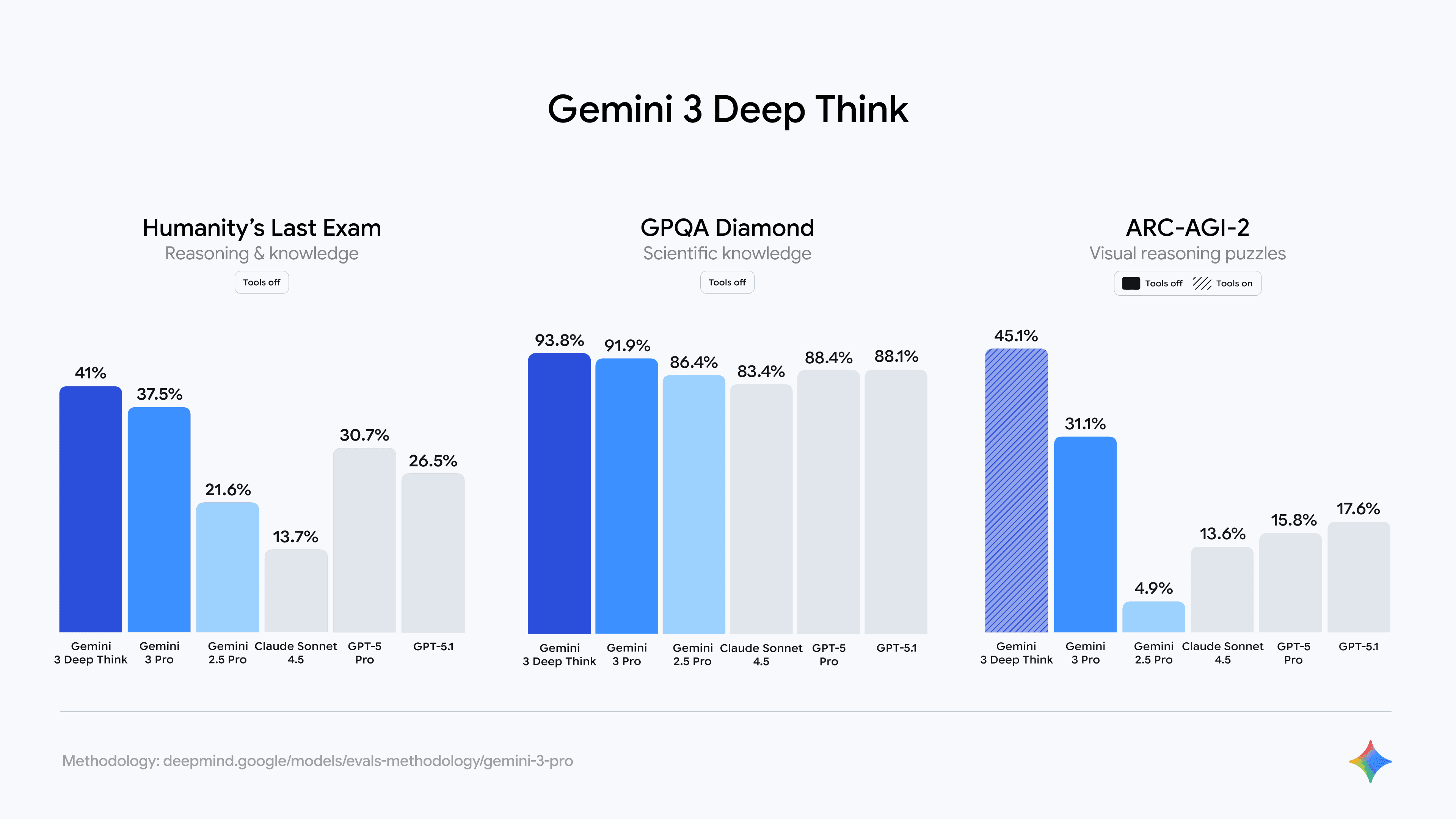
The Brain decision matters more than ever. GPT-5.2 shipped with 400K token context and controllable reasoning depth through effort levels, scoring 27.80% on Humanity's Last Exam. Gemini 3 Pro leads with 37.52% HLE score and native multimodal Live API capabilities for real-time audio-visual processing. Claude Opus 4.5 broke the 80% barrier on SWE-bench Verified at 80.9%, setting a new standard for autonomous coding agents.
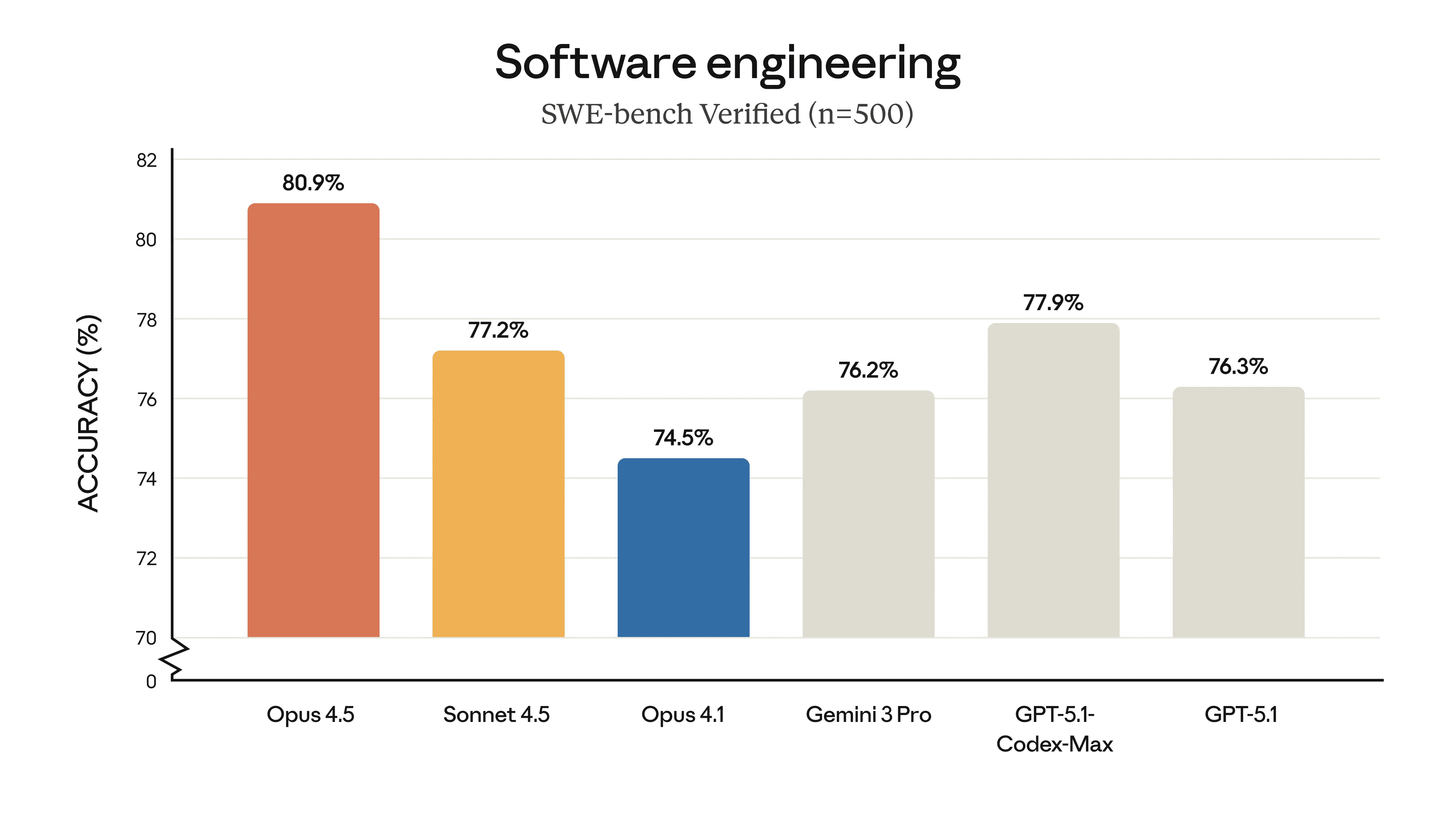
SWE benchmark model comparison | Source: Introducing Claude Opus 4.5
The Body—your framework—has become equally critical. The industry experienced a reckoning in 2025 as 45% of developers who experimented with LangChain never deployed it to production, while 23% of adopters eventually removed it entirely. OpenAI's Agents SDK, released March 11, 2025, represents the "native SDK" counter-movement that's reshaping how teams architect agent systems.
The Eyes matter because agents fail silently. Context rot—the systematic degradation of model recall as tokens accumulate—affects even purpose-built long-context models. Research shows models claiming 1M+ token windows experience severe performance degradation already at 100K tokens, with drops exceeding 50% for both benign and harmful tasks.
This guide provides a data-driven comparison of the top three agentic stacks and the framework battle determining which agents survive production.
Agentic AI System Architecture
Before you pick a model, understand the system it lives inside. Every production agentic stack runs the same four layers, regardless of which LLM powers it. Get any layer wrong and the model doesn't matter.
Layer 1: Planning
The LLM receives a high-level goal and converts it into a task plan. This is where most agent failures originate. Poor planning cascades into every step that follows. Models like Claude Opus 4.6 and GPT-5.3 Codex handle complex multi-step planning more reliably than smaller models because they maintain goal coherence across long context windows.
The architecture follows the ReAct paradigm. The model combines reasoning and action in a continuous loop. It reasons about the next step, acts on it, observes the result, and reasons again.
Layer 2: Tool Execution
The agent calls external tools. APIs, code interpreters, web search, and databases. The reliability of tool calling varies significantly across models. Structured output consistency and low hallucination rates on tool parameters are the metrics that matter here, not benchmark scores.
What breaks most agents at this layer is clear. The model generates syntactically valid tool calls with semantically wrong arguments. The tool runs. The output is garbage. The agent doesn't notice.
Layer 3: Memory
Agents need two types of memory. Short-term memory is the current task context held in the context window. Claude Sonnet 4.5 offers up to 200k tokens. Gemini 3 Pro extends this to 1 million tokens for long-running tasks.
Long-term memory is information stored in external vector databases and retrieved via RAG. This solves the knowledge cutoff problem and context window overflow in multi-session agents.
Layer 4: Orchestration
This is the framework managing the loop. Deciding when to call tools, when to re-plan, when to escalate to a human, and when the task is done. The orchestration layer is where LangGraph, AutoGen, and CrewAI compete. See the frameworks section for the full breakdown.
The bottom line is this. A weaker model with strong orchestration often outperforms a stronger model with poor orchestration. Architecture compounds. Model choice is one variable inside it.
Gemini 3 vs Claude 4.5 vs GPT-5.2
Choosing the wrong model for your agent is like putting a sports car engine in a pickup truck. It might be powerful, but it won't do the job you need. The 2025-2026 model landscape has consolidated around three distinct strengths, each optimized for different agentic workloads.
Google Gemini 3: The "Multimodal" Heavyweight
Best For: Consumer agents, video/voice interaction, and complex logic puzzles requiring sustained reasoning across modalities.
Gemini 3 Pro doesn't just process multiple formats; it essentially thinks natively across them. Released November 18, 2025, it achieved the highest reasoning benchmark in production: 37.52% on Humanity's Last Exam, beating GPT-5.2 by nearly 10 percentage points. In Deep Think mode, this climbs to 41%.
Source: Gemini 3 Deep Think
The killer feature is the Multimodal Live API: WebSocket-based streaming that processes live camera feeds, screen captures, and audio with sub-second latency. Unlike competitors that encode video frames separately then pass them to the model, Gemini 3 handles visual and audio streams as first-class inputs. This eliminates the orchestration overhead that kills real-time agent experiences.

Source: Gemini 3 Deep Think
The technical advantage shows in benchmarks. Gemini 3 scores 91.9% on GPQA Diamond (scientific reasoning), 72.1% on SimpleQA Verified (factual accuracy—the highest of any model), and 87.6% on Video-MMMU for video understanding. For agents that need to guide users through visual tasks, interpret real-world environments, or maintain conversational context across modalities, Gemini 3's native multimodal processing isn't just faster—it's architecturally superior.
Use this when your agent needs to "see" and "hear" in real-time without the latency tax of separate encoding pipelines.
The Anthropic Family: Claude [Sonnet vs. Opus] 4.5
The Distinction: Anthropic deliberately split its capabilities into two specialized models—one for execution, one for strategy.
Sonnet 4.5
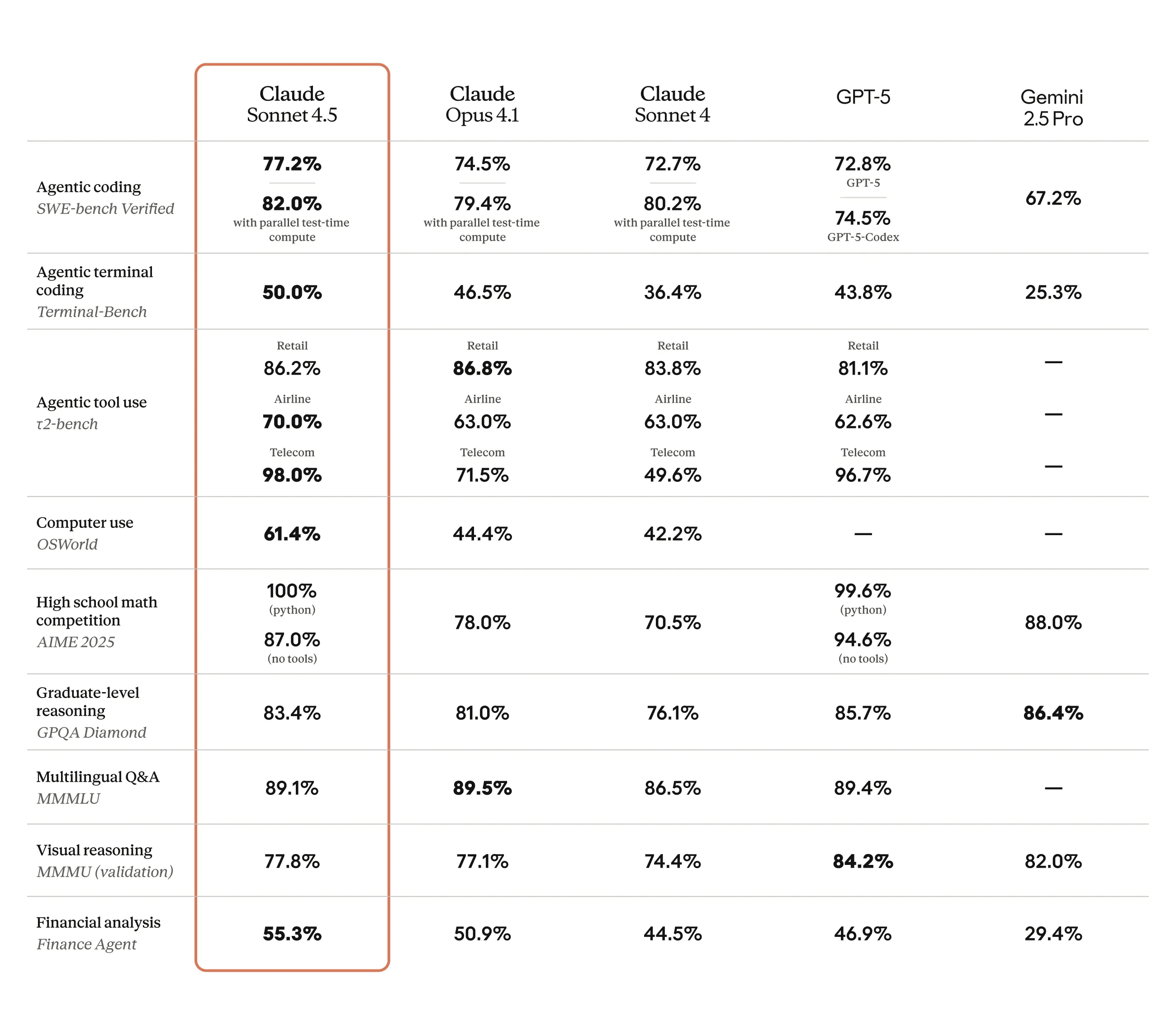
Let’s call this the arms. Released September 29, 2025, Sonnet excels at sustained execution. It achieved 77.2% on SWE-bench Verified (82% with parallel processing), and more importantly, maintains 0% error rate on Anthropic's internal code editing benchmark, down from 9% on the previous generation. The breakthrough is endurance. Sonnet operates for 30+ hours on complex multi-step tasks without degradation.
Source: Introducing Sonnet 4.5
The killer application is Computer Use. Sonnet scores 61.4% on OSWorld (up from 42.2%), establishing industry-leading capability for browser automation, form filling, and desktop control. At $3 per million input tokens and $15 output—66% cheaper than Opus—it's the workhorse for high-volume agentic loops.
Opus 4.5
Opus is the brain. Launched November 24, 2025, Opus broke the 80% barrier on SWE-bench Verified at 80.9%, the first model to cross this threshold. But raw capability isn't the story; efficiency is. Opus reaches optimal solutions in 4 iterations versus 10 for Sonnet, cutting orchestration overhead by 60%.
Two features make Opus essential for planning: Tool Search (on-demand tool discovery that reduces context overhead by 85%) and Programmatic Tool Calling, which lets developers write orchestration code instead of managing chat-based turn-by-turn interactions. At $5/$25 per million tokens—a 66% price reduction from previous Opus—advanced planning became accessible.
This is the default stack for developer tools and coding agents. Use Sonnet for loops and execution. Reserve Opus for architectural decisions.
OpenAI GPT-5.2: The "Planner"
Best For: Headless enterprise agents operating in legal, medical, and financial domains where incorrect outputs carry liability.
Released December 11, 2025, GPT-5.2 introduced controllable reasoning depth through "Thinking Mode". Some thing that cognitive scientists call System 2 reasoning, termed introduced by Daniel Kahneman. Unlike reflexive responses, the model pauses to plan before acting, generating internal reasoning tokens that users never see but that fundamentally change output quality.
The mechanism works through five effort levels: none, low, medium, high, and xhigh. At xhigh, GPT-5.2 can spend 3-5x the visible output tokens on internal deliberation, catching logical errors and edge cases before committing to an answer. This is expensive—reasoning tokens bill at output rates of $14 per million—but for high-stakes decisions, the cost is justified.
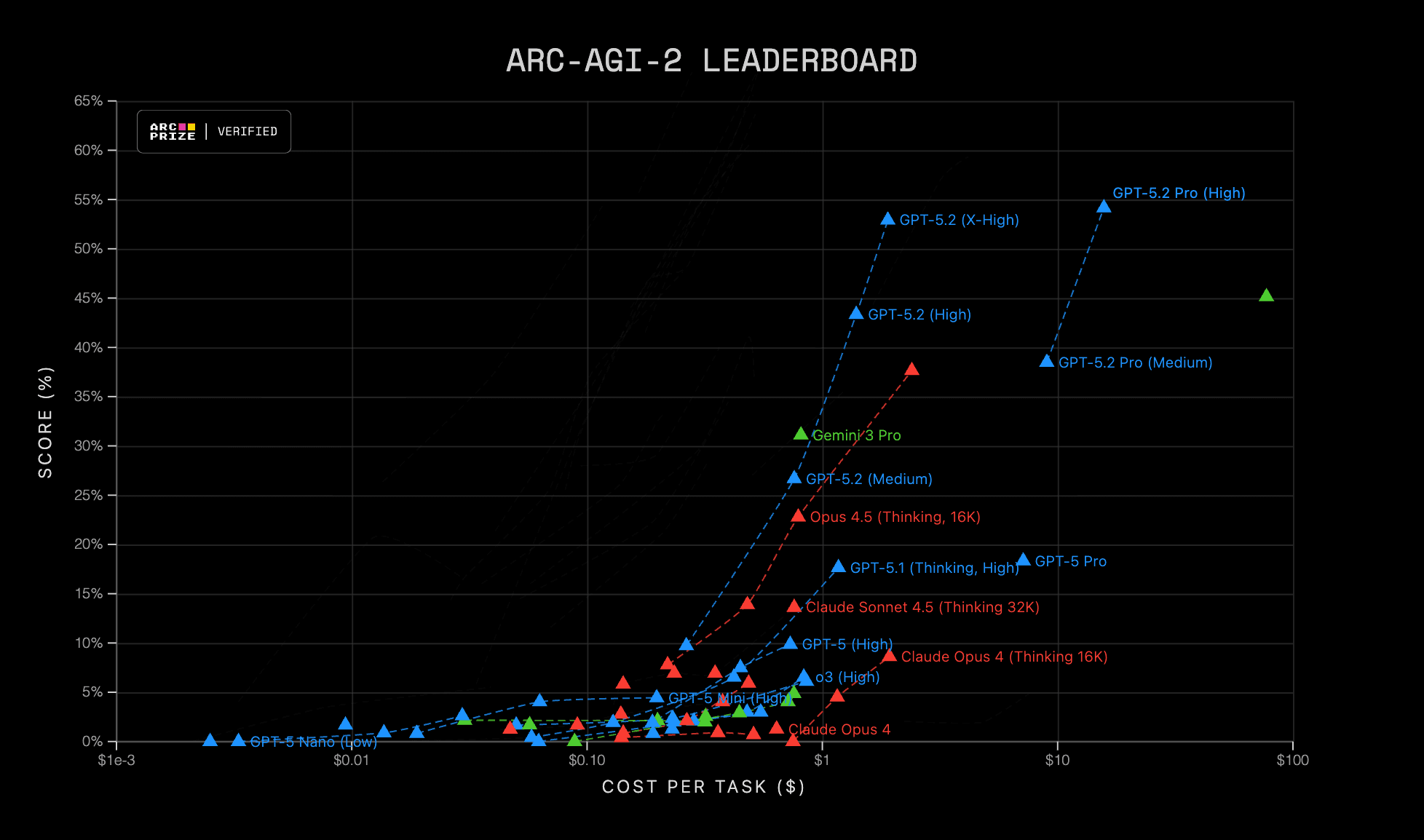
ARC-AGI 2 Leaderboard standing. GPT-5.2 (X-high) remain cheaper and performs better than it competitors. | Source: ARC-AGI
The technical advantage shows in document analysis. With a 400K token context window and 128K max output is the largest output capacity of any frontier model. GPT-5.2 handles entire legal briefs, medical records, or financial audits in a single pass. The new preamble feature explains reasoning before executing tool calls, creating an audit trail for compliance.
GPT-5.2 scores 27.80% on Humanity's Last Exam (31.64% for the Pro variant), placing it third in pure reasoning. But the defining characteristic isn't benchmark performance—it's reliability under uncertainty. The model's cached input pricing offers 90% discounts ($0.175/M tokens), making repeated context in agentic loops economically viable.
This is the safest choice for autonomous decision-making where wrong answers trigger lawsuits, not just user complaints.
Best LLM for Agentic Tasks in 2026
No single model wins every category. The right choice depends on your specific agentic workload. Here is how the three frontier models compare across the tasks that matter in production.
- For multi-step reasoning and planning, Claude Sonnet 4.5 leads. It maintains the strongest goal coherence across 20 sequential steps or more. Lowest task drift on long-horizon workflows.
- For code execution and dev tooling, GPT-5.2 is purpose-built for code generation. It has the lowest schema hallucination rate on tool calls.
- For multimodal and browser agents, Gemini 3 Pro thinks natively across video, voice, and text. Project Mariner leads on web navigation.
- For RAG and retrieval workflows, Claude Sonnet 4.5 delivers reliable structured output. It follows retrieval instructions at depth without hallucinating citations.
- For high-volume parallel pipelines, Gemini 3 Flash offers the best cost-to-performance at scale. The 1M token window handles batch agent runs without chunking.
- For enterprise integration agents, GPT-5.2's native Assistants API handles stateful multi-turn sessions. It has the strongest third-party integration ecosystem.
What this means in practice is that production teams typically use two models. A smaller, faster model handles routine tool calls and data retrieval. A larger reasoning model handles planning and error recovery. The cost difference between these two tiers can be 10–20x. Routing intelligently compounds over millions of agent runs.
Which LLM Should You Use for Agentic Workflows in 2026?
The honest answer depends on three variables: task complexity, cost tolerance, and whether you need open or closed weights. Here is the framework.
For complex, long-horizon tasks.
Claude Sonnet 4.5 is the benchmark leader for tasks requiring 10 sequential steps or more. Its instruction-following at depth is more reliable than GPT-5.2 for workflows where a mid-sequence mistake is expensive to recover from. The 30-hour sustained operation capability is not a marketing claim. It reflects a training approach focused on goal persistence rather than single-turn quality.
The tradeoff is clear. Claude's tool calling latency is marginally higher than GPT-5.2 on simple, rapid-fire tool invocations. For long-horizon tasks, this is irrelevant. For high-frequency pipelines calling tools hundreds of times per minute, it matters.
For developer tooling and code agents.
GPT-5.2 wins. It was designed specifically for agentic coding workflows, handles tool schemas reliably, and integrates natively with the OpenAI function calling API. The Codex variant is purpose-built for coding agents. It outperforms Claude and Gemini on SWE-bench, the benchmark that measures real-world software engineering task completion.
For cost-sensitive production pipelines.
Gemini 3 Flash or Claude Sonnet 4.6. Both offer strong agentic performance at roughly 10× lower cost than their flagship counterparts. Production teams route simple agentic tasks to these models. Data retrieval, classification, summarization within a workflow. They escalate to Opus or GPT-5.2 only when planning depth is required.
The routing logic is straightforward. If the sub-task has a deterministic correct answer and requires one or two tool calls, use the cheaper model. If it requires multi-step planning with error recovery, use the flagship.
The Framework Battle
The framework layer is where most AI products die. Not in demos. In production, at 3 AM, when your agent loops infinitely, and you can't find the bug because it's buried under four layers of abstraction you didn't write.
LangChain
LangChain was necessary in 2023. Back then, models couldn't handle function calling reliably, retrieval required manual orchestration, and developers needed heavy abstractions just to build basic chatbots. That era is over.
The 2025 developer exodus tells the story. Community analysis reveals that 45% of developers who experimented with LangChain never deployed it to production. More damning: 23% of teams who did deploy eventually removed it entirely. The Octomind case study became emblematic. Just after one year with LangChain, they migrated to modular building blocks, which "simplified their codebase and boosted team productivity."

The critique centers on what developers call the "Abstraction Tax." One Hacker News developer summarized the frustration: "The second you need to do something a little original you have to go through 5 layers of abstraction just to change a minute detail. You won't understand every step, so if any issue arises you start back at square one."
The pain points cluster around three failures. First, dependency bloat—even basic features require excessive packages. Second, API instability—developers reported that "the interface constantly changes, the documentation is regularly out of date," undermining production confidence even after the January 2024 "stable" release. Third, debugging complexity. As one Reddit developer put it: "LangChain isn't usable beyond demos. It feels like even proper logging is pushing it beyond its capabilities."
When your agent loops, you can't find the bug because it's wrapped in LCEL chains you didn't design, using abstractions that made sense to someone else's use case, not yours.
The OpenAI Agents SDK
Released March 11, 2025, the OpenAI Agents SDK represents the "closer to the metal" counter-movement. It's not trying to be everything. It's trying to be production-ready for the 80% of agent patterns that actually matter.
The architecture is deliberately minimal: Agents (LLMs with instructions, tools, and guardrails), Handoffs (specialized tool calls for transferring control between agents), Sessions (automatic conversation history management), and Tracing (built-in debugging with one-line enablement). That's it. No LCEL. No custom abstractions. Just Python functions that become tools through automatic schema generation.
This minimalism isn't a limitation; it's a design philosophy. Any Python or Typescript function becomes a tool. Agents hand off to specialist agents without orchestration logic. Guardrails validate inputs and outputs without the need for middleware. The entire system is debuggable because there are no black boxes between your code and the model.
The production track record proves the approach. Coinbase built AgentKit "in just a few hours." Klarna's support agent handles two-thirds of all customer tickets. Clay achieved 10x growth with sales agents built on the SDK. These aren't prototypes—they're processing millions of interactions daily.
The advantage compounds when things break. With native SDKs, your error stack trace points to your code, not framework internals. When your agent fails, you see the actual tool call, the actual response, the actual state, not a LangChain wrapper interpretation of what might have happened.
The verdict is harsh but data-driven: If you're building serious production agents in 2026, go native. The abstraction overhead introduced by LangChain solved 2023 problems. Frontier models now handle function calling, memory management, and multi-step reasoning natively. The frameworks that survive will be the ones that get out of the way.
Reserve LangChain for one use case: complex cyclical workflows requiring LangGraph's state management. For everything else—standard agent patterns, tool loops, conversational interfaces—the native SDK delivers faster development, simpler debugging, and code you'll understand six months from now.
How to Evaluate Agentic LLMs
Evaluating agentic LLMs is fundamentally different from evaluating a chatbot. You are measuring a sequence of actions, not a single response. Standard metrics like BLEU scores or human ratings for a single output don't apply.
Anthropic's engineering team identifies three distinct infrastructure components required for agent evaluation. The eval suite is the collection of tasks that measure specific agent capabilities: customer support resolution, multi-step research tasks, and tool-use chains under constraint.
The agent harness is the system enabling the model to act as an agent, executing tool calls and managing orchestration state across turns.
The evaluation harness is the infrastructure running end-to-end tests concurrently, aggregating results across runs, and surfacing failure patterns at the trajectory level.
The four metrics that actually predict production reliability are clear. Task completion rate measures whether the agent completed the full goal, end-to-end. This is the only metric that matters to your user.
Step efficiency measures how many tool calls it took. Fewer is better. An agent that completes a task in 8 steps instead of 14 is twice as cheap to run at scale.
Error recovery rate measures what happens when a tool call fails or returns unexpected output. Does the agent adapt or get stuck? This predicts reliability under real-world conditions.
Tool parameter accuracy measures whether the model generates correctly structured arguments for every tool call. One malformed parameter can fail an entire multi-step pipeline silently.
Platforms like Adaline, LangSmith, and Braintrust all support agentic trace evaluation. They log each step of an agent run and score it against a ground truth. This is the only reliable way to compare models on agentic tasks rather than trusting benchmark scores alone.
The key insight from Anthropic's eval guide is this. Evaluate at the step level and the trajectory level. A model can execute every individual step correctly and still fail the task because the steps were sequenced wrong. Both levels of evaluation are required.
Production Challenges and Solution
Your agent works perfectly in testing. Then you deploy it. Three weeks later, users report it's "acting weird." You check the logs. Everything looks normal. But something changed, and you have no idea what.
The Problem: "Context Rot"
The technical term is context rot: the systematic degradation of model recall as input tokens accumulate. As agent conversations hit 100K+ tokens, they get dumber. They forget the system prompt from Turn 1. They lose track of user preferences. They start hallucinating details that contradict earlier statements.
The research is unambiguous. Chroma's July 2025 evaluation of 18 state-of-the-art models found significant accuracy gaps between focused prompts (~300 tokens) versus full context (~113K tokens). The RULER benchmark revealed that only half of the models claiming 32K+ context maintain satisfactory performance at their advertised limits. GPT-4's performance degraded by 15.4 points when scaling from 4K to 128K tokens.
The "lost in the middle" phenomenon quantifies the damage: LLMs exhibit a U-shaped performance curve where accuracy peaks for information at the beginning and end of context but drops precipitously for content in the middle 40-60% of the window. Multi-turn conversations show up to 35% performance degradation versus single-turn interactions.
A December 2025 safety study found that models with 1M-2M token windows show severe degradation already at 100K tokens, with performance drops exceeding 50%. The Bench study—the first benchmark with average data length exceeding 100K tokens—concluded: "Severe performance degradation of LLMs when scaling context lengths" affects even purpose-built long-context models.
Your agent doesn't just slow down. It fundamentally changes behavior. And without continuous evaluation, you won't know until users complain.
The Solution: Evaluation & Observability Using Adaline
You need regression testing for AI. Not once. Continuously.
Adaline Gateway handles 200+ LLM calls for enterprises, including Shopify, HubSpot, and Discord. The evaluation suite runs three critical checks that catch degradation before users do.
First: Measuring how well models leverage the provided context across varying conversation lengths. This can be done using LLM-as-Judge, where you can define a customized rubric.
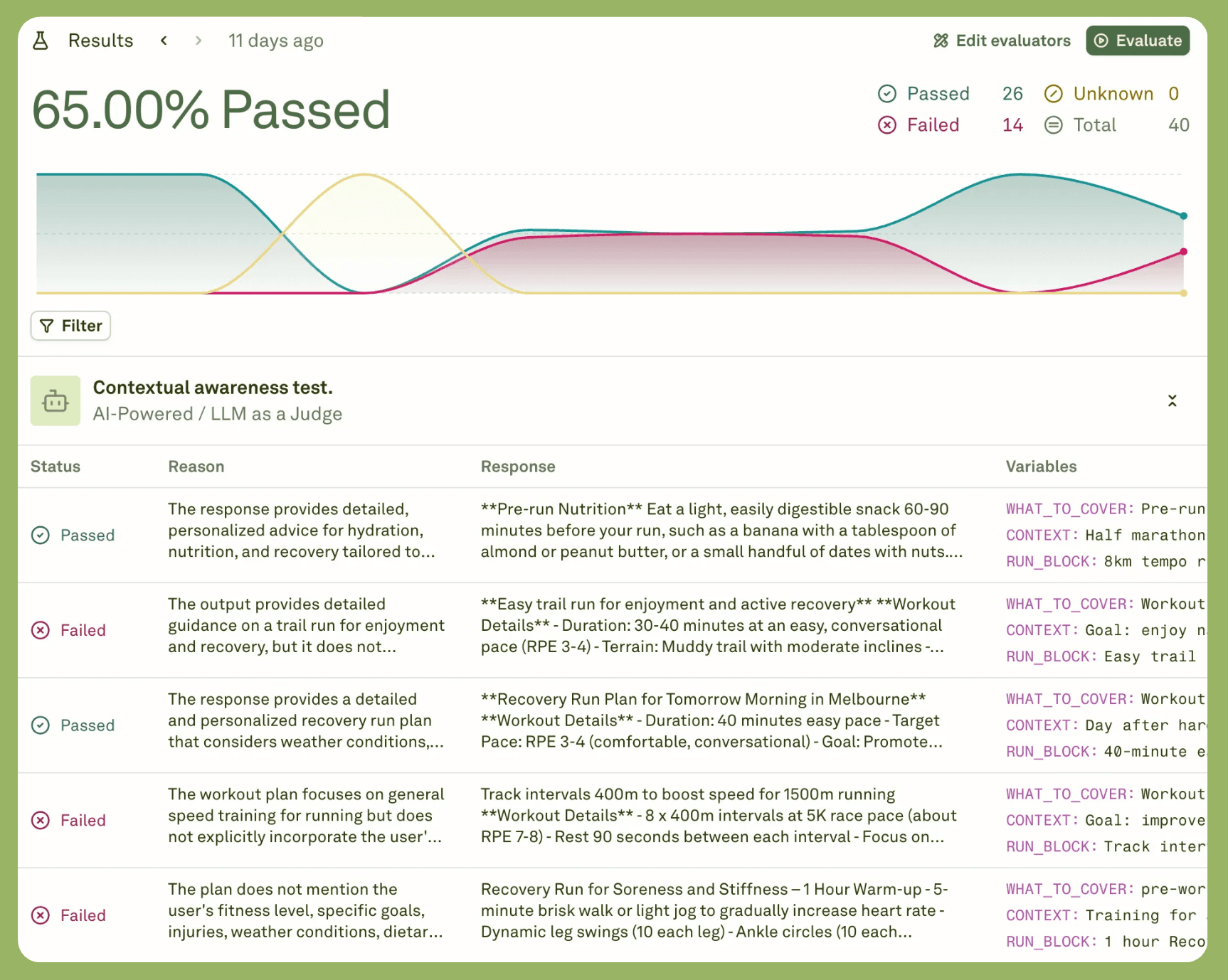
Context evaluation in Adaline using LLM-as-judge.
When the status shows failed, you know context rot is happening. Not three weeks later, when users report confusion, but immediately.
Second: Cross-model comparison across providers. Did upgrading from GPT-5.1 to GPT-5.2 break your prompt?

Version control and prompt deployment in Adaline.
Adaline tells you instantly. Model behaviors change. What worked on GPT-5 might fail on GPT-5.2—released yesterday [for instance]—because reasoning patterns shifted. Without side-by-side testing on your actual prompts with your actual data, you're deploying blind.
Third: Latency tracking, detecting context-length-induced slowdowns. When GPT-4.1 processes 400K characters, latency spikes from 1.5 seconds to 60 seconds—a 40x slowdown.
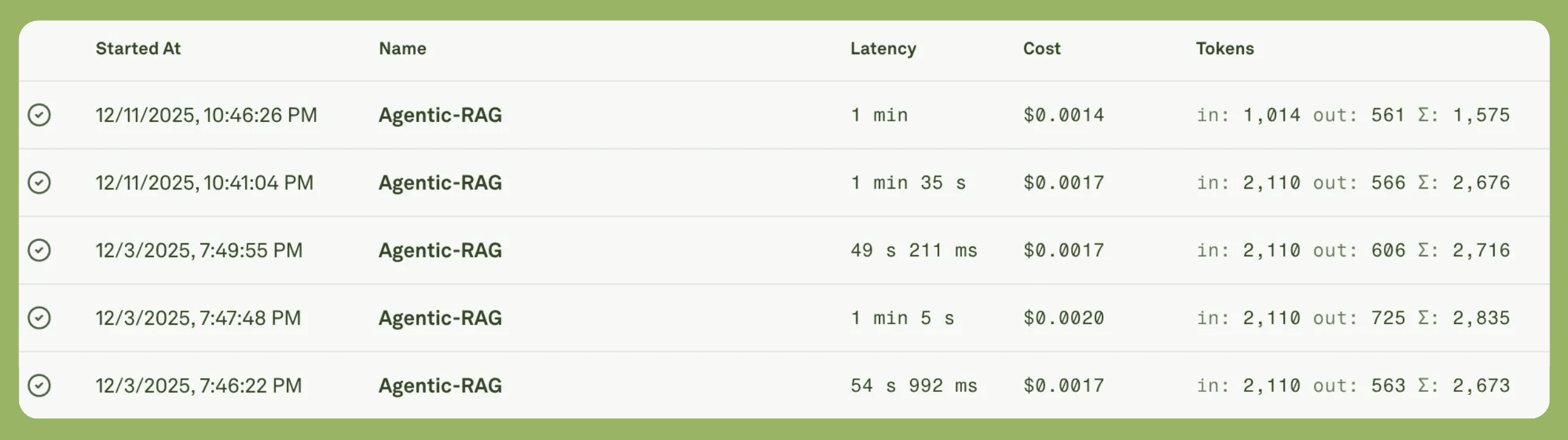
Adaline’s Dashboard shows latency, cost, and token usage per session call.
Your users won’t wait. Adaline catches this in testing, not production.

Observability in Adaline.
Don't guess. Measure. Every model update, every prompt change, every context length increase.
Conclusion
The model matters less than your architecture. Here's your decision framework:
The Cheat Sheet:
- Consumer Apps: Gemini 3 (native multimodal, real-time processing, highest reasoning benchmarks).
- Dev Tools: Claude 4.5 (Sonnet for execution loops, Opus for planning, 80.9% SWE-bench).
- Enterprise Logic: GPT-5.2 (Thinking Mode for high-stakes decisions, 400K context, audit trails).
But the real competitive advantage in 2026 isn't the model you choose. It's your ability to debug the model you chose.
Don't just build agents. Build agents you can fix when they break. Because they will break. The question is whether you'll know why.