
What is Active-Prompting?
Active-Prompting represents a fundamental shift from traditional prompt engineering approaches. Instead of relying on randomly selected or manually crafted examples, this technique uses uncertainty-based selection to identify the most challenging questions for human annotation.
Traditional Chain-of-Thought reasoning depends on fixed exemplars. These examples may not address the specific areas where language models struggle most. Active-Prompting solves this limitation through a systematic process.
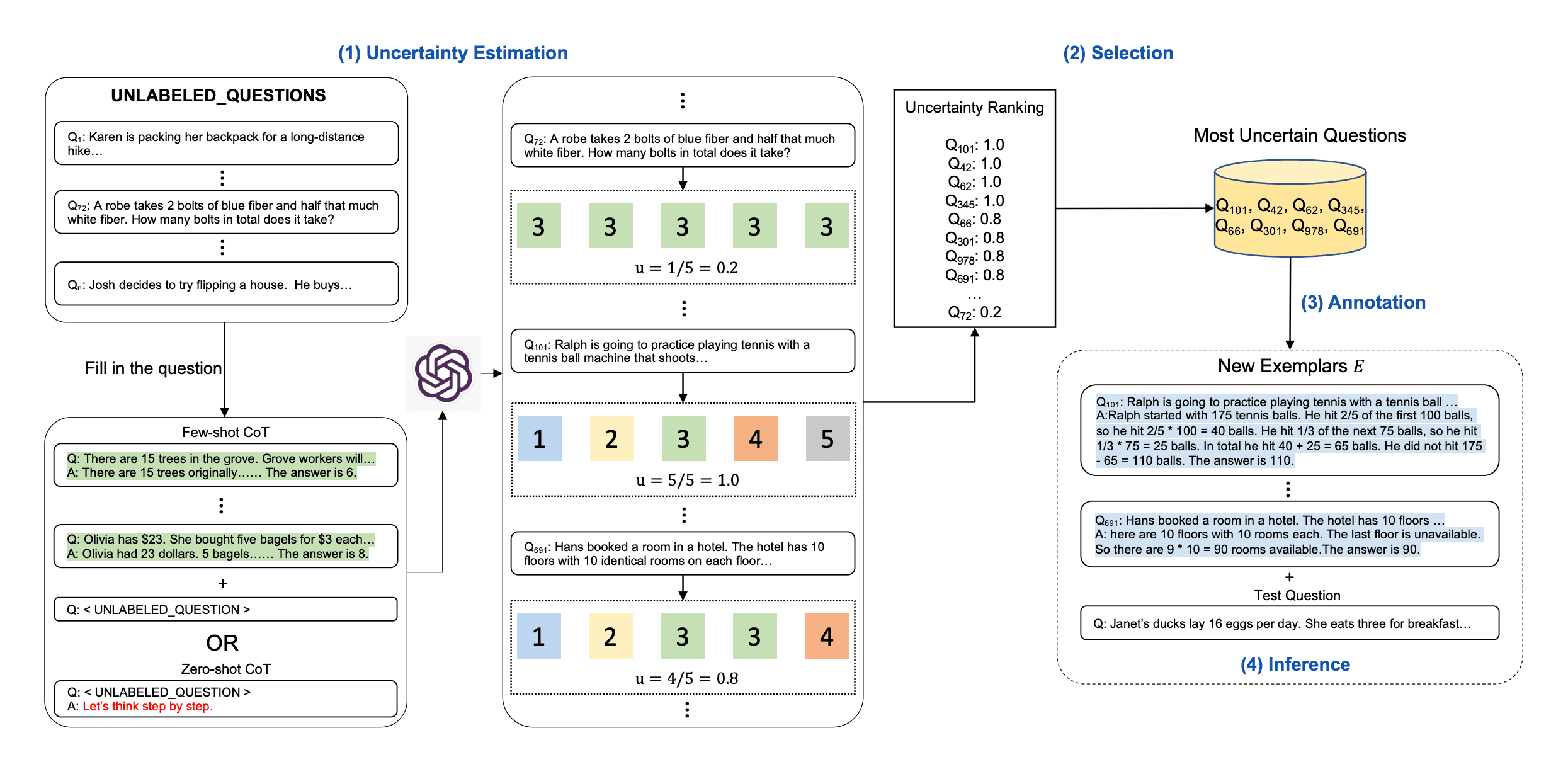
An illustration of active prompting. | Source: Active Prompting with Chain-of-Thought for Large Language Models
The methodology works in four stages:
- 1
Uncertainty Estimation
The model generates multiple responses to unlabeled questions. - 2
Selection
Questions with the highest uncertainty scores get prioritized. - 3
Annotation
Human experts provide corrections for these challenging cases. - 4
Inference
Updated exemplars improve model performance on similar tasks
Model uncertainty becomes the key metric for identifying valuable training opportunities. When an LLM produces inconsistent or conflicting answers across multiple attempts, it signals areas requiring human expertise.
This creates a powerful human-in-the-loop system. Rather than annotating thousands of random examples, teams focus effort where it matters most. Domain expertise gets applied precisely where models show weakness.
You can use Adaline to easily implement this concept.
- 1Simply upload the data.
- 2Write the prompt.
- 3Receive the initial response from the LLM.
- 4Evaluate the response.
- 5When outputs fall short, You can correct or iterate the prompt.
The iterative improvement cycle continues as more uncertain cases get identified and resolved. Each round makes the model more reliable for specific domains and use cases.
Performance enhancement emerges naturally from this selective annotation strategy. Research shows Active-Prompting consistently outperforms traditional methods across arithmetic, commonsense, and symbolic reasoning tasks by focusing human effort where uncertainty is highest.
Why use Active Prompting over other Prompting Techniques?
Active-Prompting delivers significant advantages over traditional prompting methods through its strategic approach to selective annotation and human-in-the-loop optimization.
Benefit 1: Maximized Human Annotation Efficiency
Traditional prompting wastes human effort on random examples. Active-Prompting targets only the most uncertain cases where models struggle most. This reduces annotation workload by up to 80% while achieving better results.
Consider a dataset with millions of rows. Random annotation requires labeling thousands of examples with unclear impact. Active-Prompting identifies the specific 50-100 cases where human expertise makes the biggest difference.
Benefit 2: Superior Performance on Complex Reasoning Tasks
Experimental evidence demonstrates consistent performance enhancement across multiple benchmarks:
Active-Prompting achieves 7.0% improvement over self-consistency methods while requiring fewer human-annotated examples.
Benefit 3: Reduced Model Hallucinations and Errors
Model uncertainty directly correlates with error-prone responses. By focusing corrections on uncertain predictions, Active-Prompting systematically reduces hallucinations in domain-specific applications.
Benefit 4: Transferability Across Models and Tasks
Research shows exemplars selected using uncertainty metrics transfer effectively between different model architectures. Questions identified as challenging by GPT-3.5-turbo remain valuable when applied to Llama models.
When to Avoid Active-Prompting
Skip this approach when human annotation costs exceed benefits, for simple classification tasks, with datasets under 100 examples, or when immediate deployment is required without iterative improvement cycles.
How Active-Prompting Works — Step by Step
Active-Prompting follows a systematic four-stage workflow that transforms uncertain model predictions into reliable training examples through uncertainty estimation and targeted human feedback.
Stage 1: Uncertainty Estimation
The model generates multiple responses (typically k=10) for each unlabeled question. This repeated sampling reveals inconsistencies that signal uncertainty.
Three primary metrics measure model uncertainty:
- Disagreement: Counts unique answers divided by total attempts (u = h/k)
- Entropy: Measures randomness in answer distribution
- Variance: Calculates spread in numerical responses
For example, if a model produces answers [3, 3, 5, 3, 7] across five attempts, the disagreement score is 3/5 = 0.6. Assuming 3 is the correct answer.
Stage 2: Selection
Questions receive uncertainty rankings. Those with highest scores get prioritized for human annotation. Research shows optimal performance using pools of 1,000 candidate questions.
Stage 3: Human Annotation
Domain experts review selected uncertain cases and provide correct Chain-of-Thought (CoT) reasoning, along with final answers. This selective annotation targets where human expertise delivers maximum impact.
Stage 4: Inference
Newly annotated exemplars replace original examples in the prompt. The enhanced prompts improve performance on similar reasoning tasks through better guidance.
Implementation Variants
- 1
Few-Shot Active
Prompting starts with existing human examples to stabilize initial predictions. - 2
Zero-Shot Active
Prompting uses "Let's think step by step" prompts without prior examples.
The iterative improvement cycle continues as new uncertain cases emerge. Each round of selective annotation makes the model more reliable for specific domains while minimizing human annotation costs.
Prompt Templates
Active-Prompting adapts to various task types through flexible template structures that enable systematic uncertainty estimation and human feedback integration.
Unstructured Prompts
These templates handle open-ended responses requiring detailed reasoning:
Information Extraction Prompts
Structured extraction tasks use specific output formats:
Structured Prompts
Multiple-choice templates enable precise uncertainty measurement:
Semi-Structured Prompts
Hybrid templates combine multiple question types:
Human Feedback Templates
Correction formats guide domain expertise:
This template variety ensures Active-Prompting works across reasoning tasks while maintaining consistent uncertainty measurement and selective annotation workflows.
Empirical Performance
Active-Prompting demonstrates consistent performance enhancement across diverse reasoning tasks and model architectures through systematic empirical evaluation.
Cross-Dataset Performance
Evaluation across eight benchmark datasets reveals substantial improvements over traditional methods:
Active-Prompting achieves an average 7.0% improvement over self-consistency with text-davinci-002 and 1.8% improvement with code-davinci-002.
Model Comparisons
Performance scales consistently across different model sizes:
- Code-davinci-002: 80.9% average (Active-Prompt) vs 79.1% (Self-Consistency)
- Text-davinci-002: 74.9% average vs 67.9% baseline
- GPT-3.5-turbo: 81.0% vs 78.5% traditional CoT
- Llama-2-70b: 57.7% vs 54.8% baseline
Task-Specific Improvements
Arithmetic reasoning shows 2.1% average improvement with code-davinci-002. Largest gains appear in GSM8K (4.2%) and AQuA (3.1%) where direct annotation is possible.
Commonsense and symbolic reasoning tasks demonstrate consistent improvements across all benchmarks.
Uncertainty-Accuracy Correlation
Research reveals strong negative correlation between model uncertainty and accuracy. As uncertainty decreases through selective annotation, accuracy increases proportionally.
This correlation validates the core hypothesis that targeting uncertain cases maximizes human annotation impact while reducing model hallucinations through iterative improvement cycles focused on challenging reasoning tasks.
Choosing the right LLM for Active Prompting in 2025
Selecting the optimal large language model for Active Prompting depends on specific technical requirements that enable effective uncertainty estimation and iterative improvement cycles.
Key Technical Requirements
Active Prompting demands models that support multiple response generation for uncertainty calculation. The technique requires generating k = 10 responses per question to measure disagreement, entropy, or variance across outputs.
Models must provide consistent API access for repeated sampling. Batch processing capabilities reduce costs when generating multiple responses across large candidate pools of 1,000+ questions.
Top Performers in 2025
GPT-4.5/4o Series: OpenAI’s latest models excel at Chain-of-Thought reasoning with 128K token context windows. GPT-4.5 achieves 85.1% on MMLU benchmarks while maintaining consistency across multiple generations. The extended memory enables processing complex reasoning chains without losing context.
Gemini 2.5 Pro: Google’s newest model leads reasoning benchmarks with 1M+ token context windows. Built on a thinking model architecture, it demonstrates strong uncertainty patterns that correlate well with actual knowledge gaps.
Claude 3.7/4 Sonnet: Anthropic’s models show excellent calibration between confidence and accuracy. Claude 4 Sonnet provides reliable uncertainty signals while excelling in real-world reasoning tasks.
DeepSeek R1/V3: Offers strong reasoning capabilities with 128K+ context and cost-effective API pricing. The open-source nature enables custom uncertainty metric implementation.
Llama 4 Maverick: Meta’s latest provides 10M token context windows with competitive reasoning performance. The massive context enables processing entire datasets for uncertainty estimation.
Selection Criteria Matrix
Choose models based on task complexity, budget constraints, and required uncertainty precision for optimal Active Prompting performance enhancement.
Pros, Cons & Common Pitfalls
Active-Prompting offers significant advantages while introducing specific challenges that teams must navigate for successful prompt optimization.
Key Advantages
- 1Efficiency dominates the benefits list. Active-Prompting reduces annotation burden by 80-90% compared to labeling entire datasets. Teams focus efforts where it matters most.
- 2Performance enhancement appears consistently across reasoning tasks and model architectures. Research demonstrates improvements ranging from 1.8% to 7.0% over traditional methods.
- 3Transferability enables cost savings. Examples selected for one model often work effectively with others. This cross-model compatibility reduces redundant annotation work.
- 4Scalability handles massive datasets. Implementations successfully process millions of rows while maintaining selective annotation principles.
Notable Limitations
Human dependency remains unavoidable. Domain expertise quality directly impacts results. Poor annotations can degrade rather than improve performance.
Computational overhead requires multiple model inferences. Uncertainty estimation typically needs k=10 generations per question, increasing API costs.
Limited scope means Active-Prompting works best for complex reasoning tasks. Simple classification problems may not justify the additional complexity.
Common Implementation Pitfalls
Transfer assumptions prove dangerous. Examples don't always work across vastly different domains without modification.
Over-engineering wastes resources. Apply Active-Prompting only when traditional methods show clear limitations and iterative improvement justifies the human-in-the-loop investment.
Conclusion
Active-Prompting represents a strategic advancement in prompt engineering that maximizes human expertise while minimizing annotation costs. The technique transforms traditional trial-and-error approaches into systematic, uncertainty-driven optimization cycles.
Research demonstrates consistent performance improvements ranging from 1.8% to 7.0% across reasoning tasks. These gains emerge from targeting human effort precisely where models struggle most, rather than annotating random examples.
The methodology scales effectively across different model architectures and task types. Teams can implement Active-Prompting using existing tools like Adaline to create iterative improvement workflows without extensive infrastructure changes.
Success depends on proper implementation. Use candidate pools exceeding 1,000 questions, apply appropriate uncertainty metrics, and ensure high-quality domain expertise during annotation phases.
Active-Prompting works best for complex reasoning tasks where model uncertainty correlates with actual knowledge gaps. Simple classification problems may not justify the additional computational overhead and human-in-the-loop complexity required for optimal results.
FAQ
What does prompt mean?
A prompt is the input instruction you give to a language model to guide its response. Think of it as a question or command that tells the AI what you want it to do.
What are some examples of prompts?
Simple prompts include "Summarize this article" or "Translate to Spanish." Complex prompts involve Chain-of-Thought reasoning like "Solve this math problem step by step, showing your work."
What is a reasoning prompt?
A reasoning prompt asks the model to think through problems logically. It encourages step-by-step analysis rather than direct answers. Examples include “Let's think step by step”, "Explain your reasoning," or "Break this problem into steps."
What are the five examples of reasoning?
- 1Arithmetic reasoning: solving math problems with calculations.
- 2Commonsense reasoning: applying everyday knowledge.
- 3Logical reasoning: following rules and premises.
- 4Causal reasoning: understanding cause-and-effect relationships.
- 5Analogical reasoning: drawing comparisons between similar situations.
These reasoning tasks benefit most from uncertainty-based selection and selective annotation in Active Prompting workflows.