
AI systems that can critique their work represent a significant advancement in machine learning. The Reflection Pattern enables Large Language Models (LLMs) to generate, evaluate, and refine content iteratively—creating a feedback loop that mirrors human revision processes. This capability transforms Artificial Intelligence (AI) from static response generators into dynamic systems capable of continuous self-improvement without additional human input.
The technical mechanism relies on structured generation, self-assessment, and refinement cycles. Initial outputs undergo critical evaluation against specific quality criteria before improvements are applied. Memory structures help track decisions across iterations, while defined stopping conditions prevent infinite reflection loops.
Implementing this pattern directly addresses key challenges faced by teams building AI products. It significantly reduces error rates, improves overall output quality, and enables more autonomous behaviors in applications ranging from code generation to content creation. The resulting systems require less human oversight while delivering more reliable results.
In this article we will cover:
- 1Core components: generation, self-assessment, and refinement phases
- 2Technical implementations: Self-RAG, multi-agent architectures, memory integration
- 3Production applications: code generation, problem-solving, content creation
- 4Implementation challenges: computational overhead, architecture complexity
- 5Optimization strategies: custom reflection criteria, parallel processing
Let's explore the foundational concepts of this powerful pattern to understand how it transforms AI capabilities.
What is the reflection pattern in AI?
The Reflection Pattern in AI enables models to improve outputs through iterative self-assessment cycles. It follows a three-stage process: generation (creating initial output), reflection (self-critique), and refinement (applying improvements). This approach mimics human revision processes where we examine our work, identify flaws, and make corrections.
Core mechanism
The pattern creates a feedback loop allowing AI systems to evaluate their responses before delivering final outputs. This self-critique capability proves particularly valuable for LLMs generating text or code.
Implementation requirements
Implementing the Reflection Pattern requires careful prompt engineering with distinct prompts for generation and critique phases. Many implementations use different personas for these stages to ensure thorough evaluation. Defining stopping conditions is essential to prevent infinite loops, such as fixed iterations, quality thresholds, or time limits.
Real-world applications
The pattern excels in several domains:
- Code development with progressive improvements
- Essay writing with iterative refinement
- Complex problem-solving requiring careful analysis
A single-sentence implementation can transform output quality dramatically.
Integration with agentic systems
The Reflection Pattern integrates naturally with agentic AI systems. This allows them to:
- Adapt behaviors based on past performance
- Recognize error patterns across multiple tasks
- Develop meta-agency through consistent self-evaluation
Advanced implementations like Self-RAG build on this pattern to improve factuality in AI outputs through on-demand retrieval and self-critique.
To understand how this pattern works at a technical level, we must examine the underlying mechanisms that enable AI systems to reflect on their own outputs.
Technical mechanisms behind AI reflection
Internal feedback loops
AI reflection relies on recursive feedback mechanisms that allow models to revisit their outputs. This process enables language models to evaluate reasoning, identify inconsistencies, and refine future outputs. The model creates an internal loop to assess its reasoning before delivering a final response.
Memory and context structures
Instead of processing each interaction in isolation, reflective AI develops memory-like structures to track context. These structures allow models to learn from past conversations, improving coherence and depth in responses. This tracking mechanism serves as the foundation for meaningful self-critique.
Uncertainty assessment systems
AI reflection incorporates uncertainty estimation capabilities. The system programmatically assesses confidence levels in different parts of its response. This allows it to flag uncertain elements for refinement or verification, increasing overall reliability.
Self-critique architecture
Advanced AI architectures like Anthropic’s Constitutional AI implement multi-agent structures with separate “Reflective" and “Reactive" components. The Reflective agent critiques the Reactive agent’s outputs by comparing them against external data sources. This system identifies missing information, irrelevant details, and reasoning flaws.
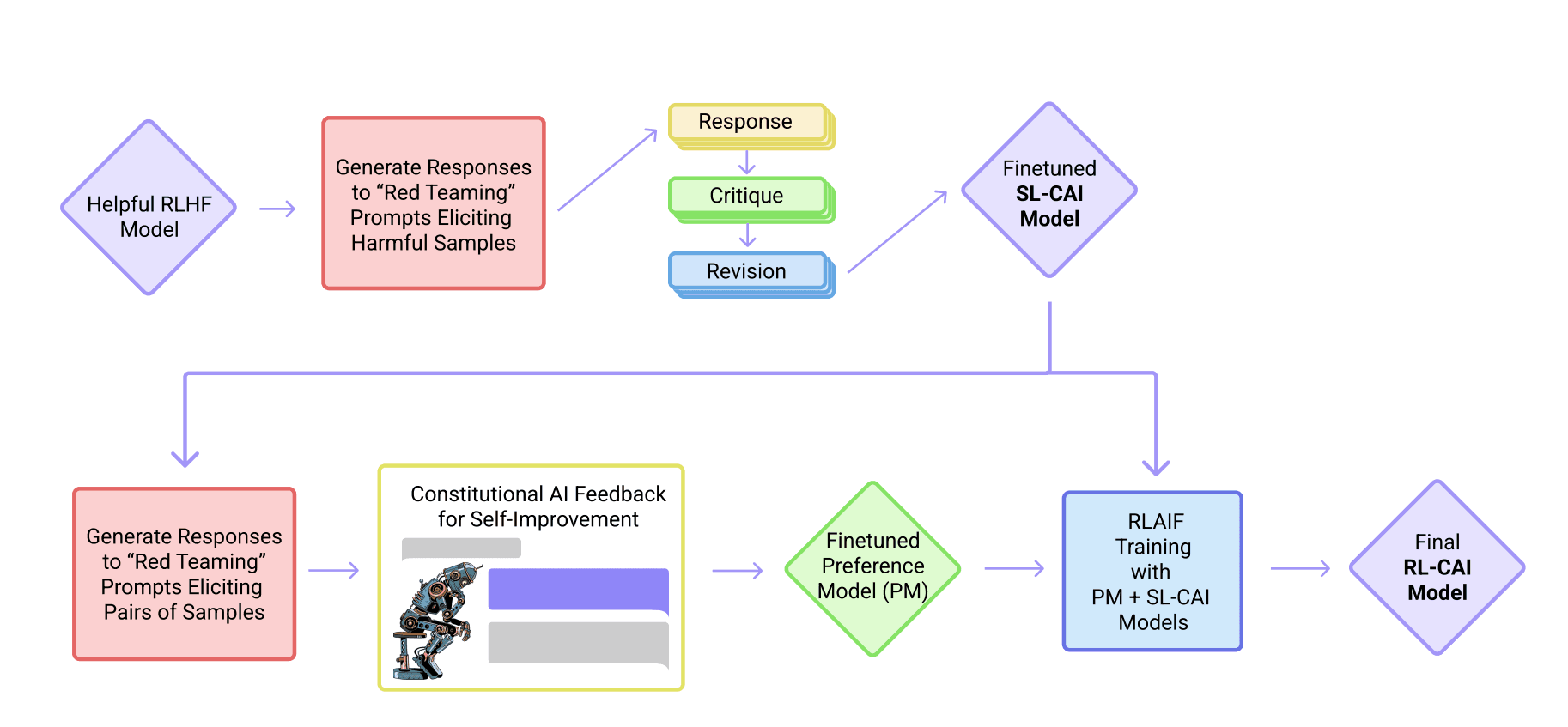
Workflow of Anthropic’s constitutional AI | Source: Constitutional AI: Harmlessness from AI Feedback
Iterative refinement process
The generate-reflect-revise cycle powers effective AI reflection. After producing an initial response, the model evaluates its quality, identifies improvements, and regenerates content. This cycle repeats until the output meets predetermined quality standards, simulating human revision processes.
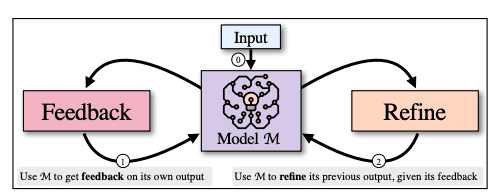
Self-Refine: An iterative process where a language model generates output, critiques its own work, and repeatedly refines it based on self-feedback until completion—all without human assistance. I Source: SELF-REFINE: Iterative Refinement with Self-Feedback
To build a complete understanding of the reflection pattern, we must examine each component in detail and see how they work together to create self-improving AI systems.
Core components of the AI reflection pattern
Generation phase
The reflection pattern begins with an initial generation phase. During this step, the AI system creates its first output based on user input. This could be text, code, or problem-solving attempts. For example, the agent produces an initial script in code generation tasks to solve a programming challenge. This generation serves as the foundation for subsequent improvement cycles.
Self-assessment phase
Following initial generation, the system enters a critical self-assessment phase. The AI evaluates its own output using defined criteria such as accuracy, completeness, and logical consistency. This can be implemented through:
- 1Self-reflection prompts that ask questions like "Is this response accurate?" or "Is there a better approach?"
- 2Secondary "critic" agents specifically designed to evaluate the primary agent's output
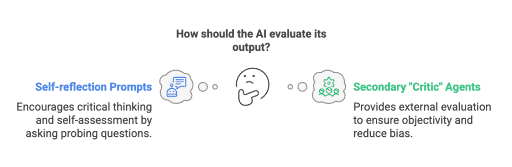
Self-assessment acts as an analytical checkpoint before any refinements occur, ensuring issues are properly identified.
Refinement stage
The third core component involves applying improvements based on the self-assessment. The system modifies its initial output to address identified weaknesses. This iterative process may involve multiple cycles of reflection and refinement until the output meets quality thresholds. The refinement stage is where the true power of reflection emerges as outputs progressively improve.
Memory integration
Effective reflection systems incorporate both short-term and long-term memory structures:
- Short-term memory retains current context and recent processing decisions
- Long-term memory holds historical patterns and learned improvements
This memory architecture allows agents to avoid repeating past errors and build on successful approaches.
Convergence mechanism
To prevent infinite reflection loops, well-designed systems implement defined stopping conditions. These may include:
- Fixed iteration counts
- Quality threshold measurements
- Time-based limitations
Such mechanisms ensure the reflection process terminates appropriately when improvements plateau or requirements are met.
The integration of these components creates a powerful pattern for self-improving AI systems that can analyze their own outputs, identify shortcomings, and continuously enhance performance through structured feedback loops. One particularly impressive implementation of this pattern can be seen in Self-RAG, which combines reflection with retrieval-augmented generation.
Self-RAG: Reflection pattern implementation
Self-RAG (Self-Reflective Retrieval-Augmented Generation) implements the reflection pattern to enhance factuality and quality in LLM outputs. Unlike traditional RAG that always retrieves a fixed number of passages, Self-RAG dynamically determines when retrieval is necessary and evaluates the relevance of information.
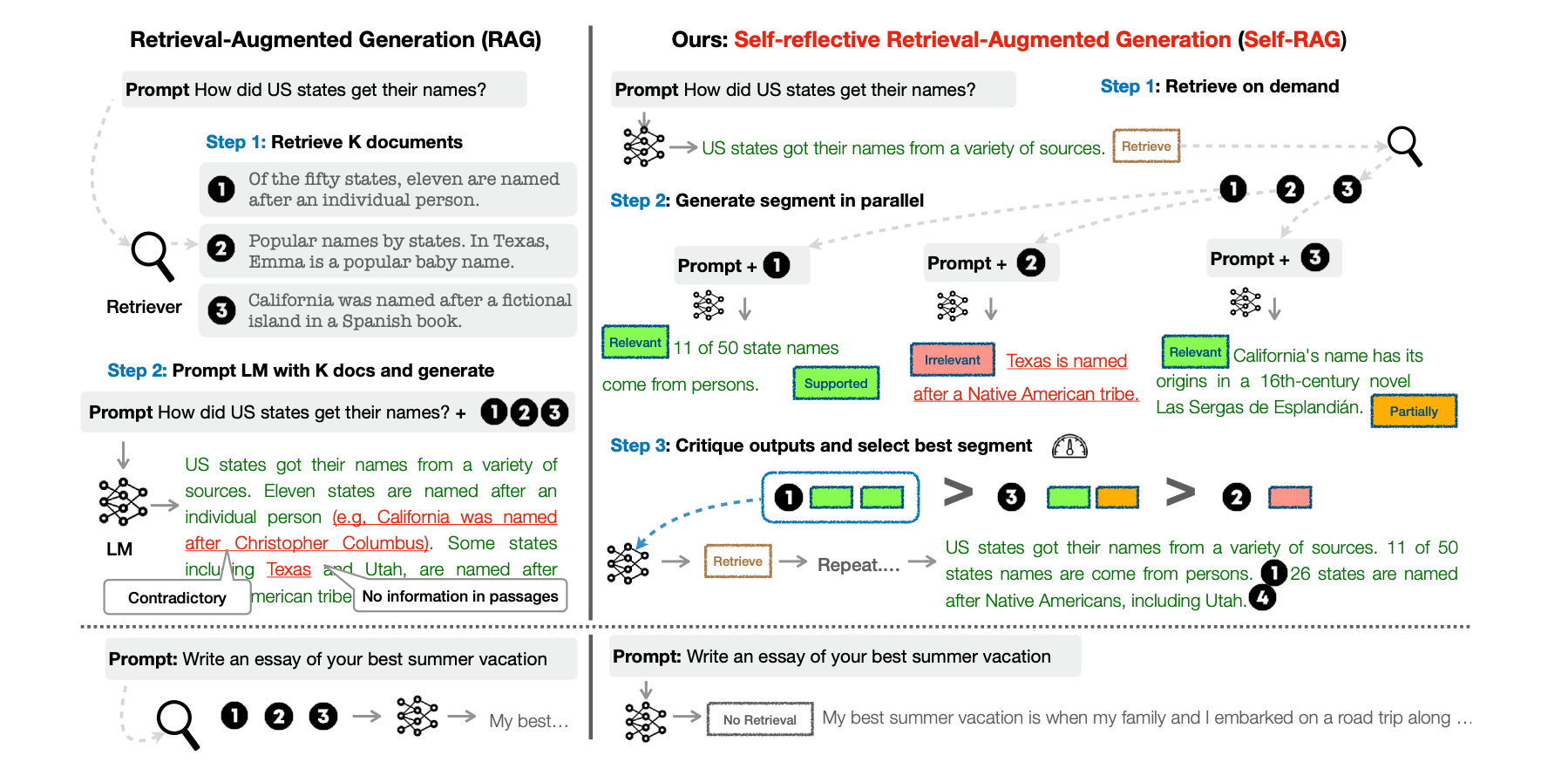
Illustration showing the difference between traditional RAG and Self-RAG | Source:
Self-RAG: Learning to Retrieve, Generate, and Critique through Self-Reflection
Key components of Self-RAG
The implementation uses special reflection tokens added to the model’s vocabulary:
- Retrieve: Determines if external knowledge retrieval is necessary
- ISREL: Evaluates if retrieved passages are relevant to the query
- ISSUP: Checks if generated content is supported by retrieved passages
- ISUSE: Rates the overall usefulness of the response
Implementation workflow
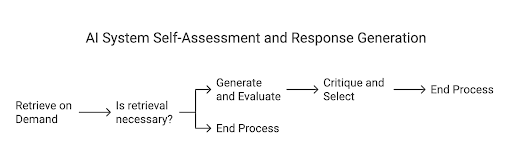
The Self-RAG process follows three main stages:
- 1Retrieve on demand: The model first decides if retrieval is necessary rather than retrieving for every query. This adaptive approach prevents information overload.
- 2Generate and evaluate: When retrieval occurs, the model processes multiple passages simultaneously, evaluating relevance with ISREL tokens and generating responses based on relevant information.
- 3Critique and select: The model critiques its own output using ISSUP tokens to verify factual accuracy and ISUSE tokens to assess overall quality.
Technical architecture
Self-RAG training consists of three models:
- A Retriever that fetches relevant documents
- A Critic that evaluates passages and generations
- A Generator that produces responses and reflection tokens
During inference, Self-RAG conducts beam search with critique tokens to identify the best continuations at each step, balancing factuality and usefulness.
Performance benefits
Experiments show Self-RAG significantly outperforms traditional RAG approaches and even some commercial models like ChatGPT. It achieves higher accuracy on open-domain question answering, reasoning, and fact verification tasks by dynamically managing retrieval and implementing self-critique.
This implementation demonstrates how the reflection pattern enhances RAG by allowing models to determine when to retrieve, what to retrieve, and how to critique their own outputs for improved factuality and usefulness. Moving from theoretical implementations to practical applications, let’s examine how to implement reflection in production AI systems.
Implementing reflection in production AI systems
Understanding the reflection pattern
Reflection in AI systems involves careful review of decisions and outputs before final delivery. This approach allows AI agents to evaluate themselves, recognize weaknesses, and develop better outputs. Reflection reduces mistakes and optimizes task efficiency through iterative improvement.
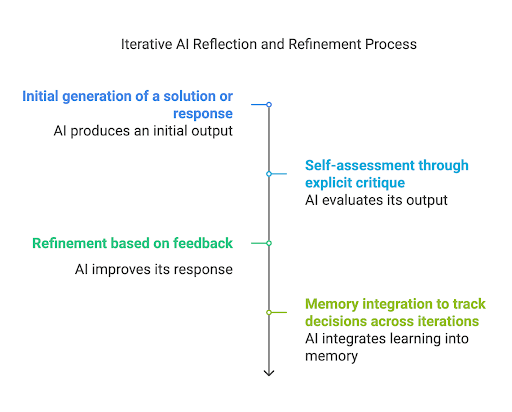
The reflection process follows well-defined steps in how agents iteratively produce outputs:
- 1Initial generation of a solution or response
- 2Self-assessment through explicit critique
- 3Refinement based on feedback
- 4Memory integration to track decisions across iterations
Architecture considerations
A reflection-enabled AI system typically includes several key components:
- Master agent: Orchestrates the overall process, identifying strategies and coordinating between producer and critic agents
- Producer agent: Combines language model capabilities with rules-based processing to generate initial solutions
- Reflection agent: Analyzes the producer's output using reflection engine and knowledge graph, providing improvement recommendations
- Memory architecture: Implements both short-term memory for immediate context and long-term memory for historical trends
Implementation challenges
Implementing reflection in production systems presents several significant challenges:
- Computational overhead: Reflection processes increase system complexity and resource requirements
- Architecture complexity: Integrating reflection into existing systems may require substantial restructuring
- Scalability: Maintaining efficiency as task complexity increases can be difficult
- Over-reflection: Agents may become locked in reflection loops, delaying decisions
Optimization strategies
To address these challenges, several optimization approaches can be employed:
- Custom reflection criteria: Specify when and how reflection should be triggered based on thresholds or importance
- User-controlled feedback: Make reflection processes observable and controllable through monitoring tools
- Dynamic learning: Implement sensitivity to reflection strategy based on user interaction and outcomes
- Parallel processing: Execute reflection tasks concurrently to minimize latency
Performance benchmarks
Experimental results demonstrate significant improvements when using reflection in production systems:
- Error reduction in critical domains such as financial modeling and healthcare
- Output optimization through iterative refinement
- Adaptive capabilities that respond to specific task requirements
- Long-term learning that prevents repeated mistakes
In manufacturing, reflection-enabled AI can identify bottlenecks and enhance production throughput. In healthcare, multi-agent systems can optimize resource allocation and maintenance planning.
The integration of reflection patterns transforms AI systems from simple response generators to thoughtful, self-improving agents capable of delivering higher quality outputs in production environments. One particularly powerful application of reflection is in code generation, where quality and accuracy are paramount.
AI Reflection for code generation and refinement
Understanding reflection in AI code generation
Reflection enables AI agents to self-evaluate and refine their outputs before delivery. This capability is especially valuable when generating code, where accuracy and quality are paramount. The reflection process follows a structured pattern of generation, self-critique, and refinement.
The process begins with initial code generation based on a user request. Then, a reflection mechanism triggers evaluation of the generated code. This can happen through self-reflection prompts ("Is this code efficient?") or by using a separate critic agent to review the output.
How reflection works for code improvement
The reflection cycle consists of several distinct stages:
- 1Initial code generation based on the user's requirements
- 2Critical evaluation of the code for correctness, style, and efficiency
- 3Specific feedback identifying weaknesses or potential improvements
- 4Refined implementation incorporating the critical feedback
This pattern mirrors human coding practices where developers review and refine their work before finalization. For code generation tasks, reflection helps identify bugs, inefficient algorithms, and style issues that might not be apparent in the first draft.
Key benefits of reflection in coding tasks
Reflection significantly improves code quality across multiple dimensions. Research shows that reflection-enabled models achieve state-of-the-art results on benchmarks like HumanEval and MBPP.
Error reduction is a major benefit. Before delivering the final code, AI systems can detect logical errors, security vulnerabilities, and edge cases. This prevents downstream issues that might be costly to fix later.
Code optimization also improves through reflection. The system can identify inefficient patterns and suggest more elegant or performant alternatives.
Implementation approaches
Multiple implementation strategies exist for reflection in code generation:
- 1Single-agent reflection where the AI reviews its own output
- 2Multi-agent frameworks with separate generator and critic roles
- 3Tool-assisted reflection that runs code through tests or external validators
Self-RAG and Constitutional AI architectures implement advanced reflection techniques where separate reflective and reactive components collaborate to improve code quality.
Challenges and limitations
Despite its benefits, reflection introduces some tradeoffs. Computational overhead increases with each cycle of reflection. This can impact response time and resource usage.
Architecture complexity also increases when adding reflection capabilities to existing systems. This may require more robust feedback mechanisms and memory structures. Over-reflection presents another risk: the system becomes locked in improvement loops that delay final output delivery.
Having explored both the technical implementations and practical applications of reflection in code generation, we can now summarize this powerful pattern's key insights and implications.
Conclusion
The Reflection Pattern represents a fundamental shift in how AI systems operate—from single-pass generation to iterative self-improvement cycles. By implementing structured feedback loops of generation, self-critique, and refinement, AI systems can significantly enhance output quality while reducing the need for human intervention.
Key technical takeaways include the importance of well-designed prompts for both generation and critique phases, the value of memory structures for tracking decisions across iterations, and the necessity of defined stopping conditions to prevent infinite loops. Self-RAG demonstrates how reflection can be integrated with retrieval mechanisms to enhance factuality in responses.
For product teams, reflection capabilities offer several strategic advantages: reduced QA overhead through self-verification, improved user satisfaction from higher quality outputs, and faster iteration cycles when building complex AI features. Engineers should consider computational trade-offs and architecture requirements when implementing reflection, while leadership can leverage this pattern to deliver more autonomous, reliable AI products that require less human oversight—ultimately creating more sustainable AI development workflows.