
The Complete Path to Becoming an AI Engineer in 2025
Transforming your career into AI engineering requires navigating a complex landscape of technical skills, specializations, and implementation patterns. This comprehensive guide maps the journey from foundational knowledge to specialized expertise, equipping you with actionable strategies to build, deploy, and maintain production AI systems. Understanding both the technical requirements and market dynamics helps position yourself effectively in this high-growth field.
The article covers essential skill areas including Python programming, machine learning algorithms, deep learning frameworks, and MLOps practices. We examine framework selection, cloud platform integration, and specialized paths in computer vision, NLP, and reinforcement learning. Each section provides practical implementation advice rather than just theoretical concepts.
This roadmap solves common challenges faced when transitioning into AI engineering, including skill prioritization, specialization selection, and portfolio development. You'll find concrete strategies to demonstrate your capabilities to potential employers and navigate technical interviews effectively.
Here’s the overview of the article:
- Career landscape and market analysis
- Technical foundations and programming requirements
- Data engineering fundamentals
- Machine learning algorithms and evaluation
- Deep learning framework selection
- Specialization paths and implementation patterns
- Portfolio development and interview preparation
AI engineering career landscape: Role definition and market analysis
Distinguishing AI engineers in tech organizations
AI Engineers occupy a distinct position in modern tech structures. Unlike Data Scientists who focus on exploratory analysis and research, AI Engineers develop and deploy ML models into applications and systems. They bridge the gap between theoretical models and real-world implementation, ensuring scalability and integration with existing software.
Machine Learning Engineers, by contrast, focus more on building and optimizing the models themselves. While an ML Engineer might develop a custom computer vision model from scratch, an AI Engineer typically implements pre-built AI via APIs to create complete applications with AI as the core feature.
Compensation and market growth
The financial outlook for AI Engineers is exceptional. Salary ranges typically span from $120,000 to $250,000 annually, with some FAANG companies offering as high as $300,000-$400,000 plus stock options.
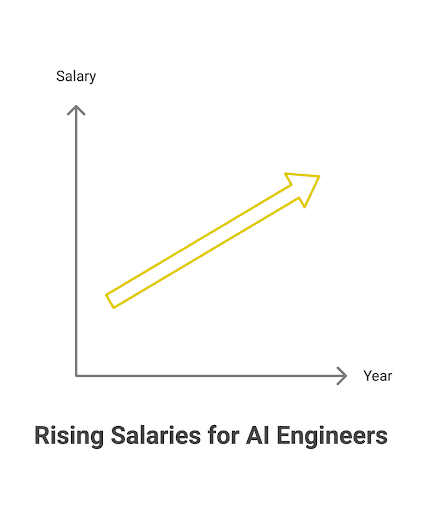
The U.S. Bureau of Labor Statistics projects a 23% growth rate for AI-related jobs through 2035—approximately five times the average industry growth rate. This surge reflects the widespread adoption of AI across virtually all sectors.
Evolution of technical requirements
Technical requirements for AI Engineers have transformed with the emergence of Large Language Models (LLMs) and production AI systems. Today's AI Engineers need proficiency in:
- 1LLM integration capabilities, including prompt engineering and API implementation
- 2MLOps skills for managing the full AI lifecycle from development to deployment
- 3Cloud infrastructure expertise for scalable AI systems
- 4Ethical AI implementation knowledge to ensure responsible deployment
The field increasingly requires versatility beyond pure engineering—modern AI Engineers must understand domain-specific challenges while bridging technical implementation with business strategy. This versatility extends to the technical foundations that power AI engineering work.
Technical foundations: Educational background and programming proficiency
Comparing educational pathways
Computer science, mathematics, and domain-specific degrees offer structured learning paths with clear academic foundations. Studies show graduates with these degrees often secure interviews more easily due to credential recognition. However, self-taught pathways demonstrate equally strong performance outcomes in technical assessments when coupled with extensive portfolio work.
The formal education route provides theoretical depth and networking opportunities. Self-taught engineers excel through targeted skill acquisition and practical implementation experience.
Python ecosystem requirements
Proficiency in the Python ecosystem forms the backbone of AI engineering work. This includes:
- NumPy for mathematical operations and array manipulation
- Pandas for data transformation and analysis
- Scikit-learn for implementing standard machine learning algorithms
Production-level code requires familiarity with additional patterns beyond basic implementation:
- Modular code organization
- Version control integration
- Testing frameworks implementation
- Documentation standards
Secondary language considerations
While Python dominates the field, secondary languages serve specific technical needs:
- Java offers enterprise-level stability for production systems requiring scalability
- C++ provides performance optimization for computational bottlenecks and real-time applications
Implementation patterns vary by language. Java implementations typically leverage object-oriented design patterns. C++ work focuses on memory management and computational efficiency.
Mathematical foundations
Strong mathematical knowledge enables effective model implementation and understanding:
- Linear algebra operations form the basis of model transformations, especially matrix multiplication and vector spaces
- Calculus concepts support optimization through gradient descent and backpropagation
- Probability frameworks enable statistical modeling through Bayesian approaches and distribution analysis
Practical implementation requires translating these mathematical concepts into code efficiently.
Engineers must balance theoretical understanding with practical application skills to succeed in building robust AI systems. Beyond these foundations, AI engineers need strong data engineering skills to ensure their models receive high-quality input data.
Data engineering fundamentals for AI implementation
Building robust data pipelines
Data pipeline architecture forms the backbone of successful AI systems. Apache Airflow is a powerful tool for orchestrating complex workflows and scheduling critical tasks. These pipelines transform raw data into AI-ready formats through systematic processes. A well-designed pipeline ensures data flows smoothly from collection to model training.
Data quality assurance must be integrated throughout the pipeline. Tools like Great Expectations help catch issues early before they compromise model performance. Early detection prevents the cascade of errors that could otherwise undermine AI effectiveness.
Monitoring plays a crucial role in maintaining pipeline health. Real-time monitoring tools like Prometheus or custom dashboards detect anomalies quickly. This vigilance ensures minimal downtime and maintains data integrity.
Feature engineering techniques
Feature engineering transforms raw data into meaningful model inputs. Numerical transformations convert raw values into formats that algorithms can process efficiently. These include scaling, normalization, and logarithmic transformations that enhance model learning.
Categorical encoding methods convert text or label data into numerical formats. One-hot encoding, label encoding, and embedding techniques provide different approaches based on data characteristics. The right encoding method can significantly improve model performance.
Dimensionality reduction approaches like Principal Component Analysis help manage complex datasets. These techniques extract essential information while reducing noise and computational requirements. A streamlined feature set often leads to more robust models.
Ensuring data quality
Data validation methodologies verify data meets expected standards before entering the AI workflow. Validation checks for completeness, consistency, and correctness help prevent models from learning from flawed inputs. This preventive approach saves significant debugging time downstream.
ETL (Extract, Transform, Load) processes form the structured approach to data preparation. These processes standardize data handling procedures across an organization. Well-documented ETL procedures ensure reproducibility and reliability.
The impact of data quality on model performance cannot be overstated. Even sophisticated algorithms produce poor results when trained on low-quality data. Regular quality assessments should be standard practice for any AI implementation. With high-quality data pipelines in place, AI engineers can then focus on implementing effective machine learning algorithms.
Machine learning algorithms and evaluation frameworks
Supervised learning implementation patterns
Machine learning engineers rely on various algorithm implementation patterns. Decision trees provide interpretable models with clear decision paths. Ensemble methods like Random Forest and Gradient Boosting combine multiple models to achieve higher accuracy. Linear models remain fundamental for their simplicity and efficiency in many applications.
Unsupervised learning techniques
Clustering methodologies organize data into groups based on similarity, helping discover hidden patterns. These techniques prove valuable for customer segmentation and anomaly detection systems that identify outliers in datasets. Dimensionality reduction applications like PCA compress data while preserving important information, making models more efficient.
Proper technique selection depends on your specific use case and data characteristics.
Beyond accuracy metrics
Evaluating models requires metrics beyond simple accuracy. Precision-recall tradeoffs are essential when working with imbalanced datasets. F1 scores provide a balanced measure of model performance by combining precision and recall. ROC curves help visualize the classification threshold sensitivity.
Business impact metrics connect model performance to real-world value. These metrics translate technical results into business outcomes that stakeholders understand.
Production implementation patterns
Successful machine learning implementations use model versioning to track changes and enable rollbacks when needed. A/B testing frameworks compare model performance in real-world scenarios before full deployment. Monitoring systems track model performance over time to detect data drift and ensure continued accuracy.
Effective implementation requires thinking beyond the algorithm. The entire system needs robust evaluation, versioning, and monitoring to deliver reliable results in production environments.
While traditional machine learning algorithms provide powerful capabilities, deep learning frameworks have revolutionized the field with their ability to automatically extract features and handle complex data types.
Deep learning framework selection and implementation
Key considerations for framework choice
Selecting the right deep learning framework significantly impacts model performance and development efficiency. PyTorch and TensorFlow dominate the landscape with distinct strengths. The decision between frameworks should align with your specific use case, team expertise, and deployment requirements.
When evaluating frameworks, consider inference speed, development velocity, and ecosystem integration. PyTorch offers dynamic computation graphs and Python-like coding that accelerates prototyping. TensorFlow provides robust production deployment options and scalability for large-scale applications.
Your project goals should guide framework selection. Mobile deployment favors TensorFlow with TensorFlow Lite and Swift API. TensorFlow integrates well with Google Cloud for cloud serving, while PyTorch works seamlessly with TorchServe on AWS.
Implementation challenges by framework
Each framework presents unique implementation challenges. PyTorch’s flexibility makes it intuitive for research but requires additional tools for production deployment. You'll need to implement Flask or Django backends instead of using built-in serving frameworks.
TensorFlow's learning curve can be steeper initially. Its static computation graph requires more upfront planning but enables performance optimizations. TensorFlow Serving provides a REST Client API for direct model deployment, making production implementation more straightforward.
Debugging differs significantly between frameworks. PyTorch allows native Python debugging tools, providing immediate feedback during development. TensorFlow debugging requires specialized tools to examine network node calculations.
Scaling considerations
For enterprise applications, TensorFlow offers superior distributed training support. Its integration with Kubernetes enhances deployment management in production environments. TensorFlow Extended (TFX) streamlines the entire ML pipeline from data preparation to serving.
PyTorch has made strides in distributed training with TorchElastic and Distributed Data Parallel. These tools provide flexibility for research settings where experimentation and quick iterations are necessary.
Define your scaling needs early in the development process. Will your models need to run on edge devices? Are you building for cloud-based deployment? These requirements will heavily influence your framework decision. Once you've mastered the fundamental frameworks, you can begin exploring specialized AI domains that align with your career interests.
AI specialization paths: Computer vision, NLP, and reinforcement learning
Computer vision engineering
Computer vision specialists work with AI systems that interpret and analyze visual data. They focus on developing algorithms for image classification, object detection, and segmentation. These engineers build models that can identify faces, places, and objects in digital images and videos.
The field requires expertise in convolutional neural networks and advanced frameworks like TensorFlow and PyTorch. Skills in detecting images through classifiers and working with segmentation techniques are essential for success.
Computer vision applications span multiple industries. Self-driving cars rely on these systems to navigate roads safely. Facial recognition technology uses computer vision to enhance security systems.
Natural Language Processing development
NLP engineers create systems that understand and generate human language. Their work powers chatbots, voice assistants, and translation services that millions use daily.
Key skills include text-based analysis and emotion tracking capabilities. NLP engineers often fine-tune pre-trained networks like BERT or GPT to specific tasks and domains.
These specialists develop systems that can understand intent, language nuances, and speech patterns. This makes interactions between humans and machines more natural and effective.
Reinforcement learning applications
Reinforcement learning engineers develop AI systems that learn through trial and error interactions. They create simulation environments where AI agents can practice decision-making safely before deployment.
The work involves designing reward functions that encourage desired behaviors. Engineers must carefully craft these systems to ensure AI agents learn optimal strategies without developing unwanted behaviors.
Applications include process optimization, autonomous vehicles, and game-playing agents. These systems excel in environments with clear objectives but complex decision paths.
Regardless of specialization, most AI systems today leverage cloud platforms for development, training, and deployment, making cloud expertise essential for AI engineers.
Cloud AI platforms: Technical infrastructure and deployment
AWS AI implementation patterns
AWS offers robust infrastructure for AI deployment through SageMaker architectures. These provide end-to-end ML workflows with automated scaling capabilities. Lambda integration enables serverless ML pipelines for cost-effective processing. This eliminates the need to manage underlying infrastructure.
Organizations can implement continuous training and deployment through SageMaker MLOps. The platform provides model version control and automated validation steps.
AWS Inferentia delivers specialized ASIC hardware optimized for inference workloads. This significantly reduces operational costs compared to standard GPU instances.
Azure AI platform technical advantages
Azure excels in scaling strategies for LLM deployment. Its infrastructure supports auto-scaling of model endpoints based on real-time demand patterns. This ensures consistent performance during traffic spikes.
The platform's API management capabilities streamline integration with existing enterprise systems. Developers can implement rate limiting and usage policies through a unified interface.
Azure's cost optimization features include reserved compute pricing and specialized VM families. Organizations can select from various deployment options to balance performance needs with budget constraints.
Google Cloud AI technical capabilities
Google Cloud's AI platform leverages TPU technology for accelerated model training. These specialized processors deliver superior performance for large language models. Organizations can access different TPU versions based on their computational requirements.
AutoML implementation simplifies model development for organizations with limited ML expertise. The platform automates feature engineering and hyperparameter optimization tasks.
Vertex AI workflows provide comprehensive MLOps capabilities with native monitoring tools. Teams can track data drift and model performance through integrated dashboards. This ensures AI systems maintain accuracy over time.
To ensure AI systems perform reliably in production, engineers must implement robust MLOps practices that bridge the gap between development and operations.
MLOps implementation for production ai systems
Real-time vs. batch prediction architectures
Modern AI systems demand robust serving architectures tailored to specific use cases. Real-time prediction systems prioritize low latency for immediate inference needs. These systems leverage technologies like TensorFlow Serving and containerization to ensure seamless scaling and rapid response times.
Batch prediction systems handle large volumes of data processed periodically. This approach optimizes resource utilization and throughput when immediate results aren't required. Many organizations implement both architectures to balance performance and cost efficiency.
The decision between real-time or batch serving depends on your application's specific latency requirements and computational demands.
Monitoring system implementation
Effective monitoring forms the backbone of reliable AI systems in production. A comprehensive monitoring strategy should track three critical areas:
- Model drift detection identifies when model performance degrades as data distributions shift over time. Statistical tests can automatically flag potential drift, triggering alerts for the team.
- Performance monitoring tracks key metrics like accuracy, latency, and throughput. Tools like Prometheus or custom dashboards visualize these metrics for quick assessment.
- Service reliability monitoring ensures the overall system remains available and responsive. This includes tracking dependencies, resource utilization, and error rates across the deployment pipeline.
- Implementing early warning systems with clear thresholds prevents small issues from becoming critical failures.
CI/CD pipeline for AI models
Automated CI/CD pipelines streamline the journey from model development to production deployment. These pipelines include:
- Automated testing validates model behavior across various scenarios. Tests should cover both model performance and system integration to catch potential issues early.
- Validation metrics provide quantitative assessment of model quality. Establish clear thresholds for metrics like accuracy, F1-score, or business-specific KPIs before allowing production deployment.
- Deployment strategies manage the transition from old to new models. Approaches like canary releases or shadow deployments minimize risk by gradually introducing new models alongside existing ones.
- A well-designed MLOps pipeline enables frequent, reliable model updates while maintaining system stability.
- Human-in-the-loop validation provides an additional safety check for critical deployments, balancing automation with appropriate oversight. As AI transforms industries, understanding human development alongside technical advancement becomes increasingly essential.
Portfolio development: Project selection and implementation
Strategic project selection
Analyzing your skill gaps is the first step to building an effective AI portfolio. Identify areas where you need to demonstrate expertise to potential employers. Focus on projects that showcase your ability to solve real-world problems in your target industry. A well-structured portfolio demonstrates both technical depth and practical application.
Architecture documentation essentials
Document your project architecture thoroughly, from initial data acquisition to deployment and monitoring. Include clear diagrams showing data flow, model selection criteria, and evaluation metrics. Your documentation should enable others to understand your thinking process and implementation decisions. This comprehensive overview proves your ability to manage complex AI systems end-to-end.
Properly documented projects stand out to hiring managers. One portfolio specialist explains what makes exceptional portfolios: "Don’t pick just random projects. Solve a problem related to the companies you’re interested in.”
Implementation best practices
Create a consistent structure across your GitHub repositories. Follow these principles:
- Maintain descriptive README files with clear installation instructions
- Include code quality metrics and test coverage reports
- Establish reproducibility protocols through environment files
- Use relative file paths for data access
- Document API keys and sensitive information management
Continuous improvement
Iterate on your projects based on feedback and new techniques. Regular commits showing improvement demonstrate your commitment to excellence and continuous learning. Consider implementing CI/CD pipelines to automate testing and deployment, further showcasing your engineering capabilities. With a strong portfolio in place, strategic learning resources can help you fill knowledge gaps and demonstrate your expertise through recognized certifications.
Technical learning resources and certification analysis
Online learning platform comparison
The effectiveness of AI education varies across platforms. Top programs offer depth in curriculum, structured programming assignments, and project-based methodologies. Courses from Stanford University provide academic rigor. Google and IBM certifications deliver practical implementation skills.
Consider the learning approach. Some platforms emphasize theoretical foundations. Others focus on practical application through hands-on projects. The best combine both elements.
Programming assignments differ significantly between providers. Quality platforms include real-world challenges rather than simplified exercises.
Certification value analysis framework
When evaluating certifications, consider their impact on hiring decisions. Research which credentials are valued in your target industry or role. Cloud platform certifications like AWS and Azure carry significant weight in enterprise environments.
The implementation requirements vary widely. Some certifications cost hundreds of dollars. Others exceed $5,000. Time commitments range from weeks to months. Map these requirements against your current situation.
Calculate the ROI carefully. Measure potential salary increases against certification costs and time investment.
Self-Study progression pathways
Structured self-study should follow a logical progression. Begin with Python fundamentals and core mathematics. These provide essential foundations.
Advance to machine learning algorithms and NLP basics. Then explore deep learning architectures including CNNs, RNNs, and Transformers. Continue with generative AI and computer vision tasks.
The final stage should cover model deployment using tools like Docker, Flask, or cloud services. Building real-world projects throughout this journey reinforces learning and creates portfolio evidence. With knowledge and portfolio in hand, the final step is preparing for the interview process to land your ideal AI engineering role.
AI engineering interview preparation and technical assessment
Mastering ML system design questions
Preparing for AI engineering interviews requires understanding key frameworks for ML system design questions. Structure your answers by defining clear requirements, identifying data sources, and outlining architectural components. Begin with problem scoping before diving into model selection or implementation details. Focus on presenting scalable solutions that address both technical constraints and business needs.
Approaching AI coding challenges
AI-specific coding challenges often test your ability to implement algorithms efficiently. Practice common patterns like data preprocessing pipelines, feature engineering techniques, and model evaluation methods. When solving these problems, clearly explain your thought process. Break down complex solutions into modular components. This demonstrates both technical proficiency and communication skills—qualities highly valued by interview panels.
Technical portfolio development
Documentation of your technical accomplishments is crucial for interview success. Create a well-organized GitHub repository showcasing diverse AI projects. Each project should include clear documentation explaining the problem statement, methodology, and results. Quantify improvements whenever possible. One single-sentence paragraph in your portfolio can highlight a key achievement.
Interview strategy and preparation
Prepare for both theoretical and practical questions. Be ready to discuss AI ethics, model interpretability, and deployment considerations. Practice explaining complex concepts in simple terms. Mock interviews with peers can help refine your communication skills and identify areas for improvement. Focus on demonstrating not just what you know, but how you approach problems.
Building resume credibility
Your resume should highlight specific AI technologies and frameworks you’ve mastered. Include quantifiable achievements that demonstrate business impact. Emphasize collaboration skills and cross-functional experience, as AI engineering roles often require working across teams. Tailor your resume to each position by aligning your experience with the specific requirements of the role.
Conclusion
Becoming an AI engineer in 2025 requires mastering a strategic combination of technical skills, specialization knowledge, and practical implementation abilities. The landscape demands professionals bridging theoretical understanding with production-ready systems that deliver business value.
Key technical takeaways include focusing on Python ecosystem proficiency, developing robust data engineering pipelines, selecting appropriate deep learning frameworks based on specific use cases, and implementing proper MLOps practices for production systems. Your journey should prioritize hands-on projects demonstrating end-to-end implementation rather than just algorithmic knowledge.
For product managers, this career path affects roadmap planning by highlighting the technical capabilities and timeline considerations when implementing AI features. Engineers should focus on building a portfolio that demonstrates model development, system architecture, documentation, and scalable implementation. For startup leadership, understanding this career progression provides insights into realistic team composition, skill requirements, and the investments needed to build effective AI capabilities in your organization.
Your success ultimately depends on balancing theoretical knowledge with practical application while continuously adapting to this rapidly evolving field.