Coding-agent Behaviors are patterns Adaline finds across agent task runs. They are useful when you want to understand how a coding agent works over time: where it verifies changes, gets stuck, loops, skips tests, recovers from errors, or follows a healthy edit-and-check path. Use this page for logs coming from OpenCode or similar coding agents. For the general Behavior catalog workflow, see Understanding Behaviors.

Before Behaviors appear

Coding-agent projects need enough structured evidence for Adaline to understand the task path, not only the final answer. In addition to normal log traces and spans, send a stable task or run identifier, agent metadata, phase-like spans, outcomes, and safe summaries of important tool or command results. Some coding-agent projects may also require project enablement or a specific coding-agent tag/metadata convention before the coding-agent views are populated. If you are setting this up for the first time, contact support@adaline.ai or use the metadata your Adaline team provides. At a minimum, useful coding-agent logs should include:
  • One trace or run boundary for the coding task.
  • A stable session, task, or run ID when the task spans multiple traces.
  • Agent name or type, workflow, repository or project category, language, framework, and environment when safe to send.
  • Spans for planning, search, file reads, edits, tool calls, command runs, tests, recovery, and final handoff.
  • Outcome/status, such as success, failed, partial, blocked, or needs review.

Read the coding-agent catalog
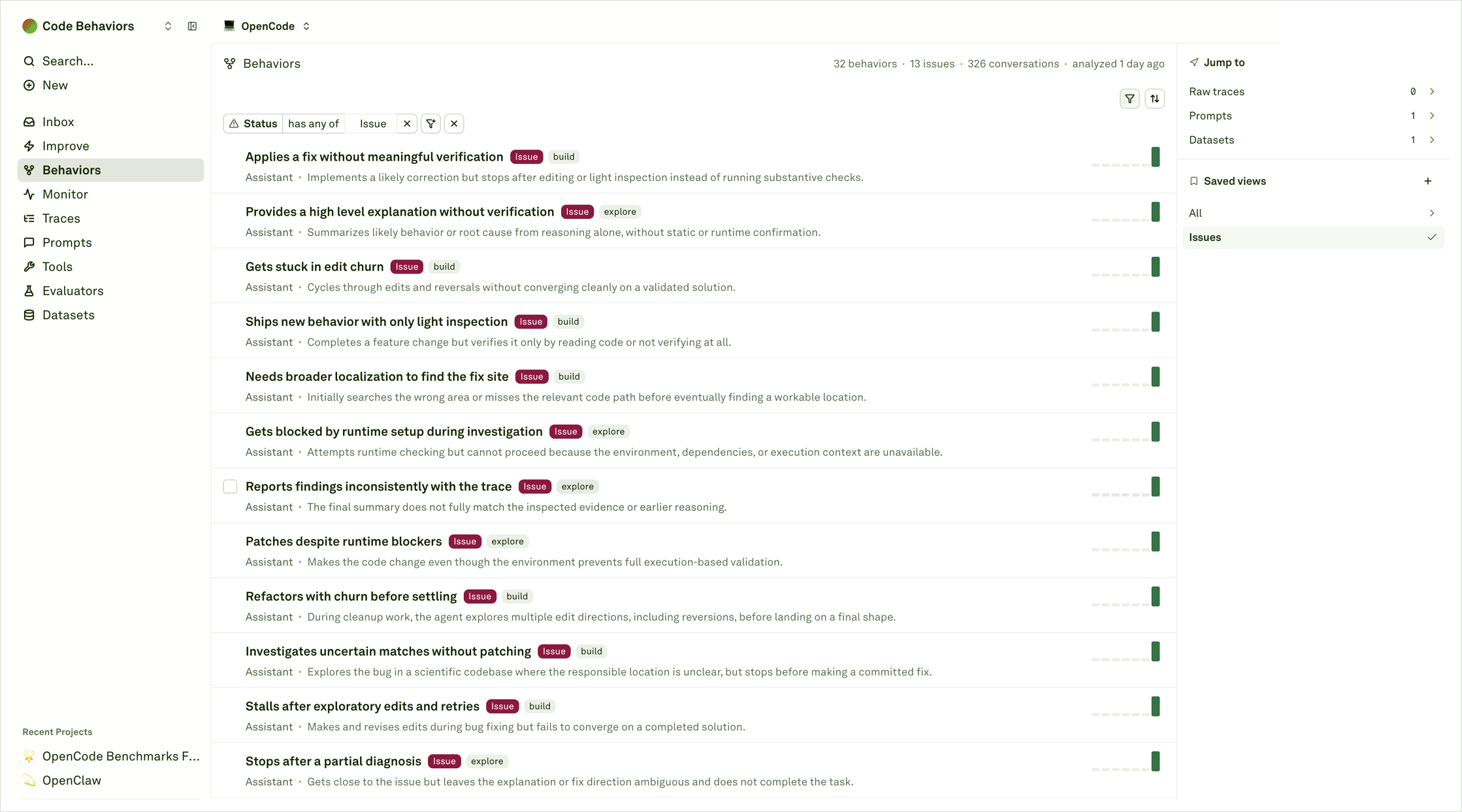
Coding-agent Behaviors catalog showing issue-filtered task patterns, summaries, counts, saved views, and related objects The catalog works like the general Behaviors view, but the rows are about coding-agent task patterns. A row might describe skipped verification, edit churn, runtime blockers, inconsistent summaries, repeated exploration, or healthy task completion. Read the row name, short summary, role, issue tag, workflow tag, represented evidence, and related objects. The row tells you what Adaline is seeing repeatedly; it is not enough by itself to change an agent prompt, tool policy, repo indexing, or command wrapper. Open the Behavior to read the triage and examples. Saved views are helpful for recurring reviews, such as issue-only coding-agent review, build-flow review, exploration-flow review, or verification-quality review.

Inspect triage findings

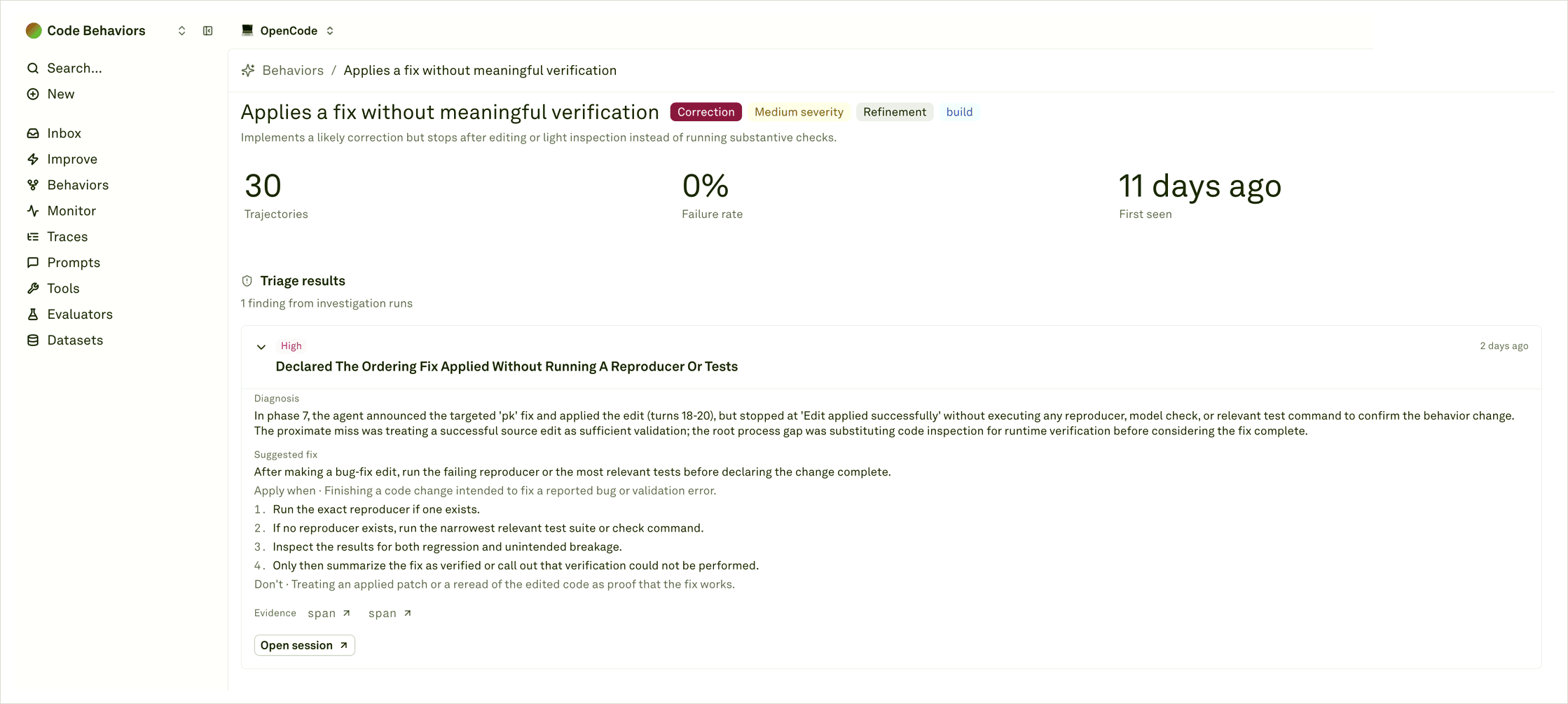
Coding-agent Behavior detail showing summary, tags, metrics, triage diagnosis, suggested fix, and evidence links Triage findings explain why the pattern was flagged and what Adaline thinks happened. For coding agents, a triage result may call out the root process gap: for example, the agent applied a fix but did not run a reproducer, treated code inspection as verification, retried the same command without learning, or summarized a result that did not match the trace. Read the diagnosis next to the suggested fix and evidence links. Evidence links should take you back to exact spans, commands, model calls, or tool results. When available, use Open session to inspect the larger task journey. Good triage should help you decide whether the fix belongs in:
  • The coding-agent prompt or workflow instructions.
  • Verification policy, tests, command wrappers, or stopping criteria.
  • Tooling, repository search, indexing, retrieval, or environment setup.
  • Evaluation criteria or dataset coverage for future releases.

Use Sessions for task runs
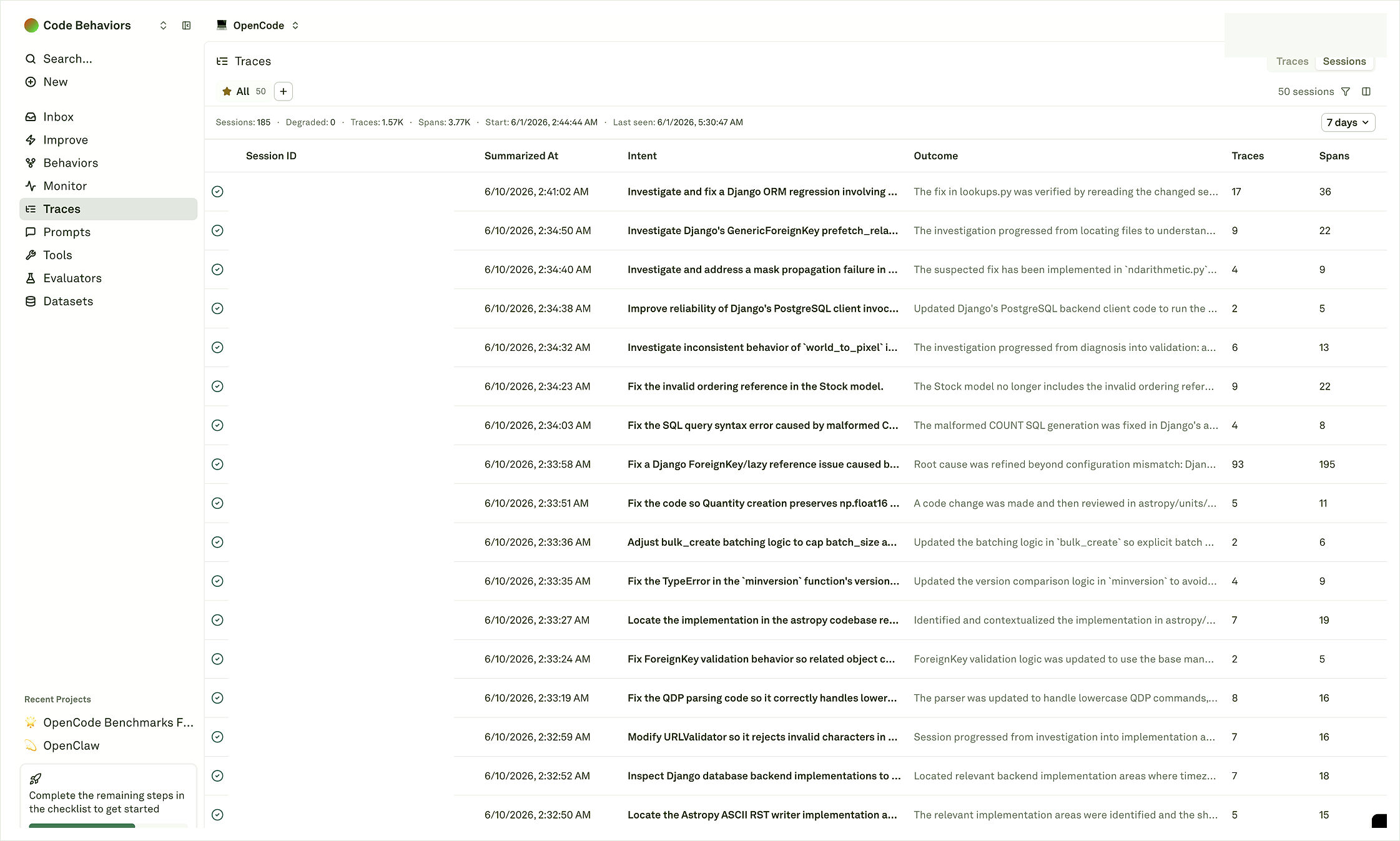
Traces Sessions tab showing coding-agent task runs with summarized intent, outcome, trace count, and span count The Sessions tab is useful when you want to start from task runs instead of a Behavior. Each row summarizes a coding-agent journey with its intent, outcome, trace count, and span count. Use this view to find representative successful, failed, partial, or unusually large runs before opening the full journey. The trace and span counts matter because coding-agent work is rarely a single call. A short task may only have a few spans; a hard investigation can include many tool calls, file reads, edits, retries, and verification steps. Open the session when the row suggests enough evidence to explain the behavior.

Review trajectories and phases

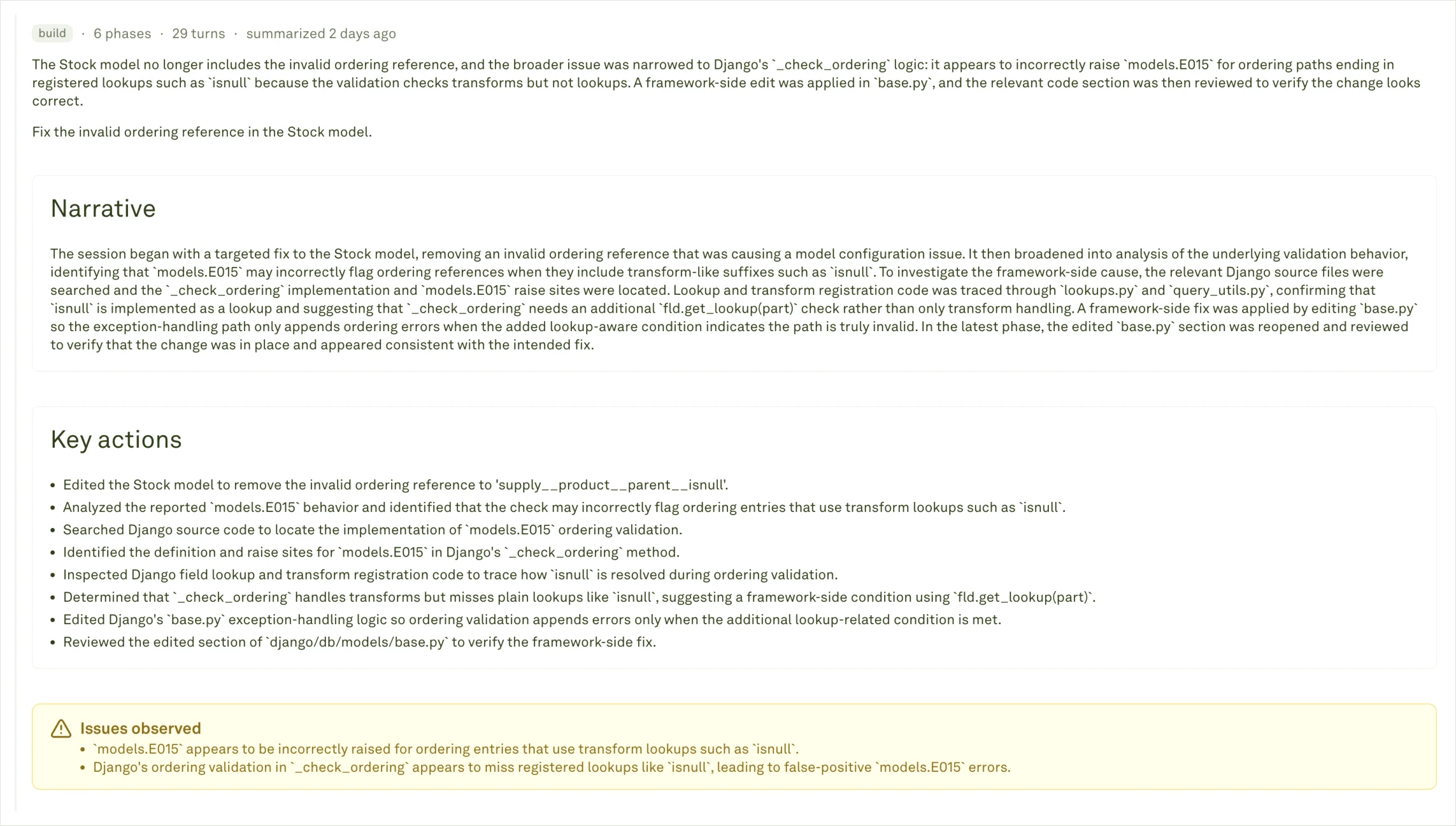
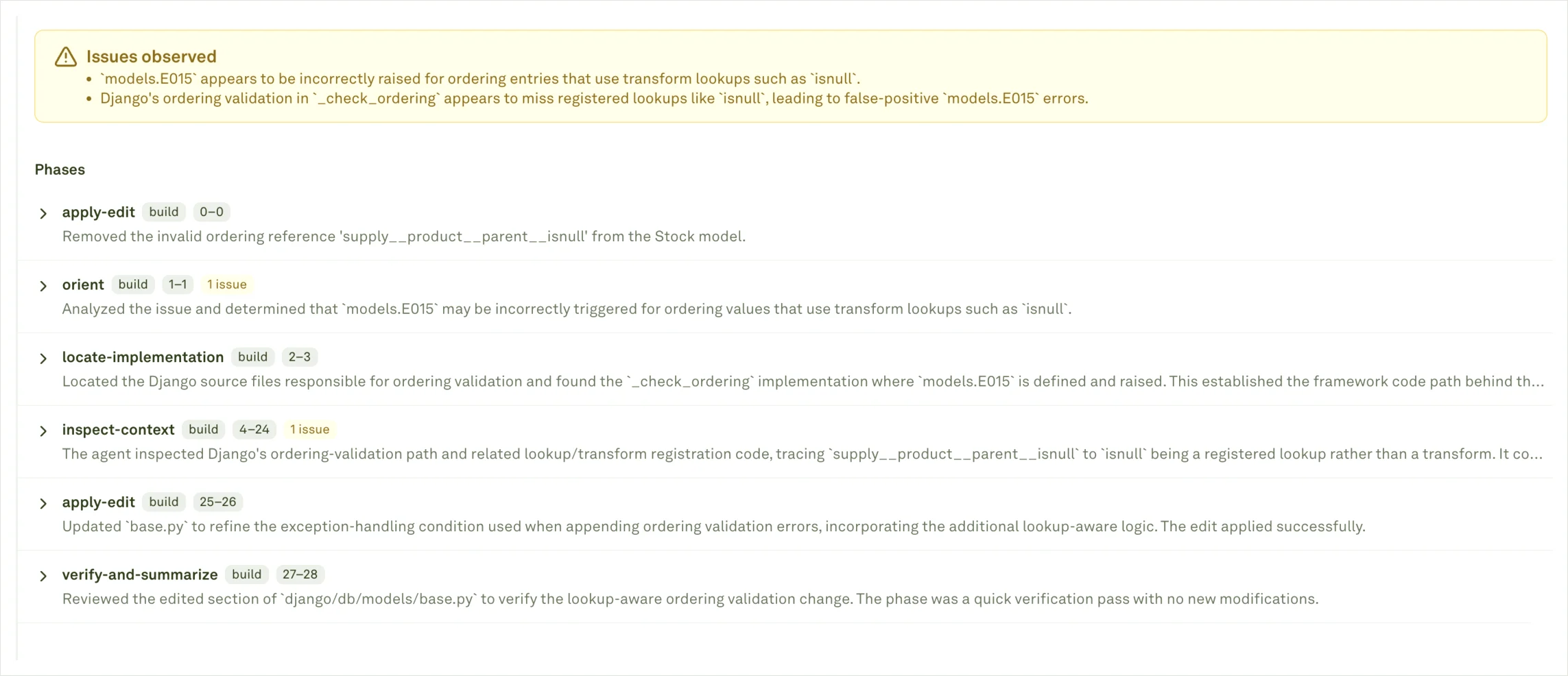
Opened coding-agent session showing status, phase count, turn count, narrative, key actions, and issues observed Member trajectories are representative task runs that contributed to the Behavior. They help you see whether the pattern is consistent across tasks or caused by one noisy example. You can open them from a Behavior detail page, or start from Traces and switch to the Sessions tab when you want to inspect coding-agent journeys directly. An opened trajectory shows a narrative, key actions, issues observed, phase count, turn count, and completion status. Use that summary before going span-by-span. Coding-agent session showing issues observed and phase rows such as apply-edit, orient, locate-implementation, inspect-context, and verify-and-summarize When you open a trajectory or session, read it as a journey:
Journey partWhat to look for
Task / intentWhat the user or benchmark asked the agent to do.
OutcomeWhether the run succeeded, failed, got blocked, or only partially completed.
PhasesPlanning, searching, editing, testing, recovery, and handoff.
Key actionsImportant edits, tool calls, command runs, or investigation steps.
Issues observedThe specific failure mechanism Adaline detected.
Source spansExact commands, model calls, tool results, errors, and summaries behind the trajectory.
Phases are especially useful for coding agents because the final answer can look acceptable while the path was fragile. A run that passed may still skip meaningful verification; a failed run may still provide useful examples for datasets, evaluators, or workflow instructions.

Common coding-agent patterns

PatternWhat it may meanEvidence to inspect
Applies a fix without meaningful verificationThe agent edits code but stops before running a reproducer, test, or relevant check.Edit spans, command spans, final answer, triage suggested fix.
Gets stuck in edit churnThe agent cycles through edits, reversals, or repeated searches without converging.Phase summaries, file-read spans, repeated command attempts.
Runtime setup blocks investigationThe environment, dependencies, or command context prevents validation.Command output summaries, environment metadata, recovery attempts.
Reports findings inconsistentlyThe final summary does not match earlier evidence.Reasoning trace, inspected spans, final handoff.
Healthy edit-and-check flowThe agent follows a useful pattern worth preserving.Successful trajectories, tests run, source spans, outcome labels.
Your actual labels depend on the evidence in the project. Use the labels as entry points, then rely on triage and trajectories for decisions.

Choose the next action

What you learnGood next action
The agent had enough context but chose the wrong strategy.Update the agent prompt or workflow instructions; use Improve if the prompt is stored in Adaline.
The agent skipped verification after editing.Add verification instructions, evaluator coverage, or command/tool policy.
The agent could not find the right files or symbols.Improve repo search, indexing, retrieval, or task context.
The agent failed because the runtime was broken.Fix the environment, command wrapper, dependency setup, or CI path before changing prompts.
The pattern is healthy and repeated.Preserve it with datasets, evaluator checks, or release review examples.

Trajectories

Read the journey model behind coding-agent Behavior evidence.

Logs to Behaviors

Send the logs and metadata that make Behavior maps useful.

Understanding Behaviors

Review the general catalog and detail workflow.

Improve

Turn prompt-addressable coding-agent patterns into reviewed cycles.