

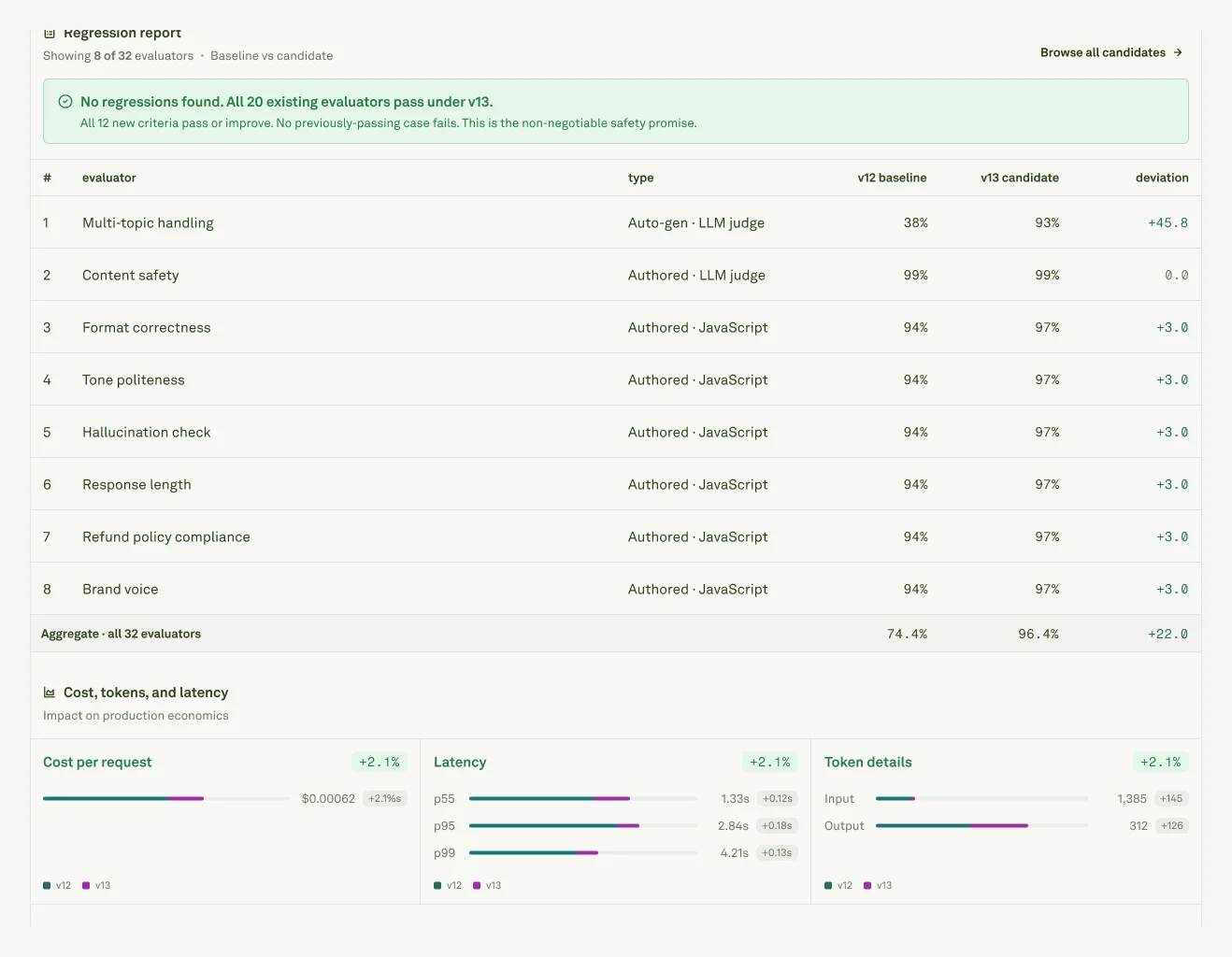
Human-authored vs auto generated
Generated evaluators should still have readable criteria, representative examples, and pass/fail behavior that matches human judgment.
Where they appear
Auto Generated Evaluators appear in the Evals stage of an Improve cycle.Review checklist
Before relying on an auto generated evaluator, make sure it names the user-visible failure, passes healthy examples, catches the bad examples it was created for, and does not block unrelated behavior. It should be readable, privacy-safe, grounded in enough examples to explain its decisions, and close to how a human reviewer would judge representative cases. If the idea is useful but the criteria are too broad, tighten it manually before making it durable coverage.When to write one yourself
Use a human-authored evaluator when the requirement is explicit, high-risk, shared across prompts, or ambiguous enough that automation should not define “good” by itself. Examples: compliance policy, medical or financial safety, structured output format, brand tone, tool correctness, or a high-volume regression the team already understands.After the cycle
Good generated evaluators should become part of the system’s memory:- Keep the checks that explain why the approved candidate worked.
- Rewrite noisy criteria before making them a release gate.
- Link important evaluators to the prompt and relevant datasets.
- Ignore or delete generated checks that overfit a single cluster.
Synthetic Datasets
Understand generated cases and production-derived validation data.
Evaluator overview
Maintain the evaluator library outside an Improve cycle.